Antigua, Guadeloupe, Iles des Saintes
6th January to 26th January
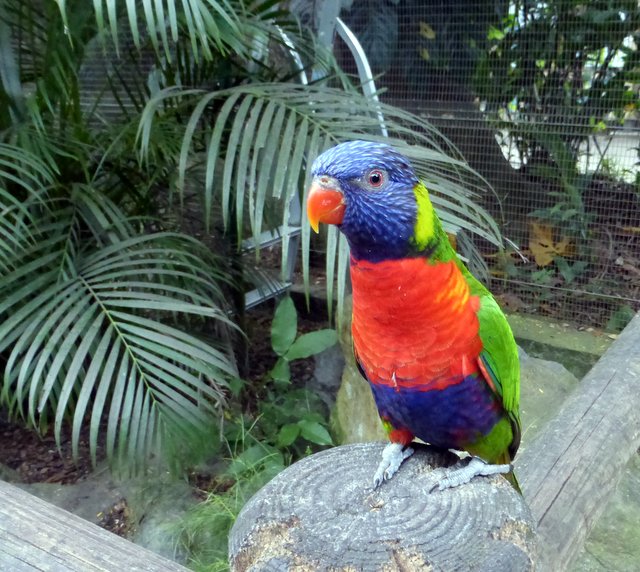
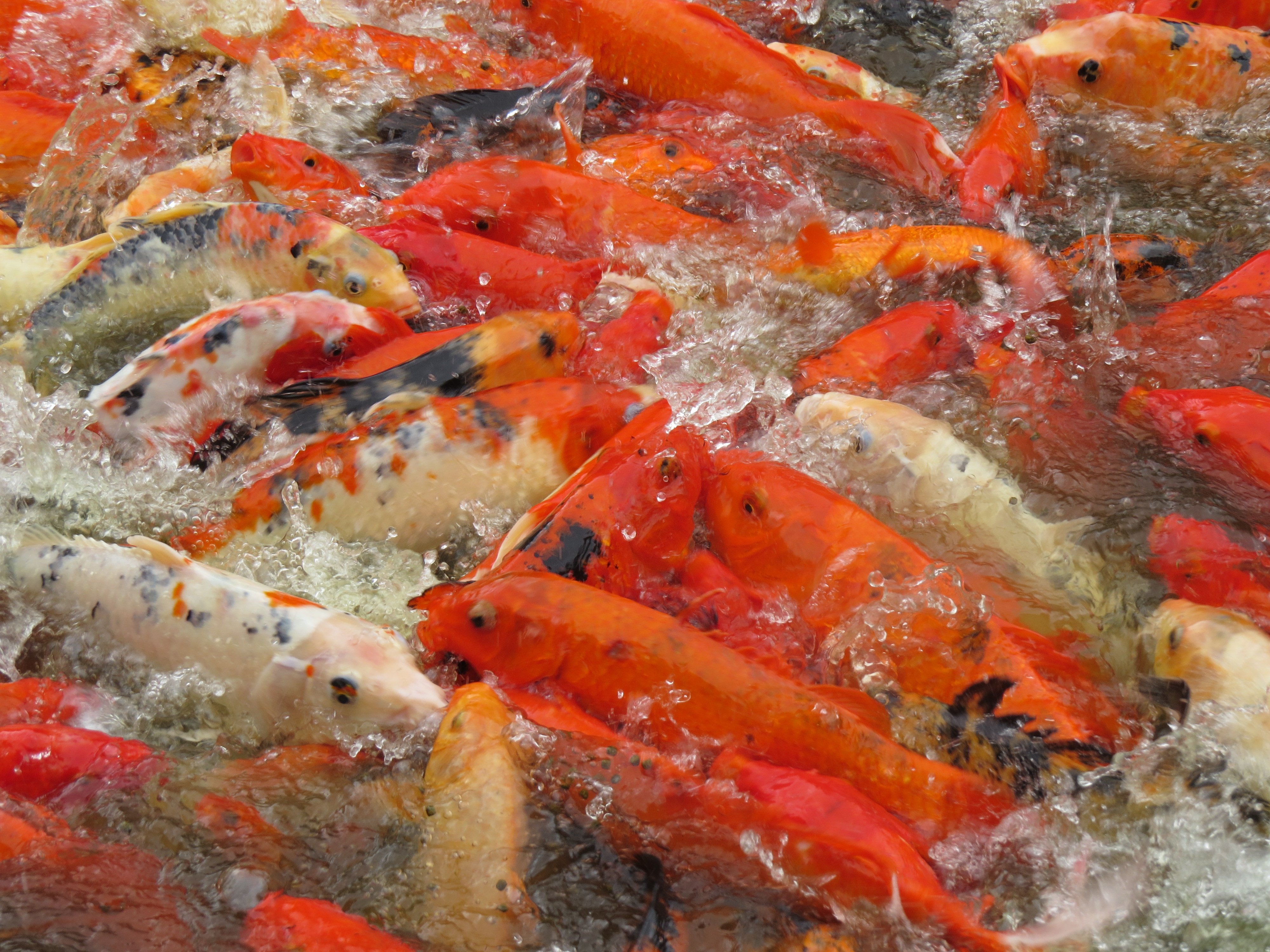
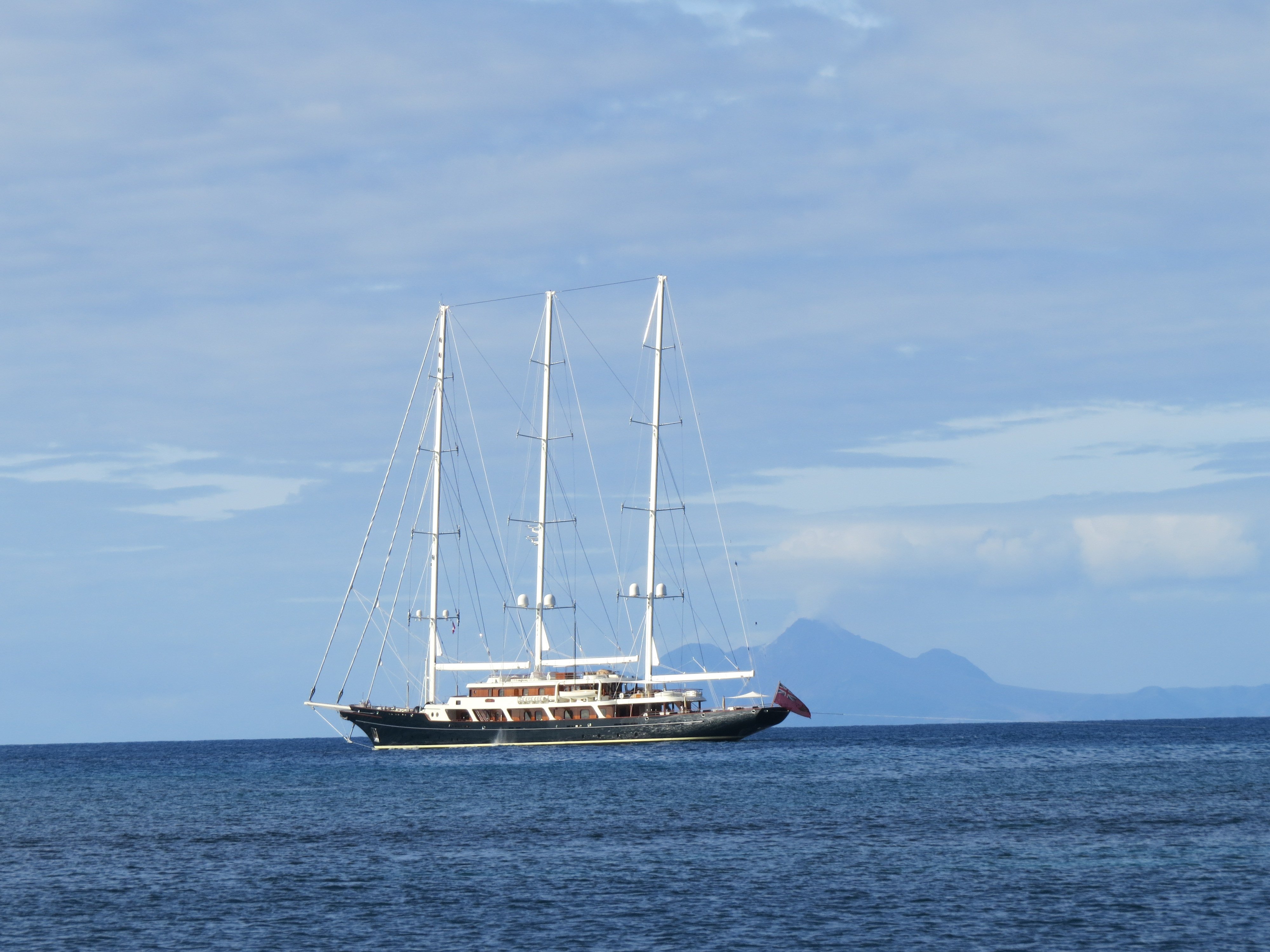
Lorikeet at Jardin Botanique, GuadeloupeHungry carp in same gardensEnglish and Falmouth Harbours, AntiguaAnother Smart yacht
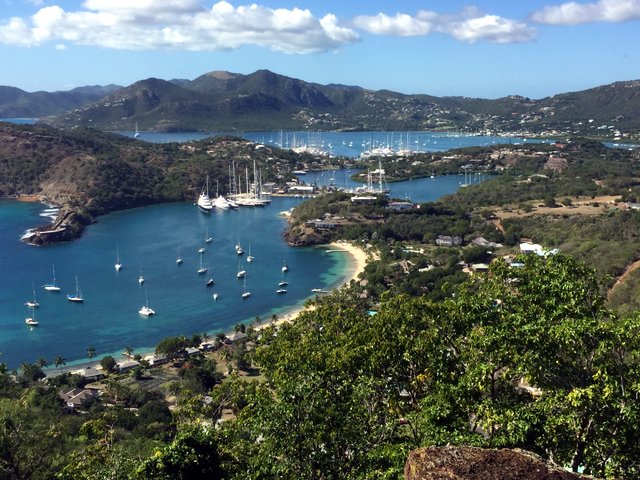
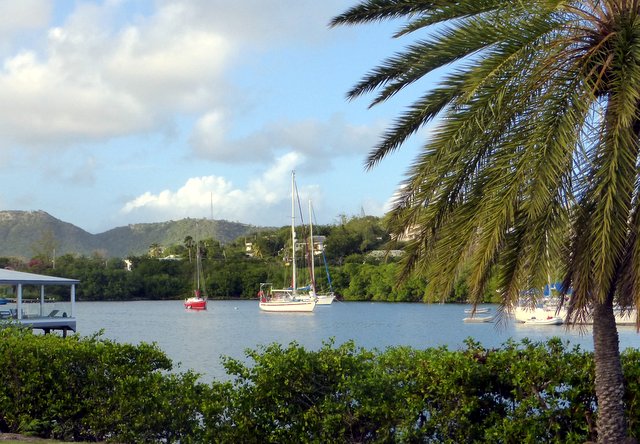
Anchored near some of the world’s grandest mega-yachts in English Harbour, Antigua (early January), I felt a bit out of my league. So I moved round to Falmouth Harbour. Alas! There seemed to be even more and even grander mega-yachts there, but many normal yachts too.
I’ve met some lovely folk on normal yachts. Indeed even the crew I’ve met from said mega-yachts have been delightful: mostly young, highly competent, hard-working, friendly and, of course beautiful – exceedingly beautiful. (Incidentally I gather you can charter some of these yachts from around 150,000 dollars a week – though Paul Getty’s isn’t for rent).
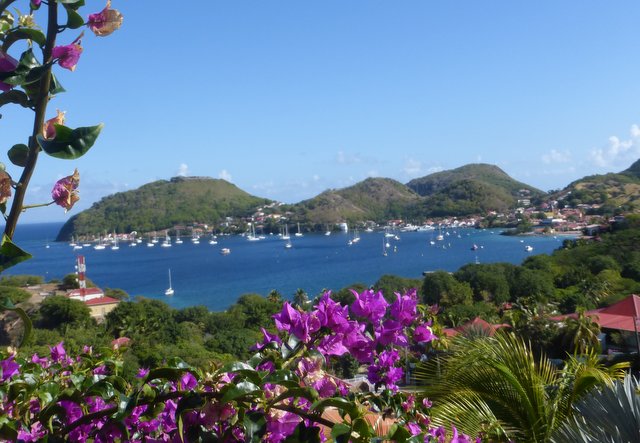
The picture above, which features in many tourist brochures, shows English and Falmouth Harbours. We’ve walked up to Shirley Heights a couple of times; it’s where you take the photo from and there’s a stream of cruise ship passengers who visit to take the same shot.
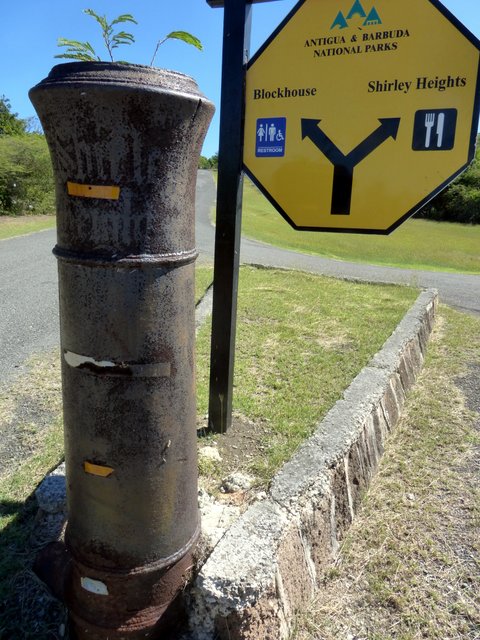
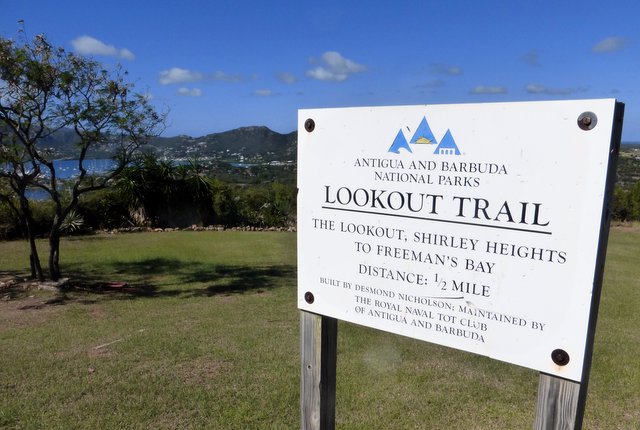
A recycled canon flowerpotFootpath down from Shirley Heights, maintained by the Royal Naval Tot Club
Before Anna arrived I was invited to a couple of gatherings of the Royal Naval Tot Club. This may sound like a joke. It isn’t. The club was apparently started by a couple of ex Royal Navy seamen when the Navy’s rum tots were stopped. Every evening its members meet. There’s a tot of rum and toast to the Queen as well as a different daily toast for other worthy causes (including the traditional “To wives and sweet hearts….may they never meet!”), plus reading from naval history from duty ‘rum bosun’. Seems to be a charming blend of traditional charitable virtue and harmless sociable fun, and though by inclination I am rather anti-establishment, I found this gathering of sailors and interest to be delightful. I am grateful to the welcoming Cornish couple who took me along. Click here for a bit more about the club.
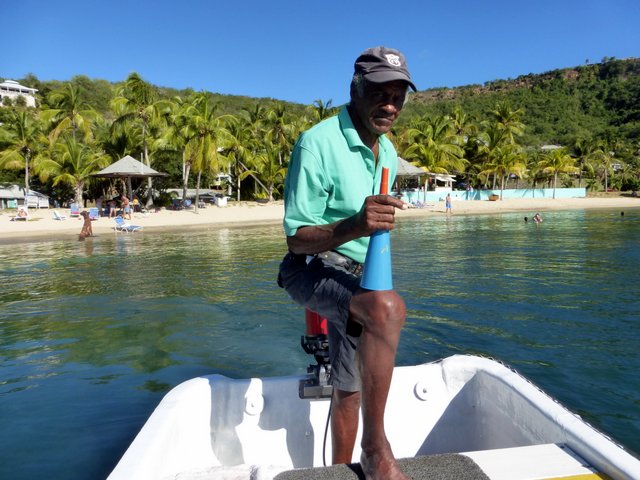
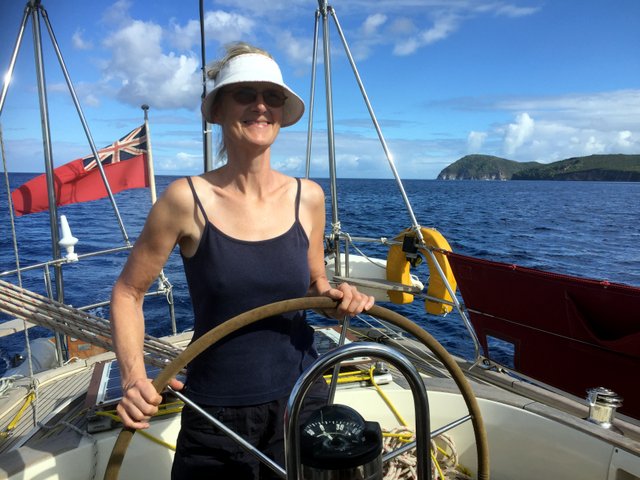
Water Taxi driver in English HarbourAnna – in the sunshine at last
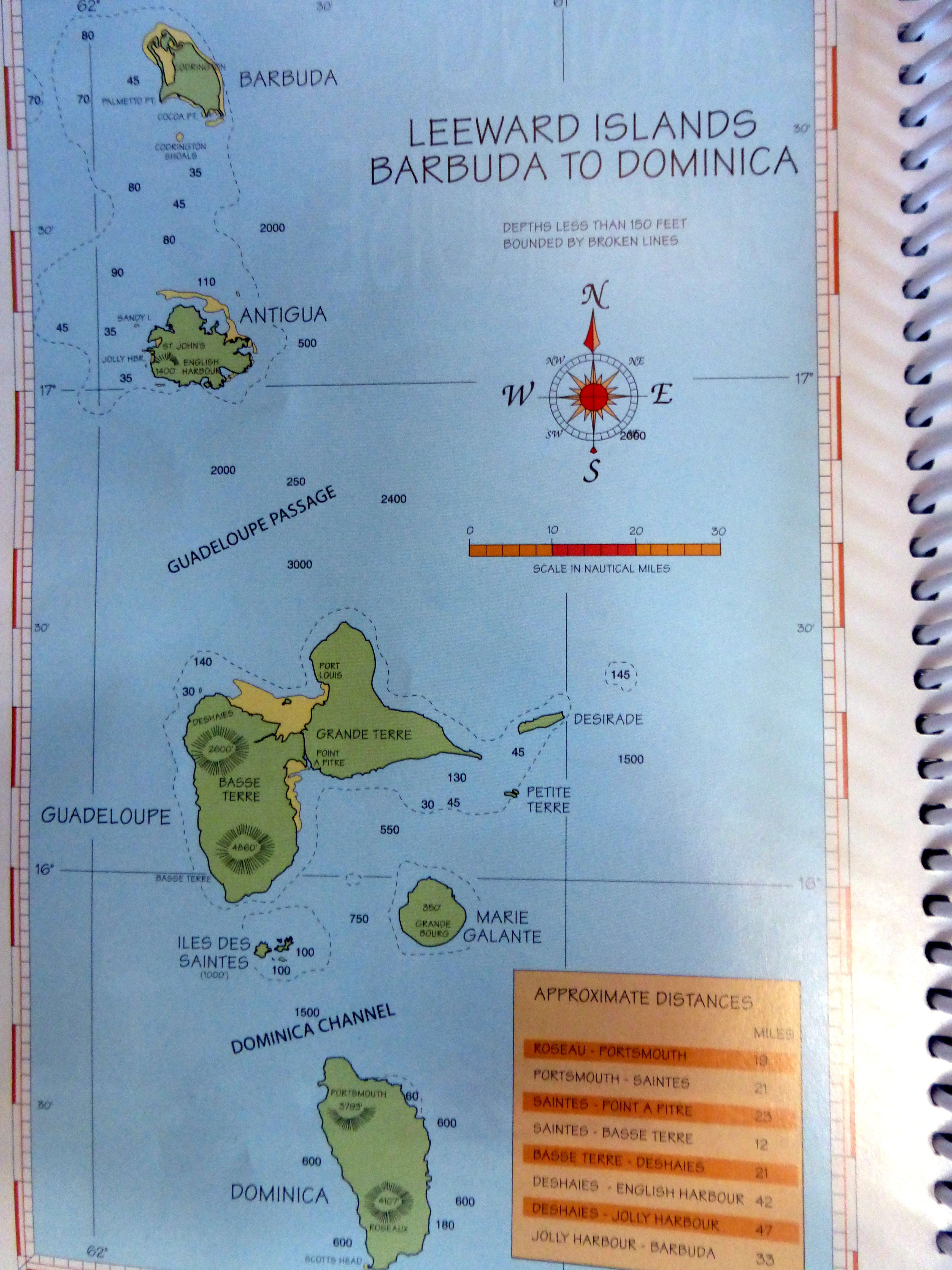
After a week on Antigua and with Anna aboard, we sailed 45 miles south to the island of Guadeloupe . It’s a wonderful island: from a distance, just high mountains cloaked in green trees; once ashore, a well organised French department in the tropics, complete with boulangerie, Bordeaux wine and the euro…and about 300,000 French citizens. From Guadeloupe on south to Les Saintes and its delightful anchorage at Pain de Sucre. Then, a few days ago, back north to Antigua.
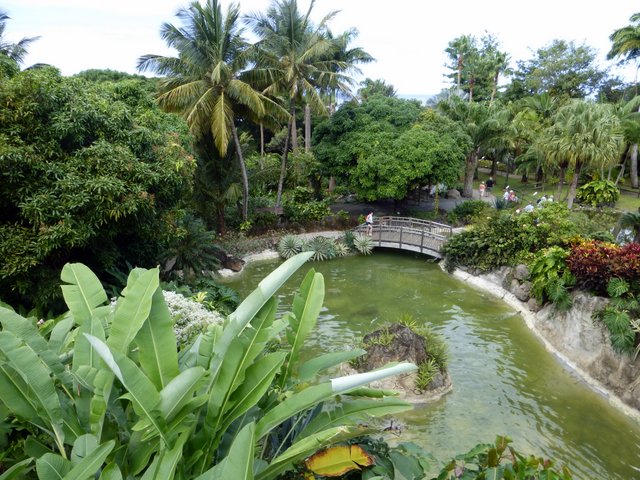
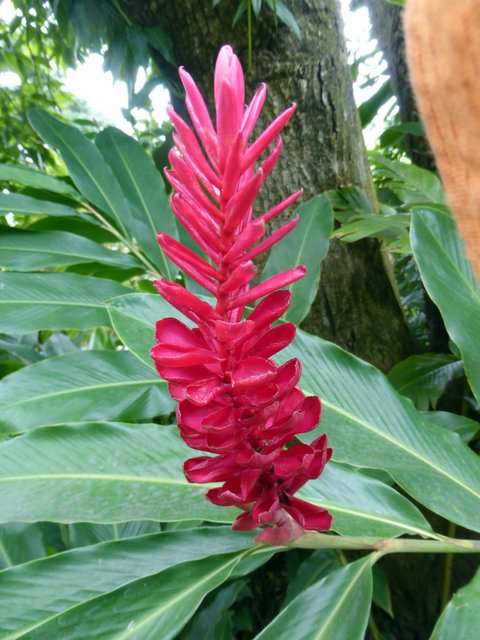
Jardin Botanique, Guadeloupe…more from le Jardin..
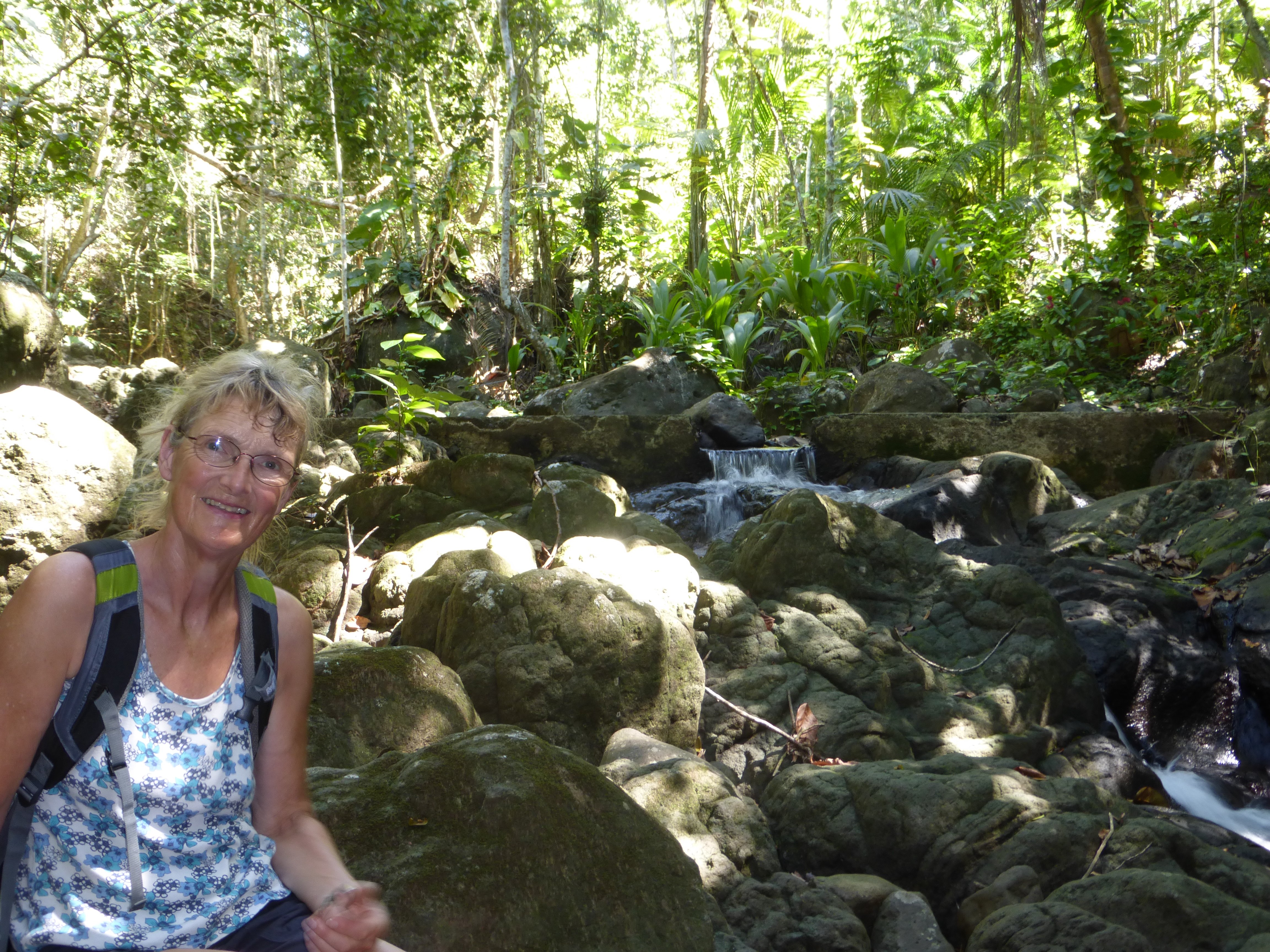
Enjoying one of Doyle’s riverbed walks!
Highlights for us? Lots and lots:
– swimming/snorkelling anywhere, in clear and turquoise sea (at least till sea stirred up by current high winds/swell);
– coral (finger, staghorn, common brain and sea fan), fish and green turtles (Johnny has kindly brought out a book so we’ll learn more)
– birds (we knew the frigate, pelican, green heron, humming birds but, with book, will learn more)
– bus trips (St John’s and Pointe a Pitre) and walking ashore (Doyle’s guide led us on an especially taxing riverbed boulder walk – “…readers have complained this hike is difficult…”(but not us!) at Deshaies. Doyle being the favoured local sailor’s guide to these islands, is best taken diluted with a good pinch of sceptical salt, we find)
– meeting delightful and knowledgable fellow sailors
– markets, music, other nationalites, unusual food….
Now, with Anna and Johnny aboard, we swing at anchor 150 metres off a very smart beach resort which has such good wi-fi that I can quickly update the blog.
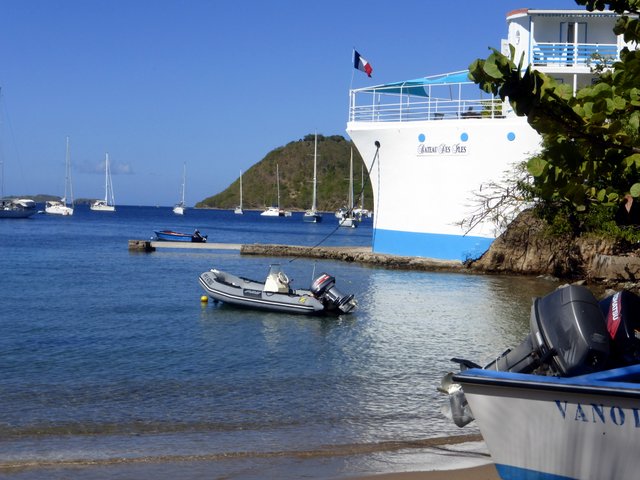
Bums at Heritage Beach (beachside rooms around 2,000 dollars a night!)Pictures from Les Saintes….Fashionable as ever!
Atlantic Crossing
21st December to 5th January 2016
Peacefully anchored in English Harbour, Antigua
We’ve arrived at English Harbour, Antigua and I’m anchored next to mangroves in Tank Bay near Nelson’s Dockyard. There’a host of fabulous, exquisite and shining mega-yachts up the road.
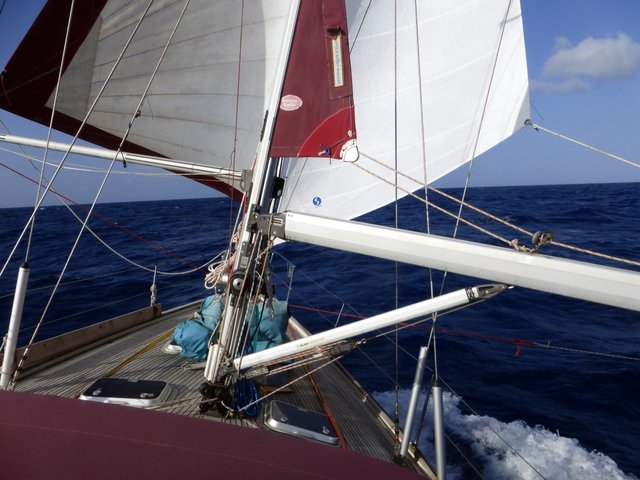
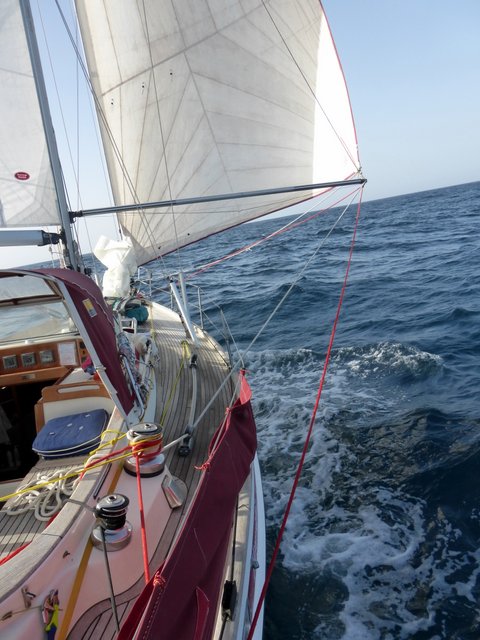
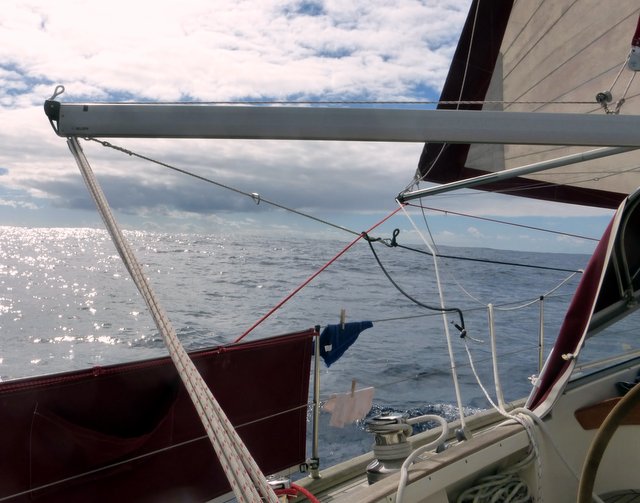
Some smart companyRolling West – with both foresails is quite comfortable
Since leaving Mindelo in Cape Verde, it’s been me, Henrietta, doing the real work – that’s over 2,100 miles of rolling ocean. Seems to me, M has been doing a lot of sitting about contemplating the nature of the universe, reading books, singing, day-dreaming or peeling onions, or whatever humans do when they don’t have a proper job. In fact this will be the last blog post I’ll write myself, at least for a while, as I’ve decided M can write it himself from here on. He needs something constructive to do.
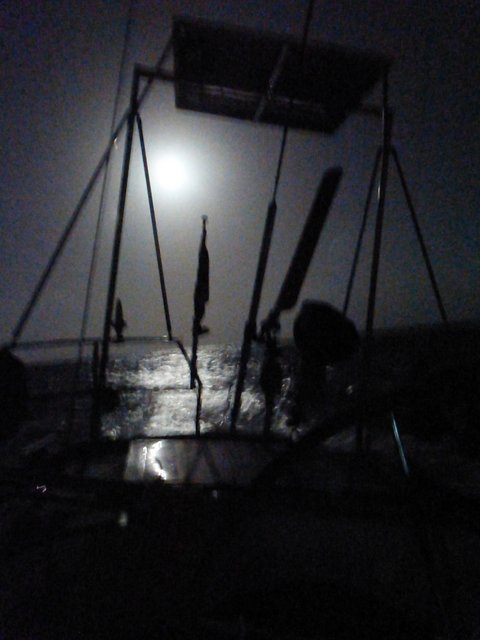
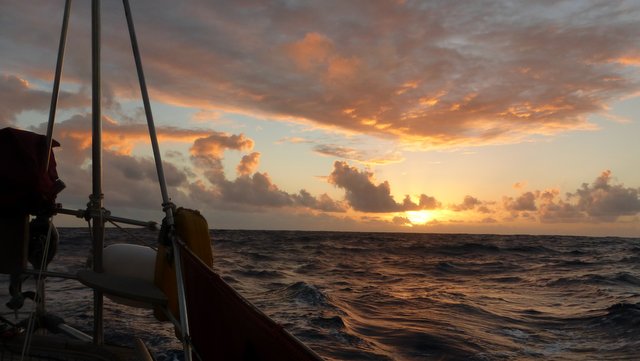
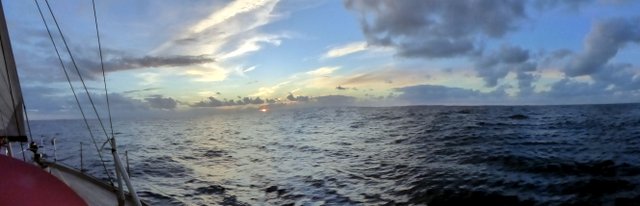
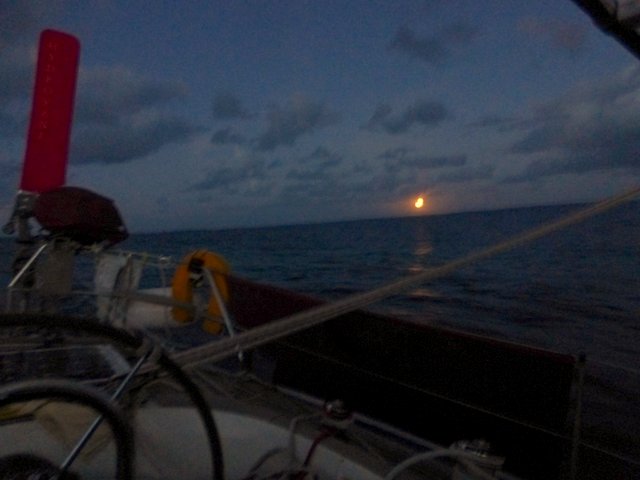
Full moon near Christmas Eve (or Father Christmas whizzing west and white hot)Sunrise New Year’s Day
First though, and before I sign off, I’ll tell you about crossing the Atlantic. (Don’t you dare call it “The Pond” ever again. It’s a very long way and it’s not clever to call ‘Oceans’ ‘Ponds’ – just silly. Even in an aeroplane, it’s hardly a ‘Pond’). For me, if you want to know, it was 2,116 rolling miles in 15 days and 4 hours. My engine was on for two hours – mainly while M faffed about trying to find a place to anchor when we got here.
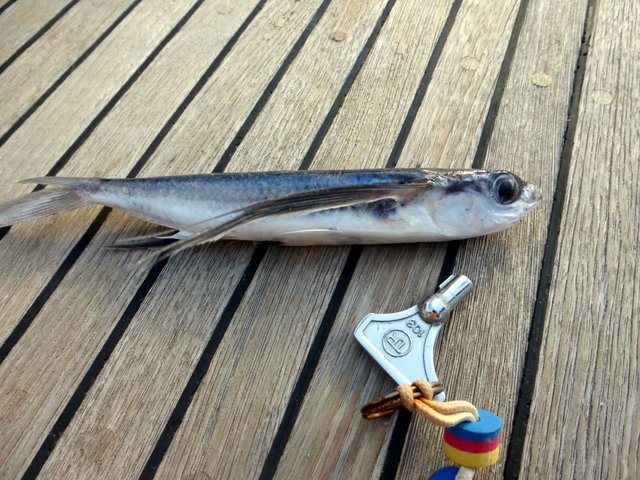
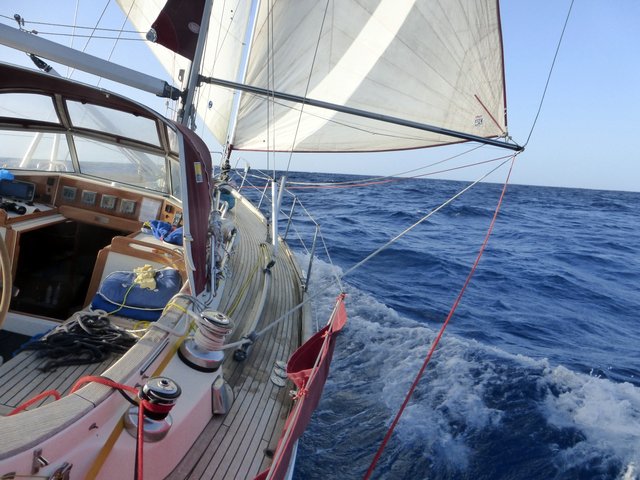
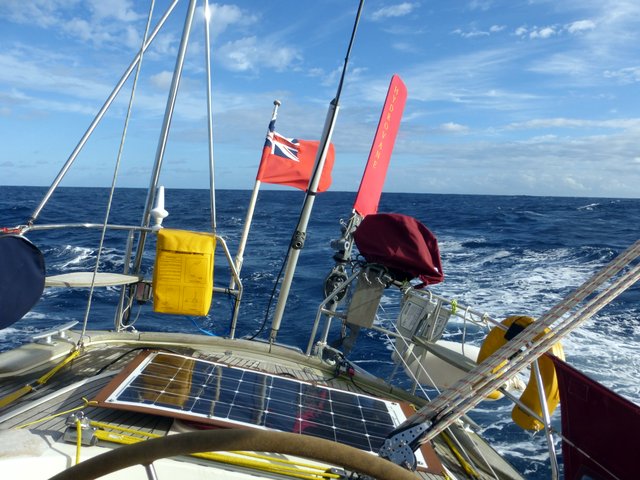
Most of the time, I have sailed downwind on a beautiful bustling blue sparkling sea. That’s how M would see it anyway. But for me, without a human’s appreciation of the finer artistic points and emotional nature of sailing, I should say I have rolled and lurched and twisted my way along with a rather awkward two or three metre swell up my backside most of the time, and with salty spray and baking hot sun on my deck by day – as well as flying fish that come aboard, crash landing on my deck at night. The wind has been fairly steady astern or on my starboard quarter, around 20 knots – just an occasional 30-35 knot squall to keep me from complacency. People call this the Northeast Trades, even though it’s been from the east most of the time. Ever since people have sailed across the Atlantic, they’ve rolled along this same road. It’s quite inspiring to think of the great sailors, explorers and ships that have followed this route through past centuries; and give a thought too to the horrors of slave ships that came the same way.
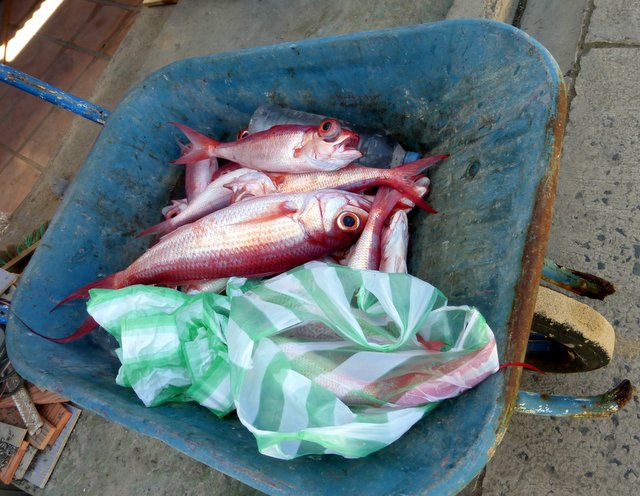
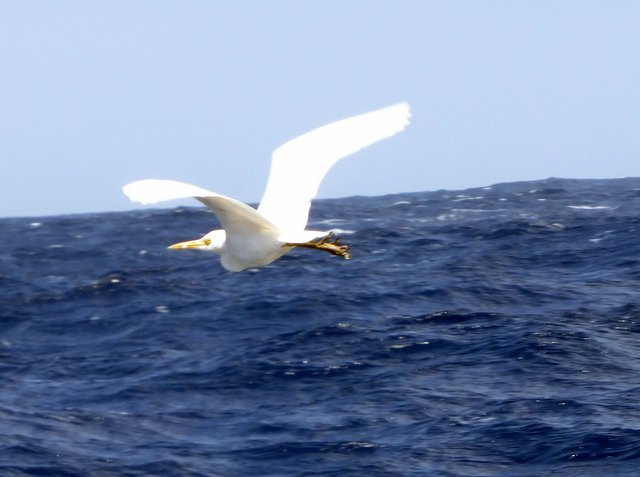
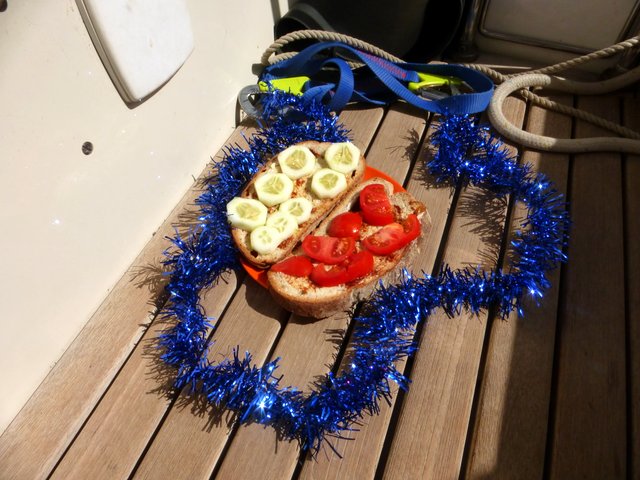
Part of the night’s ‘catch’Fishing boat crossing asternHandsome company mid-OceanChristmas lunch ….…and more…yum yum…
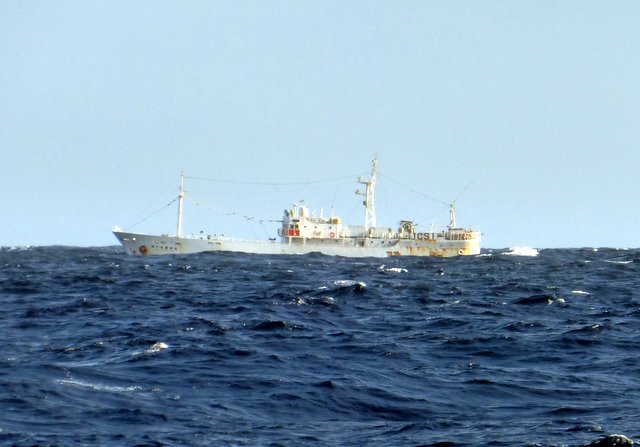
For the first three days I only wore my genoa and a scrap of mainsail, managing around 6 knots. For Christmas Day, it was calmer; then good breeze again all the way. It’s been unfailingly sunny by day and moonlit for much of the night. At dawn, there are dead flying fish scattered on my deck – at least there were in the first week – and one of M’s first jobs is clearing them before they get stinky. (One got stuck in a drain and wasn’t spotted till pretty poofy a few days later!) It does of course test a boat to be forever sailing; my bits chafe and wear and creak and squeak. Ropes and wires have to be checked; shackles watched; course forever noted and Hydrovane tweaked; sails trimmed, added, reefed, furled or dropped. We haven’t seen many other boats. In fact, apart from the first and last days, near land, we saw only one fishing boat and one tanker the whole way (there’s a picture somewhere). There’s not a lot of peace though; and Henrietta is one boat that did not have a Christmas or New Year holiday! (Mind you, it’s a lot better than freezing my bilges off in a Devon boatyard I suppose.)
And, as M will testify, I have performed perfectly: nothing has broken, been damaged or lost, and I’m as beautiful as ever (just need to get some of this salt off.) M has I think enjoyed himself, but I never quite know what he thinks. Humans are so contradictory. He seems to find it easier to deal with me than some human beings (which is pretty troublesome if you happen to be human). I think other humans love their dogs and pets for the same reason. Us boats and animals respond happily when we’re treated well and appreciated. Human beings need to sort themselves out.
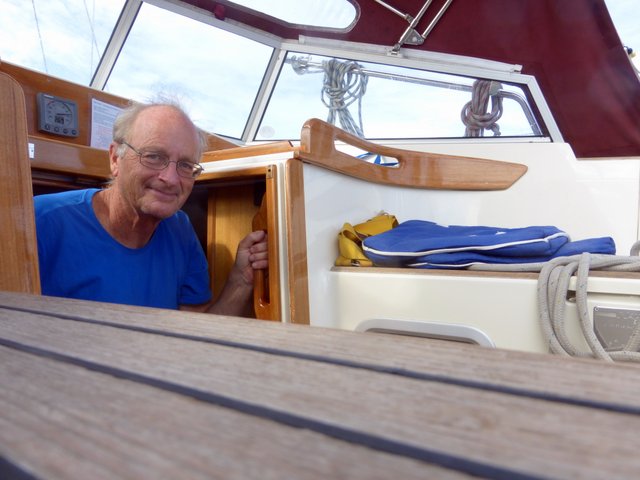
M can add a few comments now, and, as I’ve said, he can write this blog himself from now on – I’m going to rest at anchor for a day or two….. Despite Henrietta’s suggestion that I’ve just been sitting about doing next to nothing, I assure you I have been busy and am now pretty tired. The days’ chores are endless and, with never more than an hour or two of sleep, you become a bit frazzled and sore-eyed. (I cannot imagine how those professional sailors manage when they race round the world alone for months on end.) Those Atlantic rowers, I told you about, are coming to this same place too, but I think they still have three or four or more weeks rowing ahead of them. What a way to spend the winter! The 15 days have passed extraordinarily quickly. What do I do? A typical day? (I’m interested in this myself since I find it hard to account for the time! It’s gone so fast.): at dawn, check boat and gear, clear fish on deck, pot of tea, wash self, do log book…through the day…learn a bit more of hf radio, chartplotter, sextant (sensible sailors know all this stuff before they leave!)…frequently adjust sail trim/change sails/course/Hydrovane….check for rotten stores, clean cabin, decide what to eat, cook, clear up, siesta, clip toenails, whip a rope or two, read novels, tune in SSB radio, charge up electronic gadgets…and, finally, Henrietta’s right, quite a bit of day-dreaming, watching the ocean and contemplating infinity…you wouldn’t be interested in all the ideas and wisdom, and peace and calm, that come to the solitary sailor – at least until you get a bit too tired. Life is honed to pure simplicity; eat, sleep, wash and think. If you’ve done it yourself, or (I expect) climbed remote mountains or tramped empty deserts or polar wilderness alone, you’ll maybe know. Trouble is that as you grow more tired, it becomes harder to think and use the brain coherently…and I soon abandoned grandiose schemes like learning the tropical night sky and advanced meteorology, and instead, in moments of leisure, just read some of the many cruising books on board or enjoyed straightforward novels. Remember too that, given the incessant rolling and occasional unheralded lurch, everything is done very slowly. A ten minute task can take an hour. Preparing a meal can take ages. Sailing tasks too: one day, for example, with a force 5/6 from behind and heavy rolling, it took over an hour simply to rig the spinnaker pole for genoa and gybe the much reduced mainsail. I then needed a break to wipe away the sweat before hanking on and hoisting the staysail in lieu of main. Then taking it down again and securing it to wave-sprayed foredeck before nightfall. (Those racing sailors must be amazingly organised, better balanced and much stronger than me! But then they don’t have Bus Passes do they?.)
We’ve reached Antigua
I’m now enjoying the novel joy of a calm anchorage and stable walks ashore, and meeting other people. I note I have owned Henrietta for six months now; she’s been a delight and after 6,000 miles I begin to see how she works! Finally, Henrietta’s first and last stab at feeling like a human:-
Right now, …..I’m Rolling West
Rolling West o’r broad bold untamed sea, awed by scale and power and might,
Rolling West ‘neath milk blue sky, warmed by sun and soothed by breeze,
Rolling West, the sounds of hush and rush and shush, of flapping sail, of gurgle, splosh and rattle,
Rolling West, there really is no chance of rest!
[Subsequent bits remain unpublished]
(M is going to write this himself. He’s the one who’s been doing things. Much of the past week I’ve just been left to swing around all alone on my anchor.)
The video was a first effort with iphone video. It was taken on a gentle weak wind day when approaching Cape Verde. Not much threat to the BBC professionals then – but I am constantly amazed by what you can do with a modern phone. (I just bought a cheap Cape Verde SIM card – about 6 euros equivalent for 1 Gb and that will keep me happy for at least a week. O2 UK contract roaming, in contrast, will quickly cripple the bank account of any normal person – once you leave Europe. Sailors take note! I think everyone knows that, but it’s not till you do it that you realise)
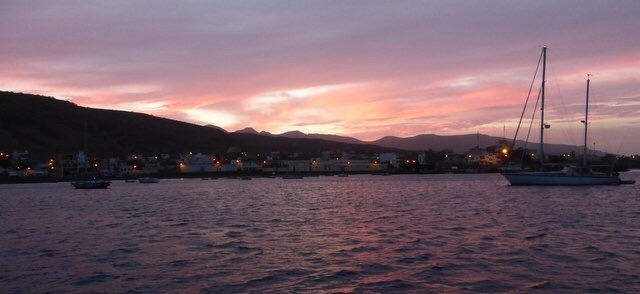
After reaching Palmeira on Ilho do Sal at northeast corner of Cape Verde archipelago, it took a day to adjust to Africa. After that, you appreciate that Cape Verde is full of delights and in fact very easy, tidy and secure compared with most countries in Africa (the UN concurs). It’s not Europe – that’s all. People are friendly and helpful. I like too that there seem fewer of the gross inequalities of wealth that are features of most of the world. But I’ve only been here a week and landed on three islands, so ready to be corrected.
Palmeira anchorage
First, Ilho do Sal: music, music, music! It’s really good and wherever you go there seems a rhythm in the air – day and night. (Police and immigration officials all have an ear-phone plugged in!) As you drift off to sleep at anchor, the sound of Afro-Calypso-Brazil type music comes across the water. I got aluguers (shared minibuses) to other towns. One such town, Santa Maria, was an unexpected surprise: it’s a tourist resort – completely out of keeping with everywhere else. But, if you want a tattoo, an Irish Bar or premiership football on telly though, that’s the place to be. I tried talking to the Yorkshire owners of a bar I visited (for wifi), but they didn’t seem very chatty.
Then a slow sail of about 90 miles (which took nearly 24 hours) to anchor at Tarrafal on Ilho Sao. Nicolau (the islands are quite widely spaced). Mostly peaceful empty brown dusty mountains, with playful children everywhere, relaxed and welcoming, delightfully untidy; it’s my sort of place! Apparently it’s wetter and more productive than other islands, and on my aluguer trip inland to Ribeira Brava, there were some bananas and papaya trees, and green terracing for vegetables – but it’s mostly brown and arid. Long chat with retired seaman running a little general store – a breed of their own, these seamen…reminiscing about Liverpool and Glasgow…”ah! too cold, always rain; this place better!”
Inland on Sao Nicolau
It was too windy to visit nearby uninhabited islands (giant rollers crashing on the beach, an effective deterrent), so I came on to Mindelo on the island of Sao Vicente. This is a city. Thousands of people, ships, a marina (though for now I anchor outside), traffic and bustle. It’s also the setting off place for most sailors heading across the Atlantic.
Sao Nicolau North Coast (I think)
This will be my last stop this side of the ocean so I’ll go to the marina for final stocking up.
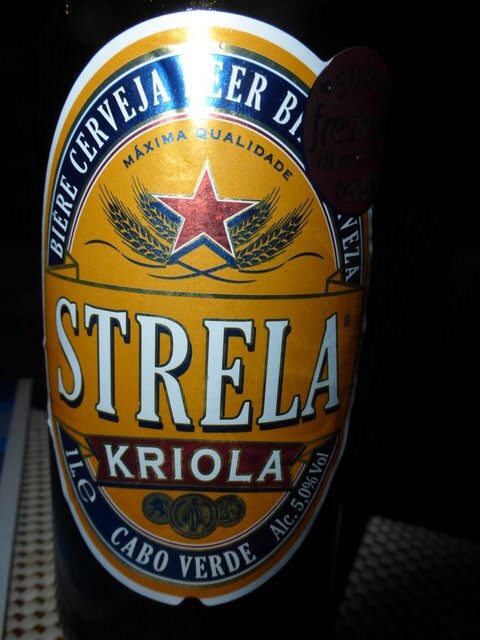
Excellent C Verde beer
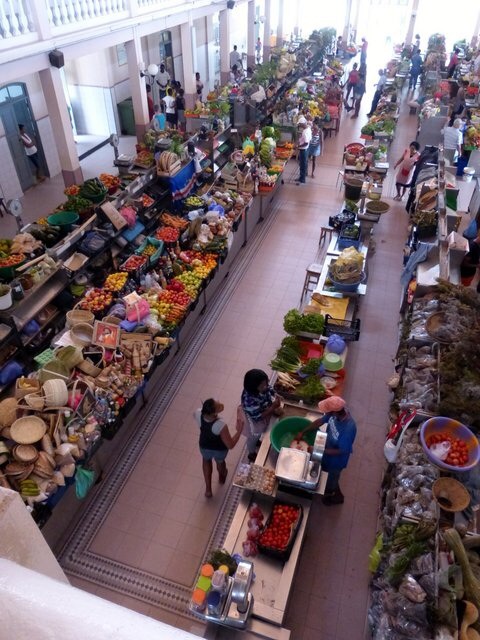
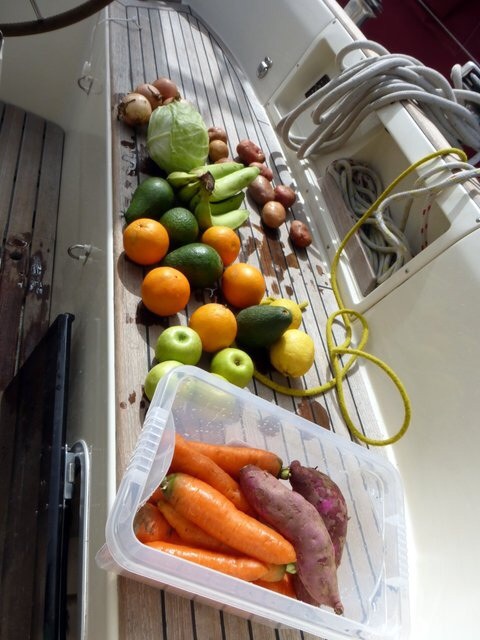
I’ve been to the market once to buy fresh veg. and some fruit – spotted a cockroach in the onions, so I’ve washed everything before stowing (I gather cockroaches are an on board problem best avoided – though many schools of thought say it’s inevitable at some stage!)
Mindelo Market (for final stores)Need to buy more!
Update:… I’ve had paperwork stamped, paid police and immigration people and have a bit of paper to say “…the above named master [me!] having complied with the regulations….the said ship [Henrietta] is hereby cleared…”.
Now I’ll just wait a day or so for swell to die down a bit, buy some more food, then head off to Antigua. It’s about 2,100 mile due west according to my phone, so my longest trip yet – feel a bit lost for words right now. There are a few other boats here heading more-or-less the same way, but I think we’ll all be a long way from normal Christmas goings-on. No posts for a few weeks…but position should update automatically with tracker. Last music in Mindelo
Happy Christmas everyone and Best Wishes for the New Year!
Loop North round Tenerife then South to Cape Verde
1st to 12th December
We have been in La Gomera quite a long time. It’s time to move on. But it’s sensible first to fix everything properly before the next big bit of the trip. M couldn’t alas, fix the AIS, SOG, COG stuff (for non-sailors, this is electronic magic that among other things, somehow shows where ships are, and shows them where you are – I’ll show a photo). And, the island of La Gomera has no magic experts so it meant another trip back to Santa Cruz, the capital of Tenerife. Not that that matters, as Santa Cruz is a wonderful city, especially colourful now with pretty and harmonious Christmas decorations (imagine…Christmas shopping in your T-shirts and flip-flops!)
There’s a paraglider on the right
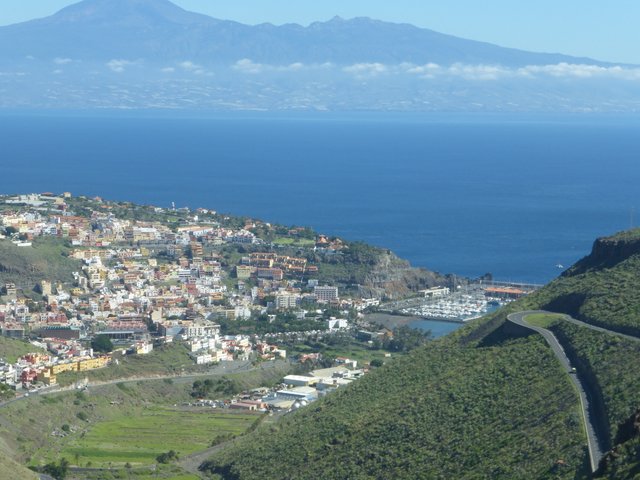
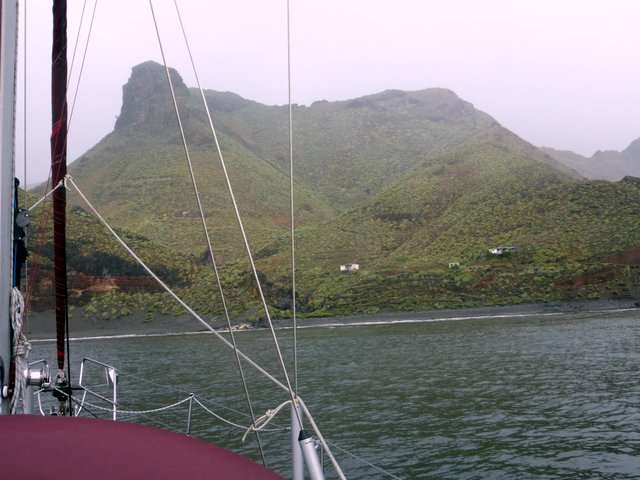
From the island of La Gomera, it’s about 65 miles to Santa Cruz, but M, with characteristic change-of-mind and weary of the beating at south end of Tenerife, took the long way round, up the west coast of Tenerife rather than east coast, an extra 20 miles or so. The west coast of Tenerife is relatively empty and the volcanic landscapes up to Mt Teide are inspiring.
Mount Teida just after dawn
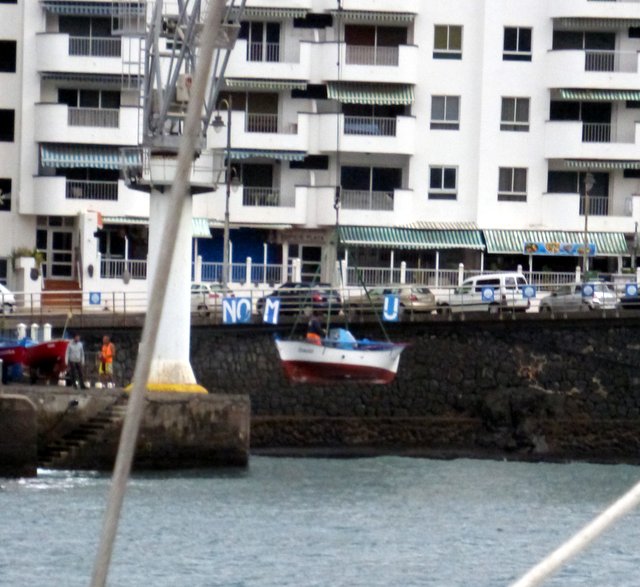
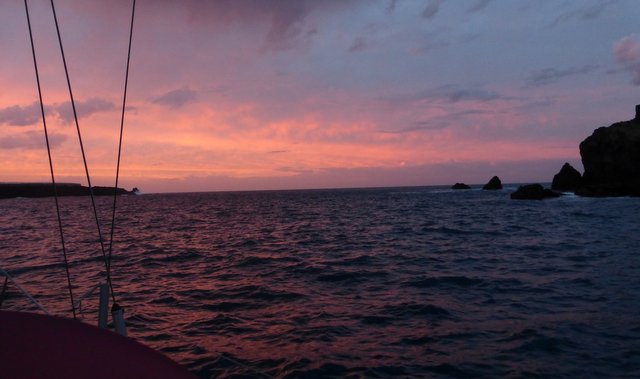
Overnight I anchored in a tiny bay off San Marcos, Tenerife – a bit rolly of course! It looked like a little tourist village, with pizza restaurant on the front, but it was late and too rough for M to land. Local fishing boats don’t moor or go ashore the normal way either; instead, they are hoisted in and out by a crane on the quay. What happens is this: straps from the crane dangle just above the sea and, as the fishing boat surges and rolls in the swell beneath, the fishermen on board reach for the straps and quickly fix them to the boat, signal to the crane operator who promptly lifts them a metre above the water. Presumably the fishermen then check their angle-of-dangle, and if OK, up they go, swinging away and over the harbour wall. It looked like a very unnerving way to end a long day’s fishing. This lift-out/in procedure happens at night too. Bright flood lights went on before dawn as a boat was lowered to the waves. (A pity, M’s photo doesn’t show it more clearly!)
Fishing boat being hoisted ashoreSunset from San Marcos anchorage
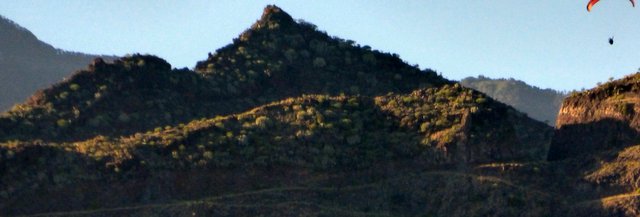
Up before dawn ourselves, we headed north up round the top of Tenerife and down south a bit on the other side. It’s a trying and tiring sort of sail as mountains, spectacular as they are, forever change the strength and direction of wind. North of Santa Cruz some very skillful paragliders were swooping and soaring on the thermals and updrafts among the mountain ridges (they’re the specks in the photo)
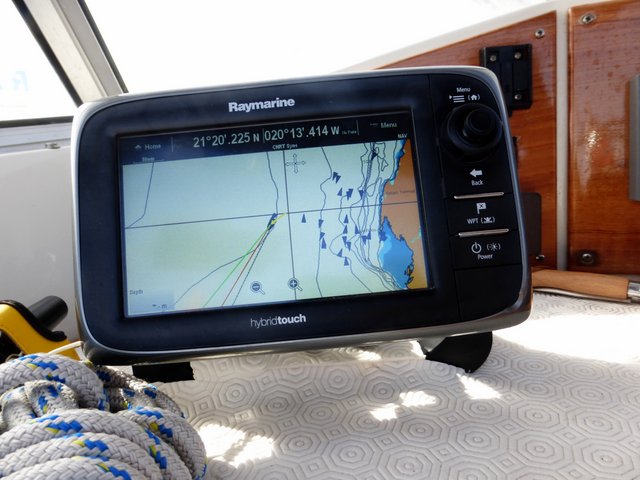
Next day, Pepe, a very quick and expert electronic magic man, came aboard and fixed AIS. (In case you’re interested, he deduced it was a contact inside a special multi-wire cable connecting two devices . He reckoned it was too short and under tension; and was something M would never have found, and didn’t have replacement cable anyway).
AIS working (little blue triangles show ships off West Africa, about 100 miles away
Whilst a longer stay in Santa Cruz was tempting, it was time to get a move on, so, weighed down with fuel, water and food, and with emigration paper from good-natured Port Police (good gracious, paperwork!), we headed out before dusk.
First trials with two fore sails
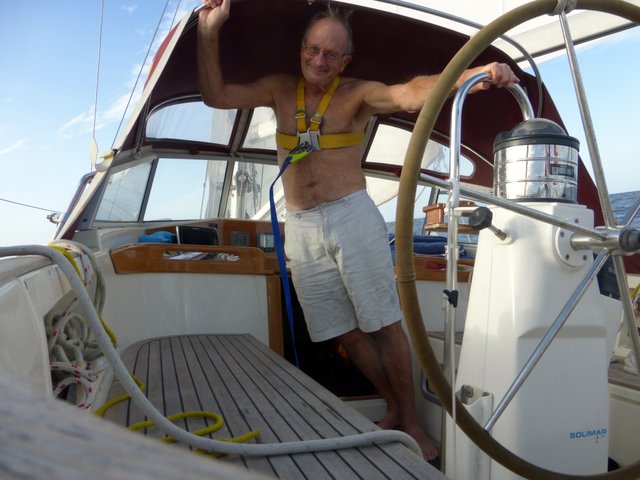
This is M’s biggest ever single-handed trip. It’s about 800 miles to Cape Verde. He has all the concerns he had when leaving Portugal on a long trip a month ago. Sleep? Safety? Sanity? The reality: – sometimes challenging but memorably marvellous. Sleep? An hour or two here and there (not such a big deal for an insomniac who has to get-up-in-the-night quite a lot anyway!) Safety? Wear a harness when scampering about on deck (well, not quite scampering….crawling really) and don’t drink (a welcome holiday for the organs of a borderline alcoholic!). Sanity? Of course! You marvel at the magnificence of vast empty powerful ocean. One sailing boat overtook us; it was over 50 ft long, with pink spinnaker up, and the only boat we saw within 20 miles in a week.
Goosewinging southwards
At night: the great sparkling dome of stars in dark tropical night sky, a few satellites twinkling across; by day: the ceaseless roll, and gurgle and swoosh, of passing ocean swell, scattering flying fish, their wild and chaotic flight so completely at odds with the swooping majestic ballet of the occasional shearwater; and, on nearing Cape Verde, a sea turtle flapping gently beneath the clear blue sea and, in our wake, a solitary fish (M doesn’t know what it is. Dorado? Nearly a metre long, lighter flashes along its back, effortlessly swishing along with us.) It’s a joyful thrill to see such sights. And, though the wilder spells sometimes make it exhausting and very slow to make a meal or wash, or even move, below deck, there is twice the satisfaction when it’s done. (Since cracked ribs on bit from Portugal to Canaries, M is even slower and more careful these days!)
Pleased with himself after work on the rolly foredeck
Not wishing to reach our destination in the dark, a sail came down and just a little bit of furled genoa slowed me so we reached Ilha do Sal, at dawn. Ilha do Sal, the pilot book says, is “the most northeasterly of the Cape Verde islands…and covers some 216 sq. km”.
I’d sailed over 800 miles (sometimes quite slowly, as we are still trying new ideas for downwind sailing; and at night, we don’t have too much sail up). The engine was on for less than one hour, just in and out at each end. I’m now anchored at Porto da Palmeira, one of the few places in Cape Verde where we have to get inward clearance (coming in your own boat seems more complicated than as an aeroplane passenger). It’s a bit of a one horse town (well, no horse, but lots of skinny exhausted unloved dogs, heads down and dejected, slumped around in African dust). Helpful boatman and general assitant, Jay, welcomed me in his inflatable (M communicates in appalling schoolboy French) and Jay points out where to anchor, then sells bread, suggests where to go and what to do…..more about Cape Verde next time….
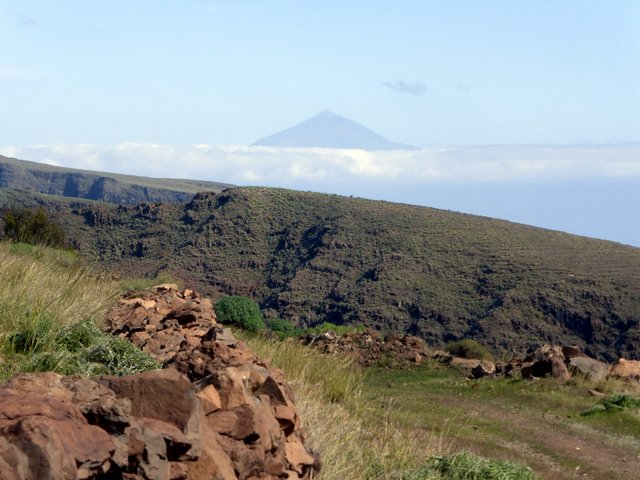
View from La Gomera (of the tallest mountain in Spain – Teide on Tenerife)Rebecca and Vanessa run the marina
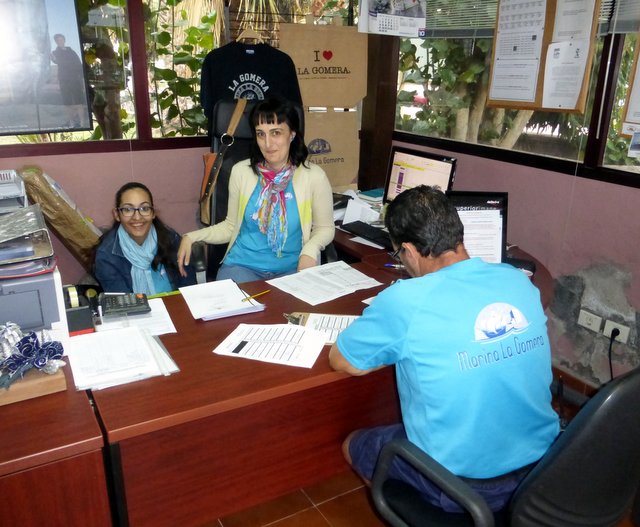
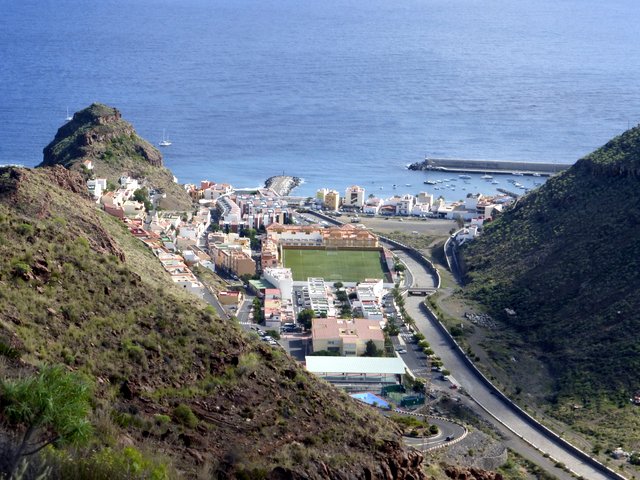
This island of La Gomera grows on us. There are sailor folk from northern Europe who’ve been here a long time. They didn’t get further than here on their Atlantic voyages – although incidentally, Columbus set out from here. An Irish couple, “…ooh! we got here 8 years ago and liked it, so haven’t moved on yet…”. And there were Danes alongside who’ve been here even longer. The pilot book suggests one of the problems is the little marina gets overcrowded because people arrive for two days and stay two weeks (or much much longer). The charming town of San Sebastian is on the doorstep. There’s regular music and cultural activity, good shops (at least until you need boaty bits), fabulous mountain walks, quiet beaches and plenty of sunshine. The marina staff, Rebecca and Vanessa, are fabulous and sometimes think we’ll be here forever.
More mountain walks
Notwithstanding all this, M and I do want to get a move on now. Before going south though, M is taking me back north to Tenerife for tricky work on my electrical innards. He can’t do it himself, despite many hours checking, testing, and reconnecting wires.
While staying around there’s been action: As well as some more long mountain walks for M, Andy Altenhofer, the delightful and versatile, law-a-bit-unto-himself, ever-in-demand German mechanic supremo has been on board and helped fit more solar panels on my stern. It has slightly detracted from the pristine beauty of my backside but, given the dire limitations of wind generators, it’s good to have peaceful daytime power from these panel things. (Really you know, us boats are better off being both beautiful and functional.)
Andy about to weld my new gantryOn board chaos
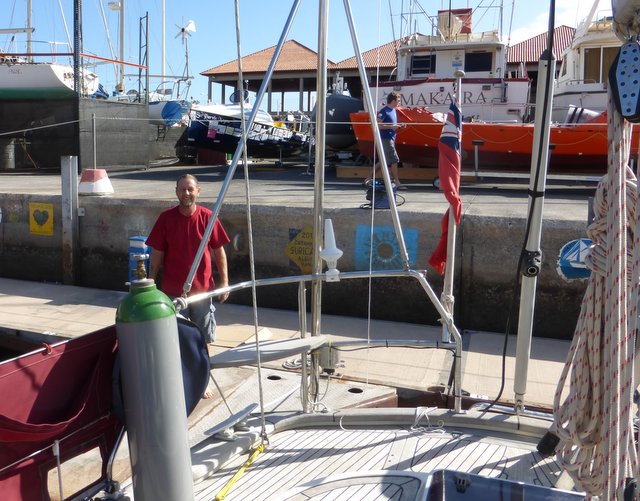
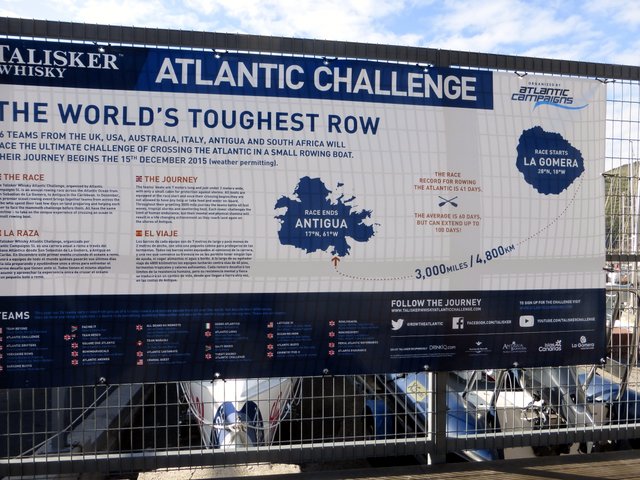
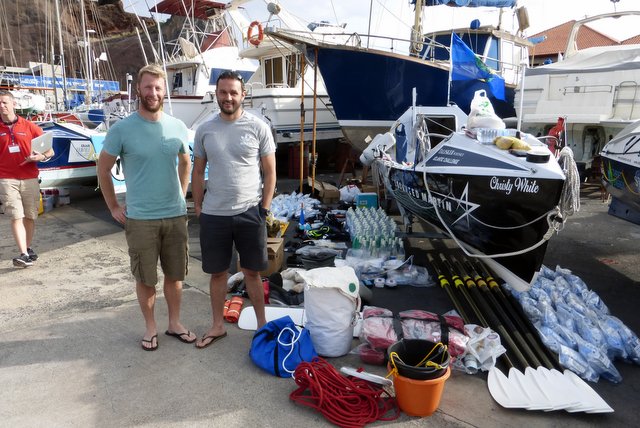
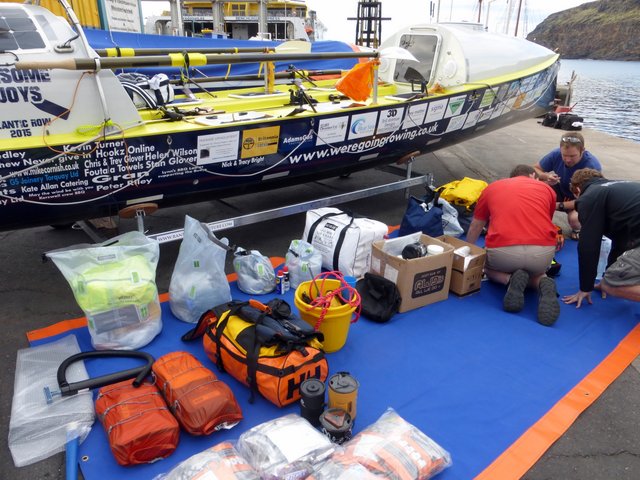
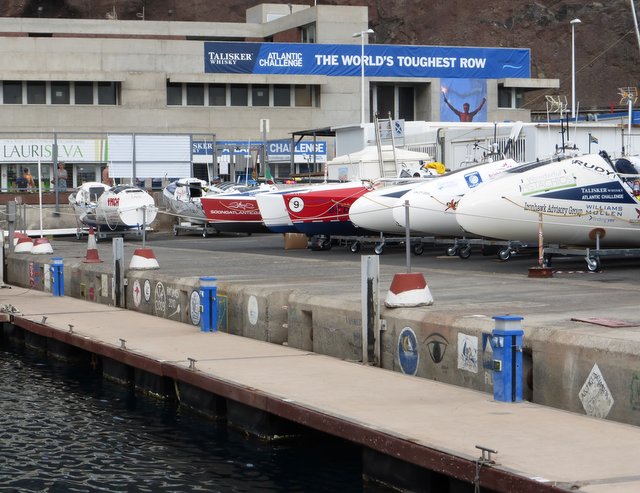
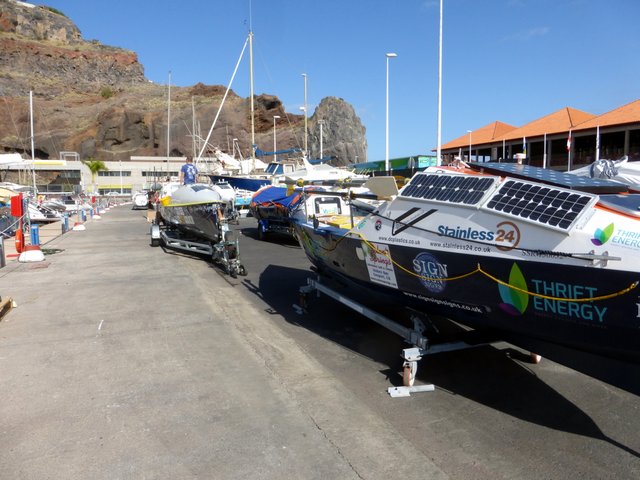
A highlight for M has been that we’re in La Gomera as we near the start of another Transatlantic Rowing Race.The rowers will leave from here for Antigua in mid-December. Twenty rowing boats are assembling on the quayside, right next to where my solar panels are being fitted. (Ben Fogle and James Cracknell may have drawn your attention to it when they took part as a pair about ten years ago). Chatting to several of the rowers is a delight. All appear calm, normal, modest and unassuming. Mind you, you cannot tell what’s going on in their minds. Most are in their 20’s or 30’s, fit young men. But there are very fit women too, and a boat with four rowers, all servicemen who’ve lost their legs in conflict. You can look at the website and find out more there. They are extraordinary and we really hope they’ll all arrive safely. Just give them a thought if you sit feeling overfed, indolent and sleepy after a massive Christmas lunch!
Atlantic Drifters, David and Tom Website hereCrew from Torbay getting their stuff ready
Minor gripe though:- Why do so many major endurance-type events become commercialised? They cost a lot for participants to enter (for this rowing race it’s many thousands of pounds, I gather), the event gains publicity and popularity (some people have them on ‘bucket lists’), certainly they raise money for many good causes, and tend to be called ‘epic’, or ‘iconic’. I’d put things like the sailing ARC trips (about 1,200 sailors on over 200 boats left Gran Canaria last weekend) and even the London Marathon or climbing Everest into the same big commercial bucket. What happens to people who simply want to do these things without the fuss….
…..Which takes us on to telling you about Graham Walters of Leicester, who was sitting quietly in a local outdoor bar with a small cup of coffee. He is a long-distance rower like no other. He’s rowed the Atlantic several times already, twice alone. He’s even older than M and now wants to be the oldest man to do it. To talk to him, you’d think he was going to row over the Serpentine to feed the ducks on the other side; amiable, gently smiling face, unflappable. He’s not in the Talisker event (it’s too expensive, and it’s hard and time-consuming for a retired Leicester carpenter to raise the sponsorship funding); his freeze-dried rations, which he bought as a job lot from previous expedition, were ‘best before 2005’ – but he says they seem fine, “…not very tasty though”; his boat is old and low tech (not self-righting like modern ones, but Graham has “…fitted a couple of inflatable bags and a gas cyclinder…which should right it”, if he capsizes); asked him “What do you do if you feel like a day off from rowing?” A: “Well you can, and if injured you have to, but it takes longer to get there then…” (he hopes to do it in 100 days); to cap it all the local authorities here are saying they won’t let him leave (he wants to go the day after the Talisker rowers); apparently the last time he set out, a few years ago, “…they sent a gun-boat after me, impounded my boat and I had to pay 5,000 euros fine..”. If authorities don’t relent he reckons he may have to go back to Gran Canaria and start from there. Here is a web-site about one of his previous exploits. An extraordinary man, really extraordinary.
Pleasant and calm – Marina La GomeraRutland awaiting bits
(M is utterly wildly and obsessively exasperated with Rutland wind generator people. He reckons by writing about it, he might get it off his chest; so this is another post by M. I only hope he will get it off his chest a bit and he’ll calm down before he does something silly with a Rutland.)
Yes, with Anna back in England and more time alone, there’s more time to get Henrietta in shape for the next bit. (I’ve decided to continue single-handed for a while and have turned down offers from friendly hitch-hiking sailors – even a lovely Spanish girl who’d have taught me Spanish (we all have our dreams!))
The list of things to do is long but, with notable exception of Rutland wind generator, I’m getting there. Sails sorted, engine ready, wiring fixed, some polish and cleaning, cracked ribs feel better too…….There are lots of experienced sailors and their wisdom on hand, which is good. Around half are going to Cape Verde/Brazil/Caribbean, half straight to Caribbean (oh! and half staying hereabouts…which makes three halves of course). I don’t yet know what I’ll do.
Meanwhile, can I tell you why you shouldn’t ever have a Rutland wind generator on your boat? (Unless maybe you keep it on a canal or in calm coastal waters with wind not more than F8) It might bore you or be libelous but it might calm me down if I do write about it, so here goes..
..….to summarise: said unit was on Henrietta at purchase; power generation a tiny fraction of advert blurb (Rutland didn’t want to know!); negligible power if wind under F4/5; exploded at F9/10, pretty noisy in between; Rutland suggested badly installed (the professional installer gave them short shrift I suspect); suggested I should have realised something was going awry in storm and perhaps slow the blades by rotating the unit with boat hook to feather to wind (these people may have a fine sophisticated lab designed device, but zero appreciation of life at sea in a storm on small boat). Unit was less than two years old, hence covered by ‘warranty’. I.e. Theory: I post remains of thing from Portugal to Corby and Rutland fix it and send it back. Practice, I package, take to post office, record, arrange and pay posting by airmail, then wait over two weeks for fixed unit to be sent back to Tenerife (I’d both arrived and subsequently left Tenerife by then); later I sail back from La Gomera to Tenerife (San Miguel, conveniently near the airport, is not a pretty place) to collect it, pay various import and carriage costs,
San Miguel on Tenerife (dire development under airport flight path behind an ok marina)
sail back again to La Gomera (about 35 miles each way), open the box…WHAT? NO BLADES, NO CONE, NO BITS in the box to reinstall. Emailed Rutland…who offer ”sincere apologies” (bits had been forgotten…now, I await another package…Costs so far exceeding 200 euros for incomplete and non-fixed unit (i.e. total budget for a week living aboard). I’ve talked to many owners of Rutland 914is. Few are happy and at least one other will drop it overboard as soon as it goes wrong. There may be many happy owners out there, but in my view it’s an unsafe unsuitable generator for ocean sailing, and you’ll certainly get safer power from an earwig’s armpits.
I must tell you about Lewmar and the tale of the Delta anchor though. In total and joyous contrast to Rutland, when I told them and sent photos of my new 16kg anchor that had bent at a not-especially rough anchorage (16kg being confidently recommended as fine by chandlery in France), Lewmar promptly and without question sent a brand new 20kg anchor straight to Tenerife, where I collected it at no cost to me, about 10 days later.
So sailor folk, my future maintenance budget may go Lewmar’s way, but never another cent to Rutland/Marlec.
I could tell you a similar tale of Gil and Musto clothing, but you’ll have had enough by now. (In case you were wondering though: Gil the good egg and Musto the rotten apple).
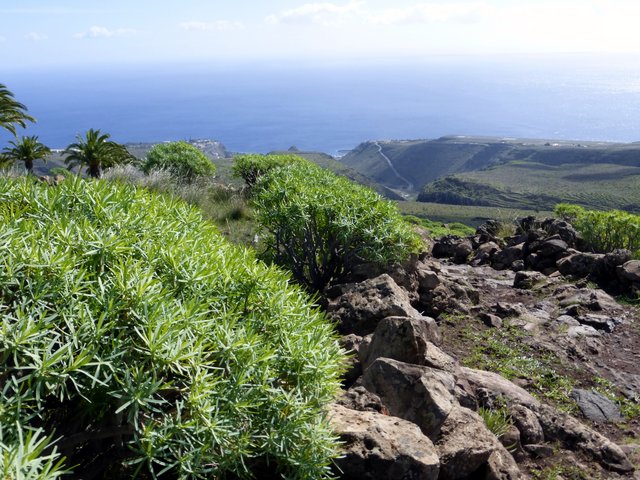
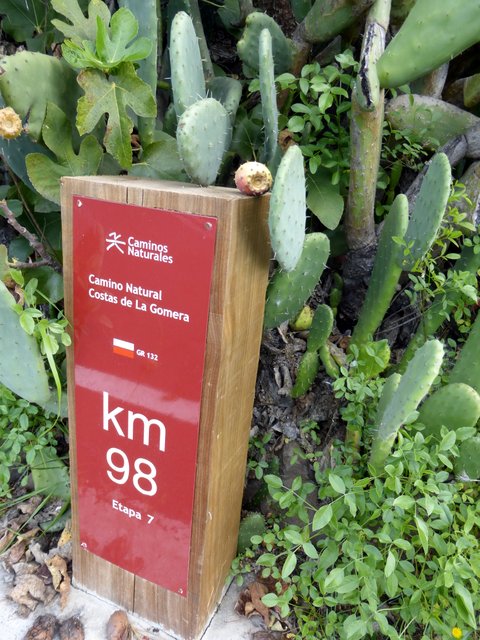
Between boat chores and being sociable (and getting into a pickle over Rutland, and dilemmas over when to go, where to go and whether to go), I have enjoyed more wonder-filled walks on this lovely island of La Gomera. Buses are reliable, if infrequent, trails and paths are mostly well marked, the weather is mostly benign, choice of scenery great….Here are some pictures.. .
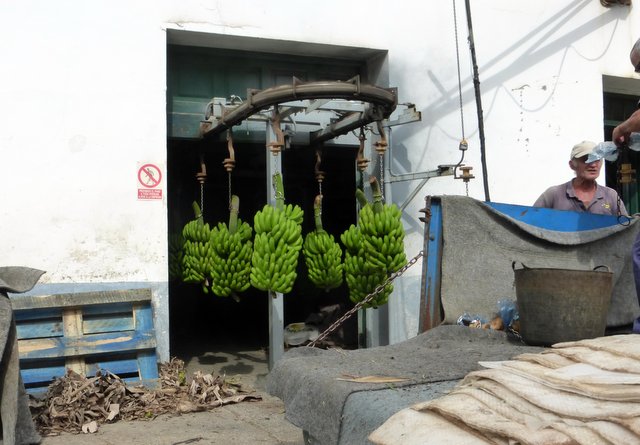
Taken by passing walkerBanana depotCamera on a rock
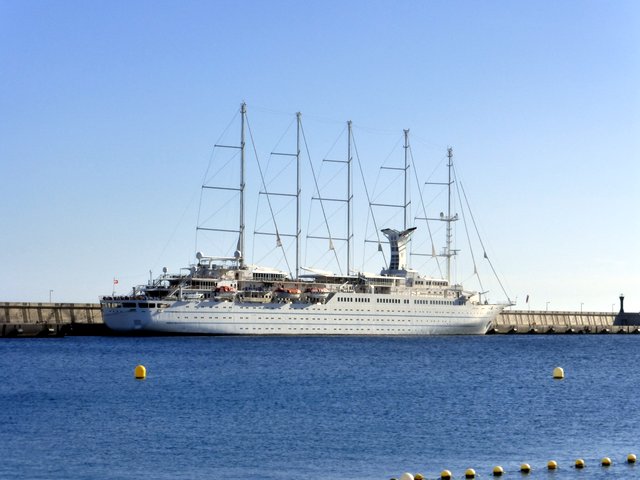
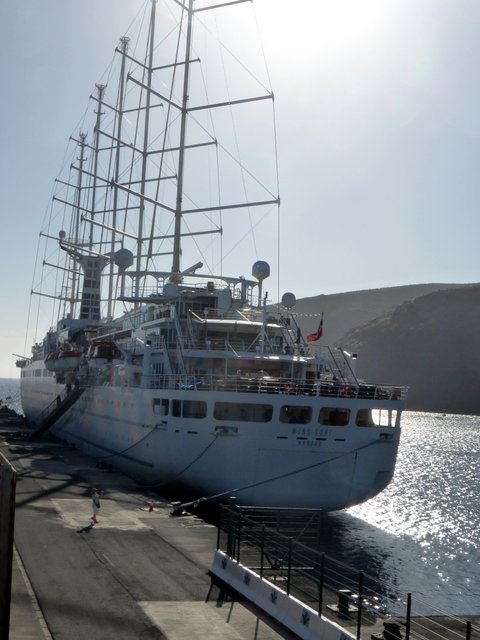
A large motorsailorCloser to a motorsailor (it’s a cruise ship)
Tenerife to La Gomera, on to La Palma, then back to La Gomera
1st to 12th November 2015
Wonderfilled market in Santa Cruz
(Henrietta is getting M to write this blog post. He’s been with Anna and seems to have no time for me. I’m a bit miffed, but do accept most men seem to love their human friends even more than their boats. They really do!)
Seemed strange….
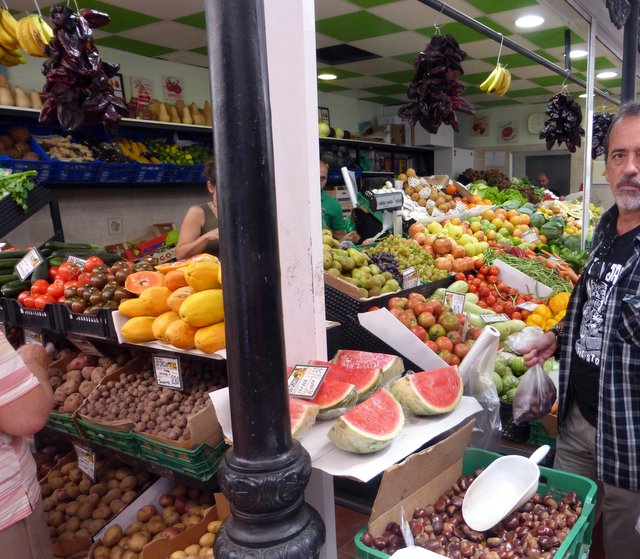
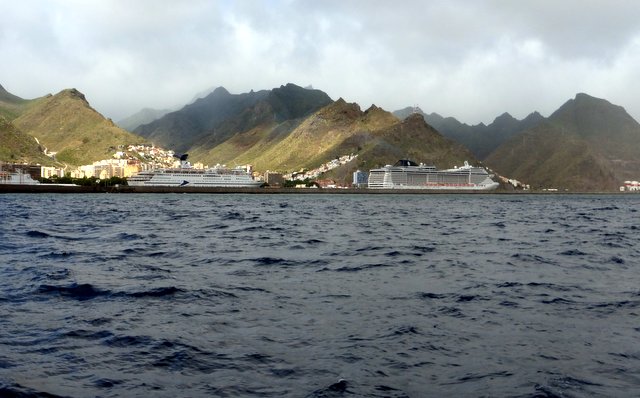
Ok then! I found my way to the bus station in Santa Cruz, Tenerife, and met up with Anna who’d caught a bus there from the airport in the south. (Spanish coming on leaps and bounds these days and we can now get to a Canarian bus station!) Weary after our journeys and as the next day was windless, we stayed in Santa Cruz, sharing the city’s delights with the thousands of visitors disgorged from vast white cruise ships that docked nearby. The ships seem huge and ungainly, with hulls and backsides resembling unimaginative white housing blocks – P&O – Posterior xx Oversized. The city has a marvellous and colourful market, and unexpected charms on every street corner (see pics)
A walk while anchored near Poris, Bahia de Abona
Next day we sailed off south, down the Tenerife coastline, till lack of wind and impulsiveness led us to head for shore and anchor (a pleasant bay, Bahia de Abona). In late afternoon we rowed ashore,deftly avoiding capsize and a swim as we landed in the surf; then had one of those hot hot humid dusty roadside walks into the nearby village of Poris (I presume it rhymes with Boris and might want a name change).
‘Accelerating’ over to La Gomera
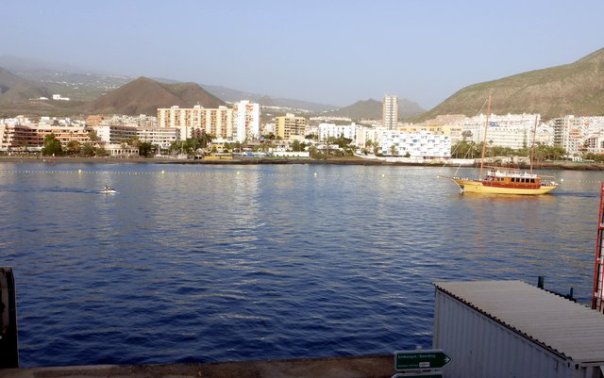
On south again next day to San Miguel where there’s a busy but welcoming marina. It was an afternoon where everything seemed to go right – so right that you get nervous that it can’t go on being so good! But the gods were on our side today: A new and bigger anchor had arrived thanks to Lewmar (It fits perfectly too). Diesel was available and we filled up. A secluded berth was vacant and we took it. The marina bar had useable internet service. A volcanic beach was nearby and fine for a refreshing swim. Just a slightly off-key note with local resort concrete blocks and food shops; I find it depressing to see UK produce available when there’s a good, cheaper and better local alternative. Some totally unadaptable Britons must presumably buy Tesco tinned sardines (2x local price), Buxton bottled water, and Heinz baked beans. (Don’t forget the Coco Pops either).
Barren cliffs and a rolly anchorage, off La GomeraValle Gran Rey
Lunch break (double ‘selfie’)Bus journey out of San Sebastion de la Gomera (marina centre right, Tenerife in distance)Resting…at last
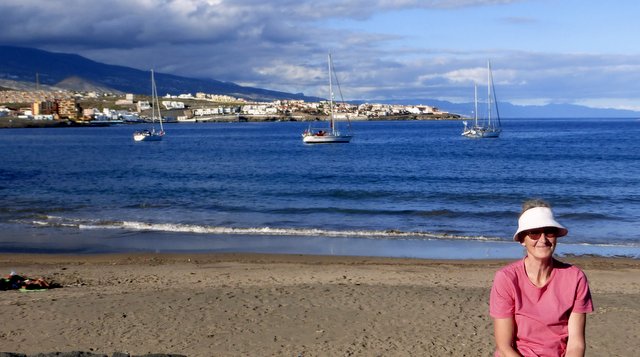
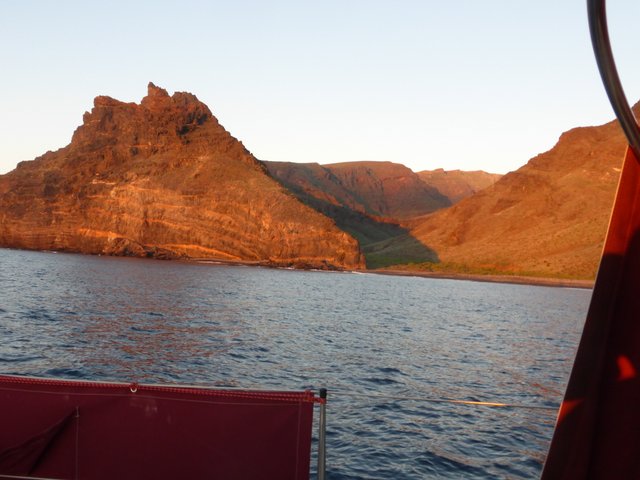
After a night there, we sailed over to the relatively little island of La Gomera. This included our first flirtation with an ‘Acceleration Zone’, where wind picks up quite quickly by 10-15 knots and you can enjoy some exhilarating sailing as you approach a new coastline. (I think this happens in bits of the Mediterranean too, but I’ve not been there.) Rather than go straight to the marina we opted to anchor off the coast. Alas! Coasts in the Canary Islands often have persistent irregular swell making them rolly. This one was no exception. But it was beautiful…rolling beneath the high and barren cliffs…stars twinkling as darkness moved in…..
Admire my tail!
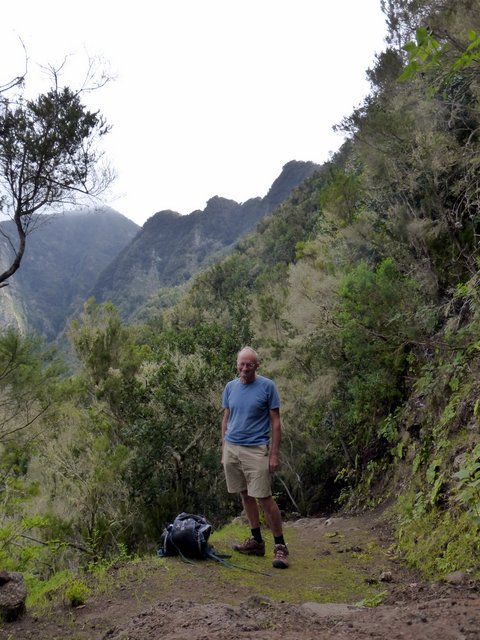
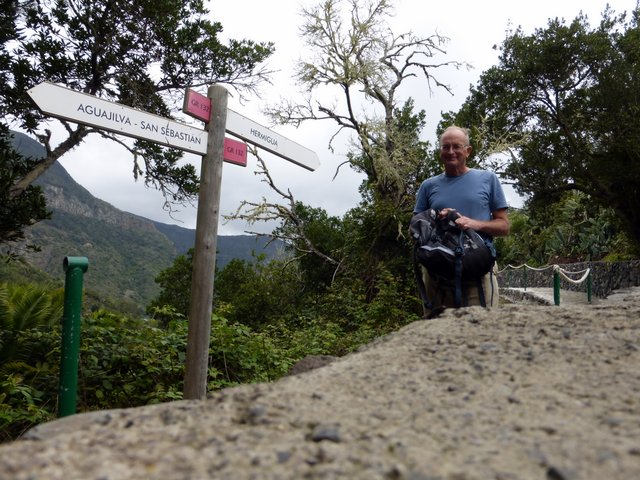
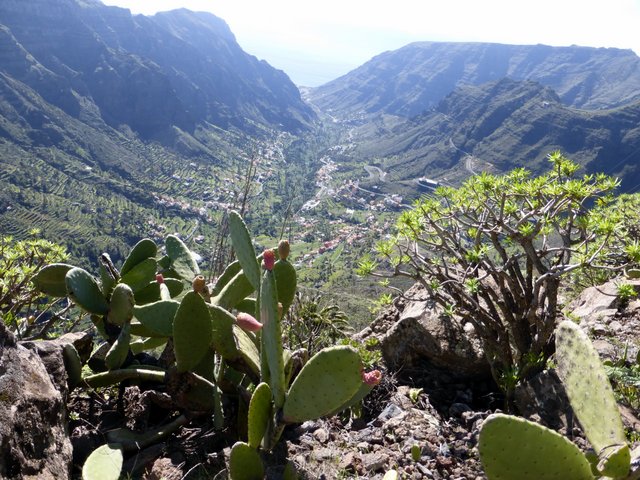
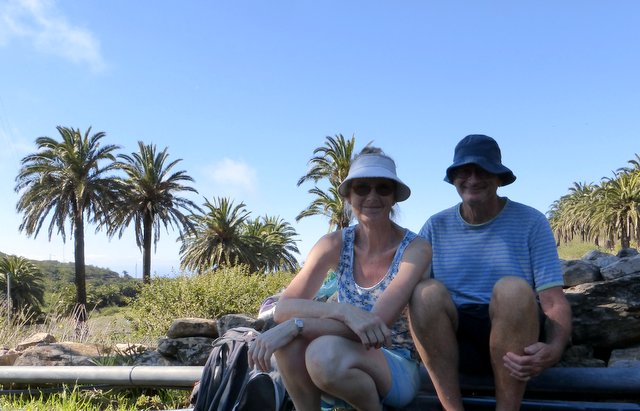
Next day, we overdid it, we overdid it…..Early into San Sebastion de La Gomera marina, berth ‘Henrietta’, pack up rucksacks and picnic lunch and find a walking map, catch a bus up a zigzag road to a high village (1,200 metres), jump out of bus, walk rocky path downhill miles and miles (this is two folk past 60 with dodgy knees, remember!), but we are entranced by the Valle Gran Rey: natural and manmade terraces, cactus, banana, vine, avocado and more, and, as we drop lower, tidy white pink and terracotta mountainside huts and houses….after many sweat-filled hours we arrive at the seaside, find a beer, then find a bus back and, as night and darkness arrive, enjoy the cool switchback bus journey home with village lights twinkling beneath the high mountain road. (Knees are hurting a bit, but never mind!)
Santa Cruz de la PalmaGentle walk – La Palma
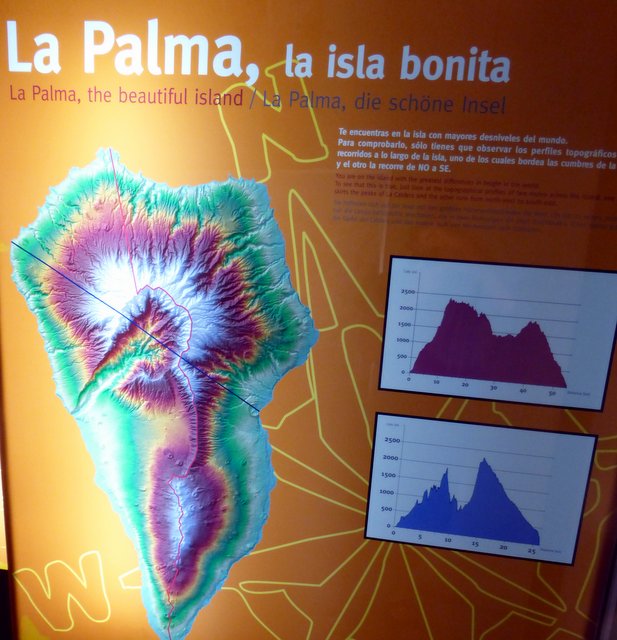
After a day relatively resting in La Gomera, we sailed all next day to the next island, La Palma. It’s about 55 miles and I’d left a bit late (wanting to recover deposit for marina passes) – so we arrived after dark (always something that makes for anxiety when a port is new and unknown, and lights of the town obscure navigation lights). All went well though. Marina staff were typically fantastic and shone a torch to show where to go and a half hour later we were tied up. The marina is less than half full. It suffers surge and this deters many visitors. But the marina facilities are good, the town of Santa Cruz de la Palma is a gem, the countryside striking and a delight for walking and admiring volcanic nature (the last eruption in 1971)……
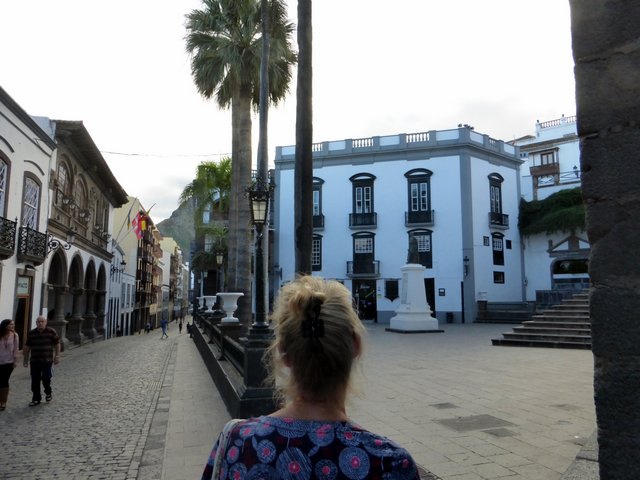
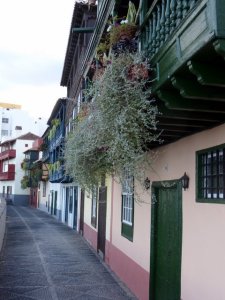
Much photographed street in Santa Cruz de la Palma
You’ll have had enough of this rambling travelogue ….suffice to say we loved La Palma; we met lovely people (including Challenger 3 skipper Paul, and sailors Phil and Laura, quite newlyweds, also on a Najad, and sailing on the Islands Odyssey [15 boats going to Caribbean via littler islands than the ARC proper]); we stayed three days on La Palma, then sailed back to La Gomera.
Yesterday, we took a ferry, an hour over to Los Cristianos on Tenerife. It’s close to the airport but isn’t a place that holds much for us. We ate a simple meal, trudged past shoploads of sun-hats, buckets and spades, and Tenerife labelled T-shirts, then waited for an airport bus. It came on time and Anna climbed aboard. We had a hug, and felt listless and sad. A few hours later her flight landed in Bristol and my ferry docked in La Gomera. I’m back with ‘Henrietta’ now. A week of repairs, tidying, cleaning, researching, walking and resting (and a haircut) is needed.
It’s just been me and M for the past ten days. I do the real work of getting us along while M sits around or experiments with my sails, spinnaker pole, Hydrovane, solar panels, electric bits, fixing bits, and cooking bits, and ropes all over the place; and deciding where to go nd how to get there. He does sit around a lot too – thinking or dreaming mainly. Bob left us in Cascais after several unforgettable weeks. He was practical, industrious and willing – beautifully watching my trim at all times (just a bit frustrated with my tell-tails, which he reckoned weren’t up to muchl!)
Another victim of that stormOcean sky (sun setting)Ocean sky (moon rising)
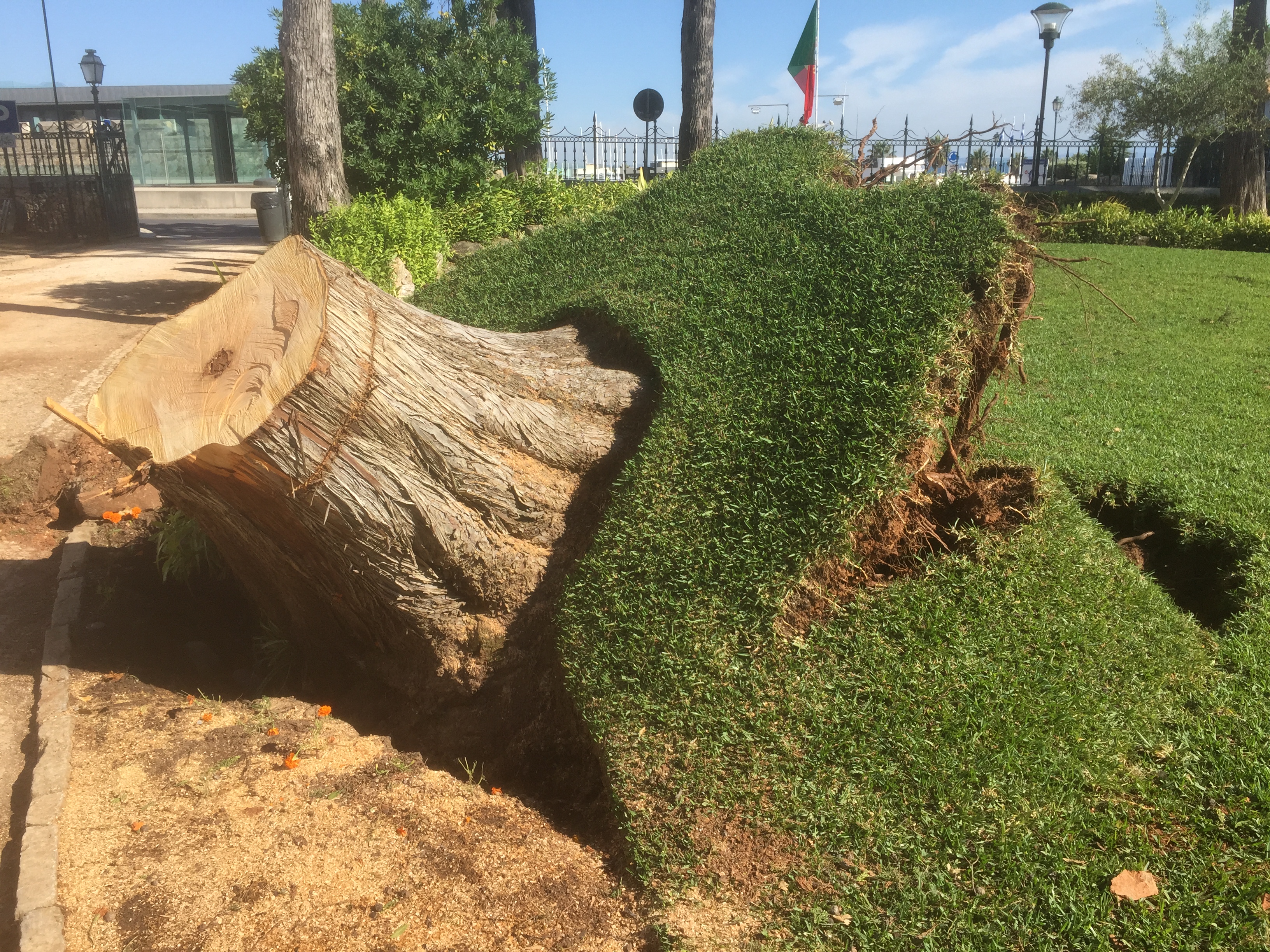
What has been going on? You’ll remember that I was a bit bruised after the attempt to reach Madeira, and had to return to Cascais, near Lisbon, for repairs. Cascais itself had been a bit battered by the winds too: apart from the oil tanker driven ashore, there was damage to fine old trees in the local park (here’s a picture of a grand and aged tree uprooted – it crashed onto the roof of the unfortunate building behind – all efficiently tidied up soon after). It took a few days for sail repairs, Rutland wind generator left-over bits sent to Corby, chips in gel coat repaired (cause: exploding Rutland = v. alarming), bilges and carpet dried, dodger sewn up. In a nutshell, local Portuguese people have been overwhelmingly helpful, fantastically friendly and generous of their time and advice; fellow sailors a colourful mix of hue and view; Lewmar? Brilliant and excellent service and they’ll send a new and bigger one to replace a bent anchor; Rutland? The jury’s out.
After the unplanned days in Portugal there was just enough time (if weather was ok) to reach Tenerife, about 750 miles away, before Anna’s arrival. Forecast was more-or-less ok. (In fact, if we’re fussy, I’d say the first three days were too windy, the next three too windless – but if you’re too fussy you’d be better off staying in bed anyway.)
Before leaving Portugal the prospect of M’s first big single-handed trip was a bit daunting. How to sleep enough, manage all this stuff and keep healthy enough, happy enough and sane enough? (M will write more about this another time. In essence though, single-handed sailing a beautiful boat across a grand and wondrous ocean is a marvellous experience.)
Happy skipper….(this is a’selfie’)…trying lots of ropes
Anchored off northern Tenerife
Early days with F6/7, and well-reefed sails were fast and exhilerating; choppy seas, spray flying over foredeck, warm sunshine or heavy shower, the sky a riotous jumbled patchwork of clouds in palest washed out pale to darkest inky blue; the ocean swell unceasing and filled with grandeur and power. We are over-awed. At the end of day 6, we approached Tenerife at dusk, finally dropping anchor in the dark, off a remote deserted beach under a mountain, at the north end of the island.
Next morning was wet and windy in Tenerife. I sail a few miles south to Santa Cruz. Anna was flying from Bristol by now. We meet up late afternoon in Santa Cruz bus station….more next time…
View past Dom Vasco of Sines marinaSunshine and calm sea at Sines
After another day or two in the sunshine and warmth of Sines, with skipper and me, Henrietta, as obsessed with weather forecasts as ever (Wind and weather are of course an obsession of boats and sailors everywhere), we left for Madeira or Porto Santo, which is a smaller island nearby. Alas, it wasn’t in said forecasts – at least not for our patch of ocean – but after about 20 hours and going well, we were hit by strong winds, and then by even stronger winds, and then even more, until it was plain Force 9/10, with gusts 55 – 65 knots.
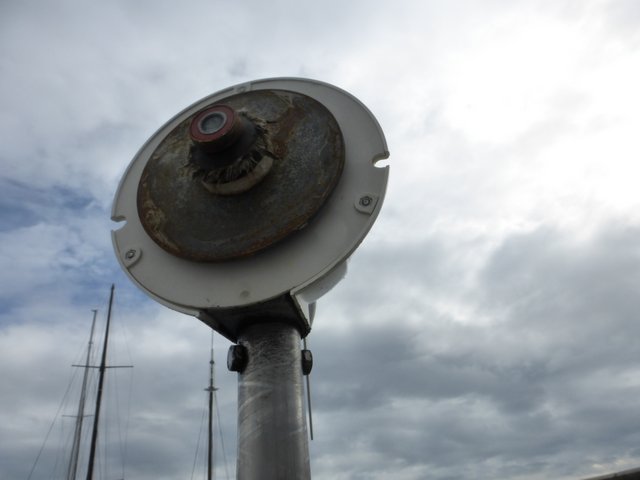
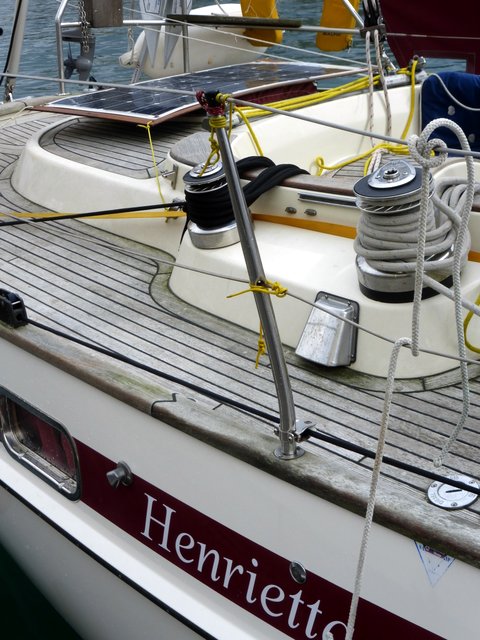
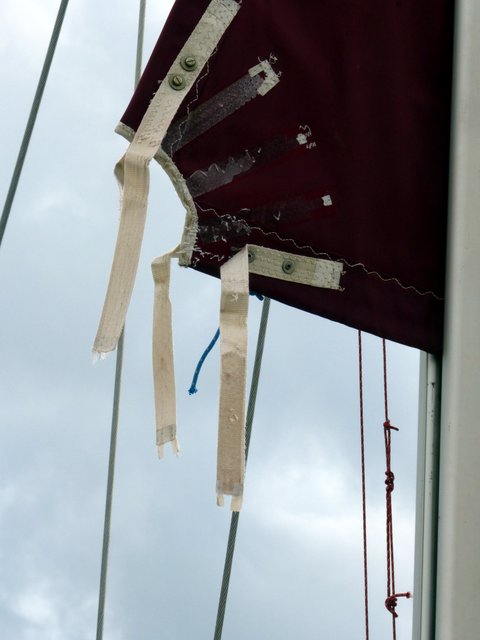
I was hove to with no sails up and skipper and crew hanging on. As seas grow bigger and bigger I am thrown around a bit but I maintain a fairly steady course, rudder on full lock, sideways to seas and staggering downwind, occasional waves crashing into cockpit. (M has only read about this sort of thing in books so, looking on the bright side, it is all valuable experience for him.) Although I am a strong and thoroughbred Swedish boat and have no harm to my body, after several hours, damage was apparent on some of my bits: – clew of mainsail ripped off, genoa UV strip partly torn, wind generator exploded (yes, we were lucky that shattering blades caused no damage), one solar panel backing plate destroyed, one dodger torn, one stanchion bent, bilges flooded, one bilge pump not working….M is not being over dramatic if he admits to sometimes wondering why on earth he enjoys sailing. (Short answer: when it’s like this, he doesn’t!)
It was much rougher earlier!Tanker across marina entrance with some tugs
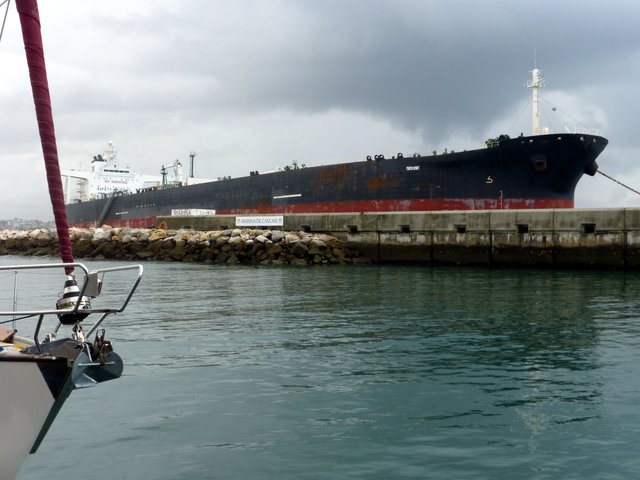
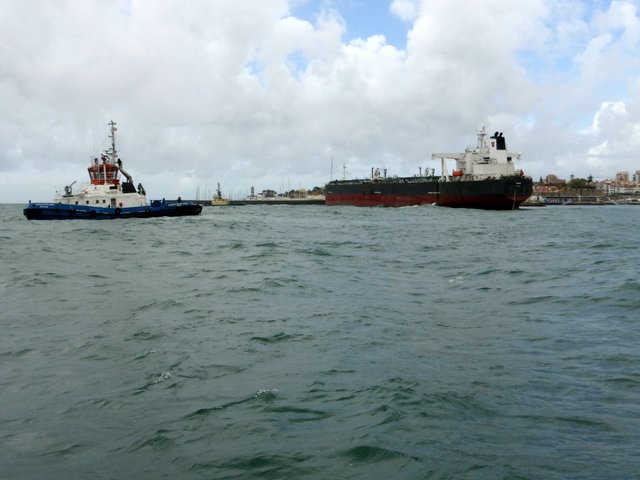
Decision taken a few hours later in daylight, and once seas were more manageable, to sail roughly downwind about 120 miles to Cascais (near Lisbon) – i.e. closer to England than we were four days ago. Cascais has facilities, but as we approached the marina, M spots a tanker that seems anchored very close to shore. In fact, as we grew closer we see it is aground at marina entrance, with no less than seven tugs around (waiting for tide to rise and try towing it off). Later we discover this tanker, which was very big, had dragged its anchor in big waves and very high winds. Luckily not full of oil, and luckily not being swept onto Cascais beach or boat moorings, and luckily with double skin hull, disaster was averted. As local people are saying, it was a miracle. Anyway sailors, when you see a big ship in trouble, you know it really was very windy and rough. The worries of a tanker captain must be immense compared with those of a yacht skipper. click here for tanker story
Now, a day later, crew have had some sleep and proper food. A start has been made on repairs. The weather forecast obsession is back – with renewed rigour and vigour. Hope to be writing a happier blog next time!
In case you can’t guess, this is a Rutland generator minus the bladesBent stanchion. There used to be a dodger too.An important bit was torn from here.
Here are photos of some damage because some folk like to see such stuff.
Povoa do Varzim – you may remember I had an uncomfortable stay there – snapped mooring line and later a snapped rubber shock absorber thingummyjig….plus sleeplessness for crew.
Povoa’s redeeming features? Delightful and ever-so-helpful marina staff, meetings with Nigel (from Exeter too, on a Vancouver), and Chris and Barbara (they live on their boat and have sailed nearly everywhere in north Atlantic [lots of tips], and Chris has climbed, potholed, kayaked – and taught all of them – everywhere else too…the sort of person who lives five normal people’s lives and remains totally normal, unassuming and friendly). My crew had a really good meal with them in downtown Povoa – not really sure if it was downtown but it was near the metro station.
Comfortable sailing down the coast of Portugal
Many harbours on Portugal’s Atlantic coast get closed when there is heavy Atlantic swell, so for three days, or maybe four, we weren’t able to leave Povoa. When at last we were allowed out, there was a quick exit through surf-bordered, rolly, swelly harbour entrance (did an aunt used to say “up and down like a roast leg of pork”? maybe not), it was a good sail – reaching and running about 180 miles south to Cascais – such a joy to enjoy good sailing after so much engine.
Anchored at dusk off CascaisBloodhound?Anchored off Cascais, I think I served as one end of their starting line
Cascais? Cascais is a very smart holiday resort about a dozen miles down the Tejo estuary from Lisbon. The Almanac and various sailors’ sources warn of sky-high and mouthwatering marina charges in Cascais, so I anchored outside and did not enjoy three uncomfortable nights bouncing and snatching about on a windy lee shore – most of the time too wet and breezy for crew even to row ashore. Next day…enough of this…into Cascais marina. Pay attention and take note, sailor folk: after 1st October, it’s said to be ‘low season’ here and marina prices plummet. (About 25 euros for me…a bargain which must be half the price of most of England’s south coast marinas…and marina staff gave my crew a bottle of wine as well). It really is smart. I think there’s even the Queen’s old yacht ‘Bloodhound’ in the marina (see picture). And several super-shiney professionally-crewed yachts.
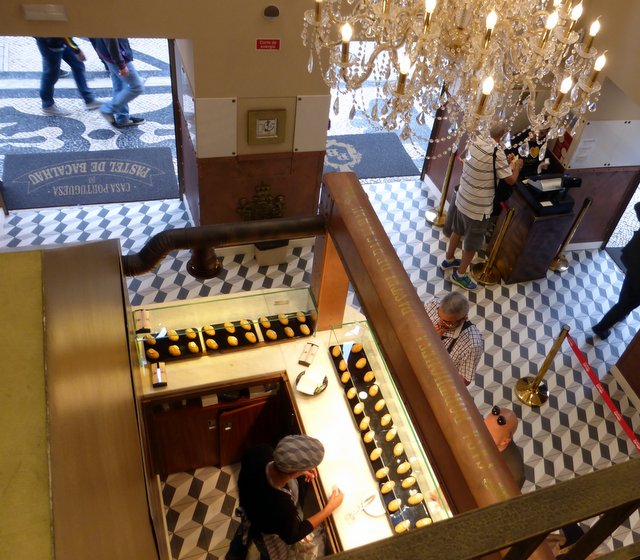
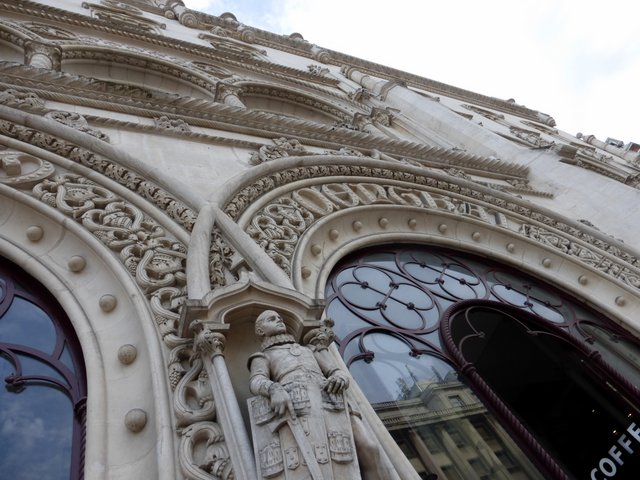
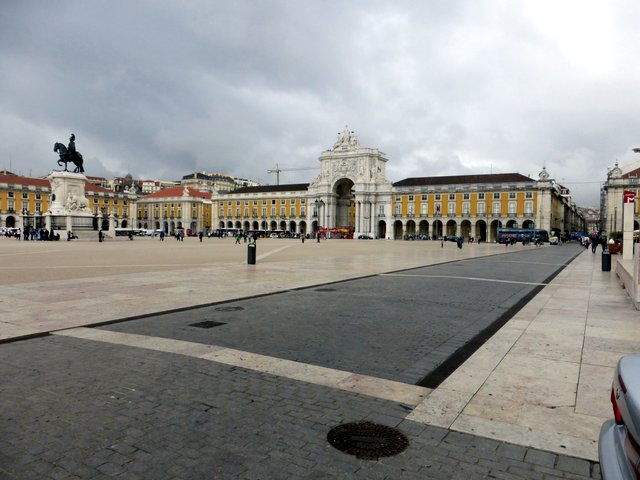
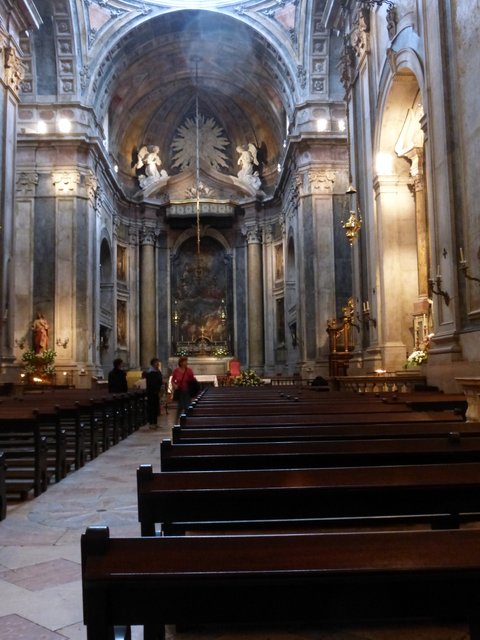
As we waited and waited for better weather – at that stage intending to go straight to Madeira and Porto Santo (a long way), there was time for local interests and culture. A couple of days in Lisbon, an easy train ride, gave glimpses of Portugal’s distinguished history and current delights and plenty of sombre cathedrals…some photos below.
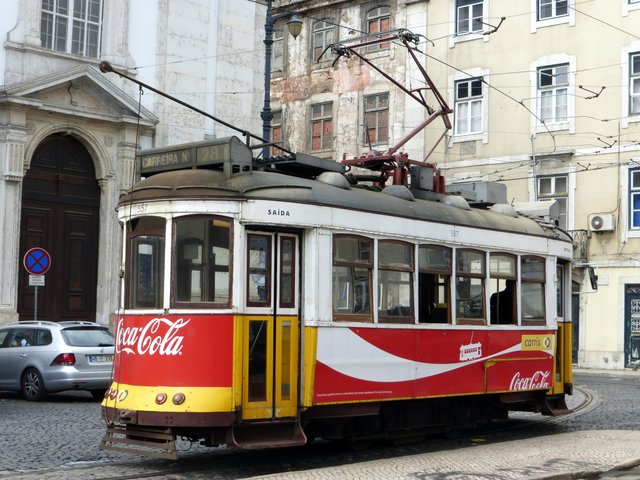
Tram no. 28, a popular tourist trip
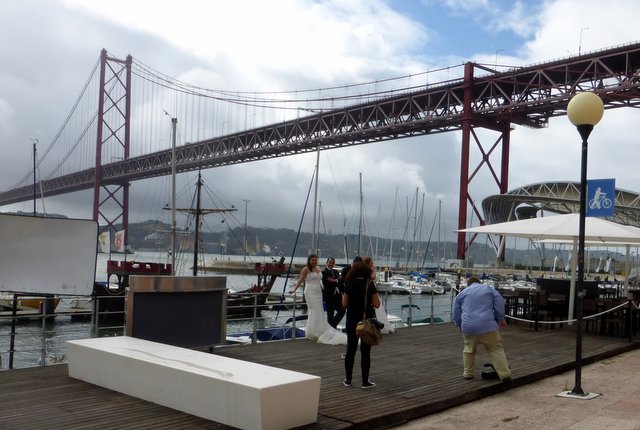
Wedding couples pose in front of the bridge
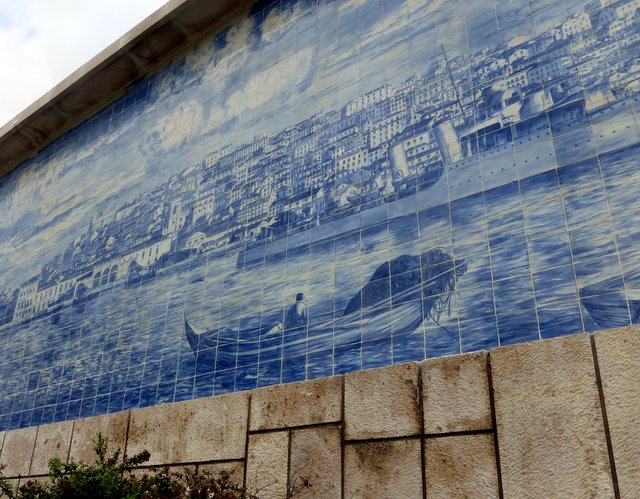
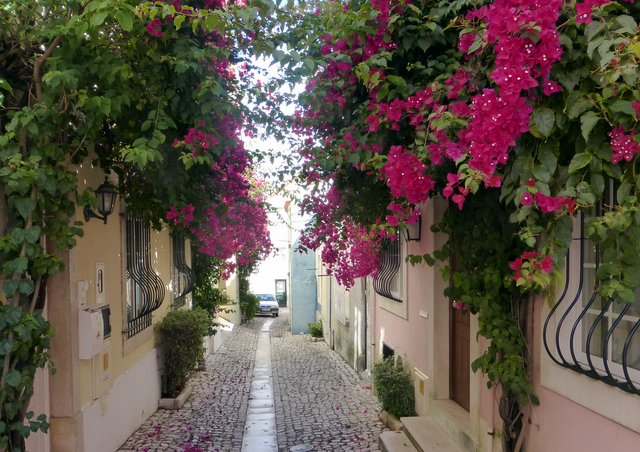
Cascais too has more than its share of fine buildings, enchanting streets and those ubiquitous tiles.
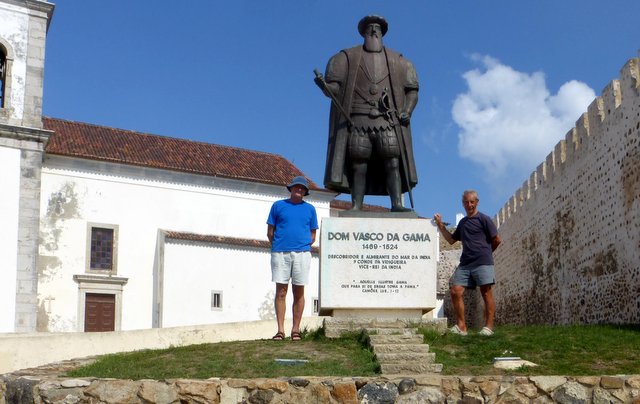
Panoramic view of Sines from anchoragePosing with Dom Vasco…
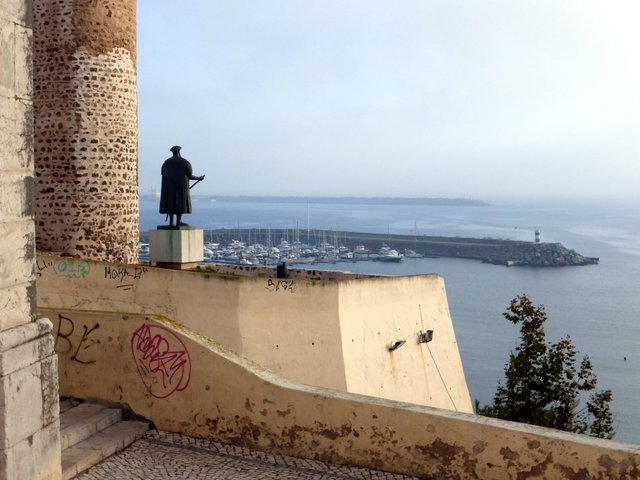
By now, M wants to get a move on. We’re meant to be well on our way to the Canaries. In fact we’re little over halfway from Devon. Alas! big windy lows are destined for our patch of the Atlantic, and four or five days of rough sailing seem unappealing. We instead move south to Sines. This might be where Vasco da Gama was borne (see photo); but marina manager seems doubtful… but then he’s from Lisbon. (By the way, you don’t call it Sines as in Cosines, you call it ‘Cinch’ as in ‘a bit of a ~’ – soft cinch though. Portuguese pronunciation seems not at all straightforward.)





















 Sailing Henrietta