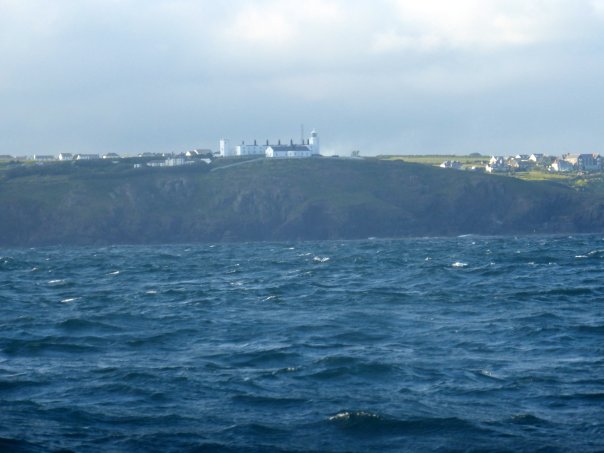
After a bus trip to Praia on the island of Terceira (when it poured with rain all day but still looked pretty – though not nearly as fine as Angra), I left next day, bound for Britain. Nine and a half days later, just after midnight, I rounded the Lizard and reached Falmouth.
Final dawn before Cornwall – 100 miles to go
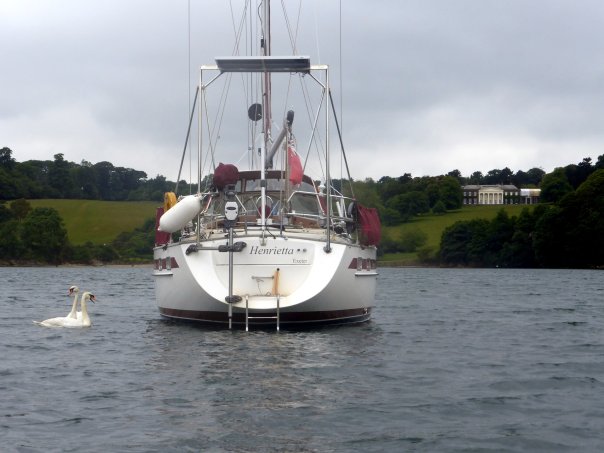
Falmouth was packed with boats. It’s Classics Weekend – meaning dozens and dozens of beautiful old sailing boats all over the place, but impossible in darkness to find a spot to stop – and so I meandered in moonlight a few miles upstream to a calm anchorage in Channal’s Creek, overlooked by National Trust’s Trelissick House, and then in the peaceful early hours enjoyed a giant glass of Antiguan rum.
French catamaran overtakes me on the way
…and there’s a ‘low’ over Britain
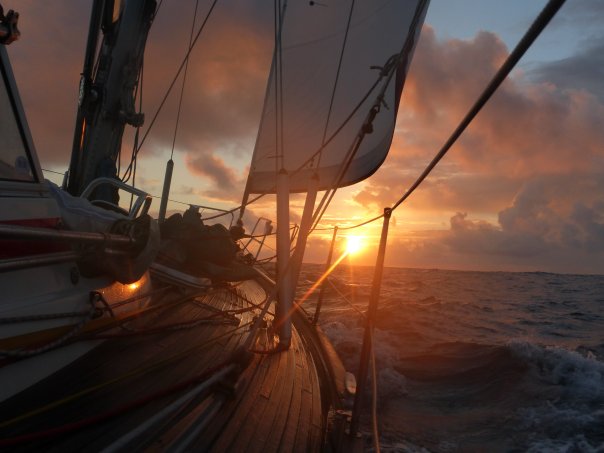
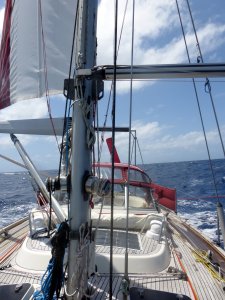
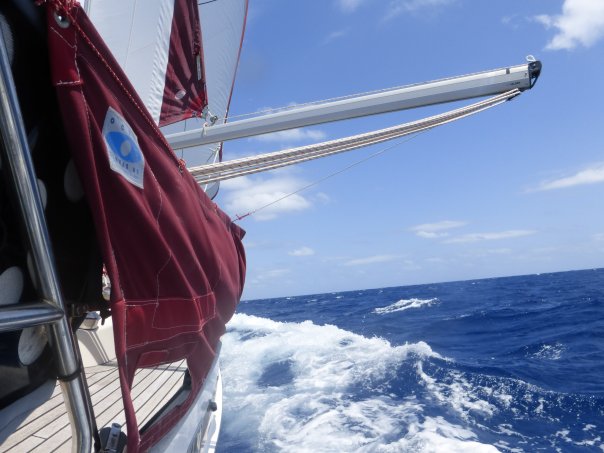
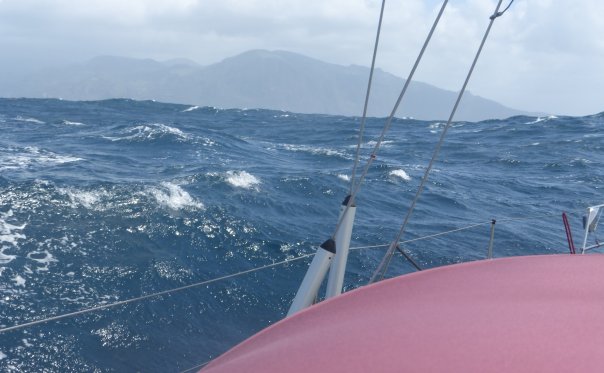
Well reefed and on the way from Azores (photo from overtaking catamaran)
It had been a varied ocean voyage from the Azores with busy days and nights, almost continuously (or so it seemed) reefing/unreefing/altering course. Mainsail clew tore off its webbing straps when half way, so, until managing a crude repair, I sailed with only the genoa for almost 500 miles.
Rounding the Lizard at dusk
For me, ocean voyages are far too long. In fact, anything more than a day trip of about 40 miles is too long. I’d rather have a good night’s sleep, have an early morning and leisurely pot of tea, see if the weather looks cheery and, if so, set sail along a pretty coastline with sunshine and birdlife for a few daylight hours, reach a calm and secure anchorage, have another pot of tea, later watch sunset with fresh food and a glass of plonk, then go to bed. In short, I don’t like the dark; human beings are meant to be asleep at night when it’s dark, not hauling in sails and watching out for ships. But the world wasn’t made that way, so before long I’ll have to do more of these long ocean trips.
After a weekend in Truro and Falmouth, it’s as if I’ve never been away. People I meet in Cornwall are as delightful as those I’ve met anywhere. Fine food is good, varied, cheap and plentiful. Scenery and wildlife is wonderful. And, since arrival here has coincided with both Classics Weekend and a shanty-singing festival, the streets and pubs of Falmouth are fun and busy, and chocabloc with hairy sea salty folk and lusty bearded singers, and beautiful women’s choirs too and quality buskers. Anna came and joined me in Truro so it’s been a treat to have company and shared experience once more. (In case you’re interested, first experience was Wetherspoons, Truro, for fish and chips and pint of Doombar – it really is as if I’ve not been away!)
Falmouth is busy
with shanty singing and…
…classics..
I’ve had plenty of time to reflect upon these months afloat, living peacably and mainly alone on “Henrietta”. I’ll not burden you now with what I’ve learnt of the sea or me, or other places and people; what I’ve enjoyed or missed; where my life is enriched or shrunken. Without the detail and the secrets, I must conclude that for folk like me, for now, the sailing life is best. (Just need to sort the EU question, then fix my boat and body, see family and friends, and see what happens next.)Henrietta in home waters
The Azores islands are lovely: people civilised, warm, friendly and welcoming; countryside fresh green and bursting with early summer zest; interests abound in walks, history, buildings and people. I’ve visited four of the islands; there are five others for another time.
Flores, my first landfall, was charming and I loved walking on sunlit rural roads with hydrangea, wild rose, sweet pea, canna lilies and more adding colour to the hedgerows, listening to tuneful birdsong, and feeling solid ground beneath my feet. With a gaggle of well-kitted German walkers I enjoyed a delightful cliff walk a mile or two from the marina – but blow me, marinised leg muscles feel mighty stiff afterwards.
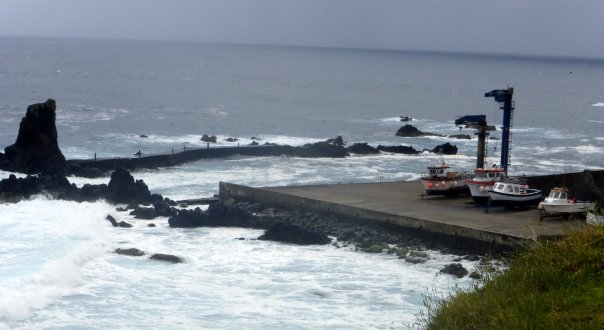
Then a bus ride to the capital, Santa Cruz, which has a modern and fascinating whale museum (making use of the defunct whale factory) – and not a lot else (you mustn’t get too excited by the term ‘capital’). It’s not a good port for yachts and we’re told not to go there (see photo below).
The port at Santa Cruz, Flores (fishing boats are lifted out)
Whaling boat in museum (tubs have 700 metres of rope for harpooned whale)
Alas! Even Flores’s little marina suffers from wave surge with NNEasterly swell and Henrietta’s strain and discomfort shortened my visit; four of us yachts leaving earlier than hoped for for the sail 130 miles east to Horta. (The islands are well spaced.)
Horta, on the island of Faial, is one of the world’s busiest yacht transit centres. Apparently around 1,300 boats call in each year. I reckon a large part of the 1,300 were there at the same time as me. The place seems to have become the key Atlantic sailors’ cross-roads with all manner of yacht from almost everywhere. Constant movements, bustle and excited shouts as friends recognise one another. There were no free berths for Henrietta and the anchorage was crowded, so after a troubled spell rafted alongside others next to a quay, I didn’t stay long. But it was a shame to move on so soon as Horta, the town, was beautiful: lots of charm and colour, good shops, marvellous cafes and bars and more. And I met up with several others whom I’d met earlier in the year.
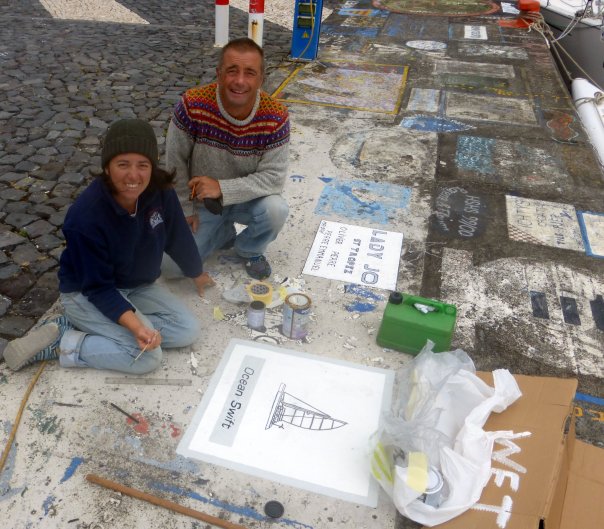
Emma, with John, finishes her artwork for Ocean Swift joining the thousands of murals already there….
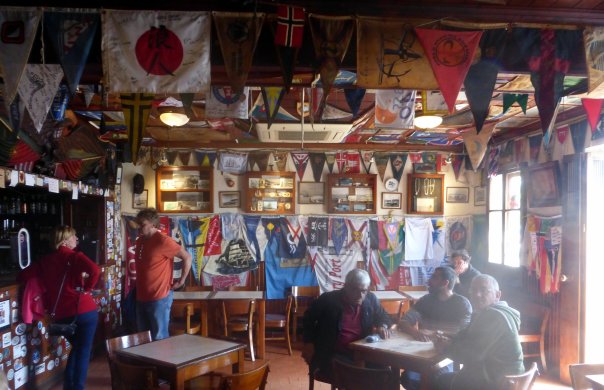
Popular sailors’ Sport Bar, festooned with global burgees and more…
The day I left Horta was very windy and very wet, but much more comfortable for me on Henrietta than running the Azores Trail Run, one of those super-arduous mountain marathons from a cloud-swept caldeira, which was taking place on Faial that same day. (I later met a sinewy Swedish/German couple who’d taken part.)
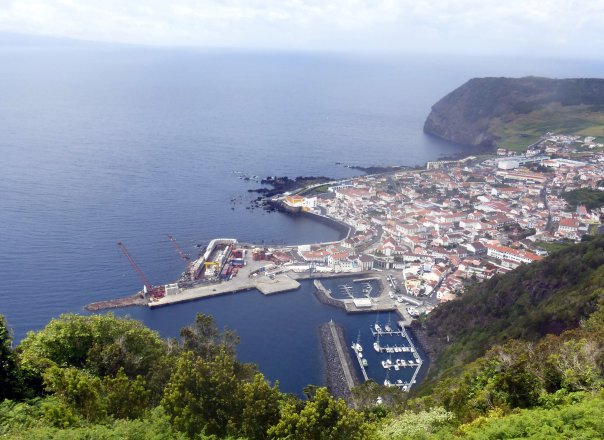
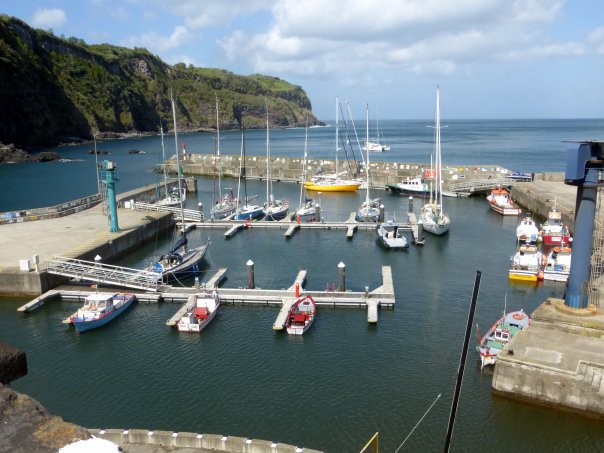
Next stop after Horta was Vila das Velas on Sao Jorge (Sao has an accent I can’t do on laptop) where Jose manages a little marina. Jose, like all the staff I meet, is helpful, charming and knowledgeable – even coming out in cold torrential horizontal rain as I arrived, to help me tie up. Spent several days here as it’s friendly, has good walks etc. Hired a car to see more of the place than buses allow.
Velas, Sao Jorge (my version of pilot book cover photo) – Henrietta upper pontoon on right
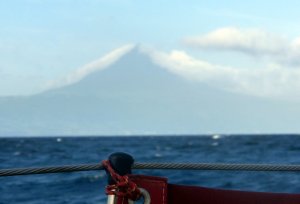
I left the island of Sao Jorge after a week and sailed next to Terceira, the third biggest Azorean island, just glimpsing the Azores’s highest mountain (and Portugal’s too), Pico, as I headed for Angra do Heroismo (its inhabitants had bravely resisted the Spanish invaders a few hundred years ago and were later given the title ‘Heroes’ – indeed the island was the only bit of Portugal that was not conquered) .
Pico
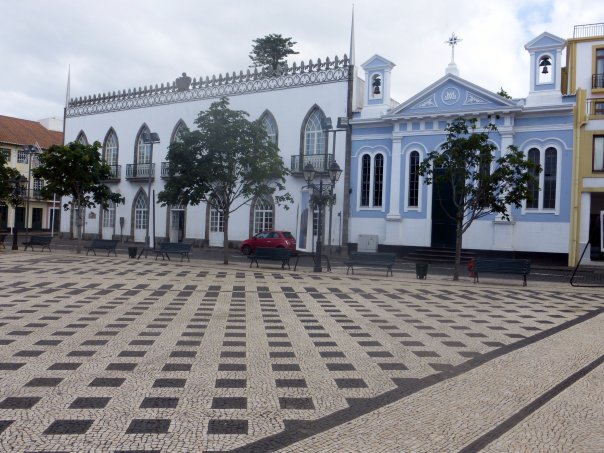
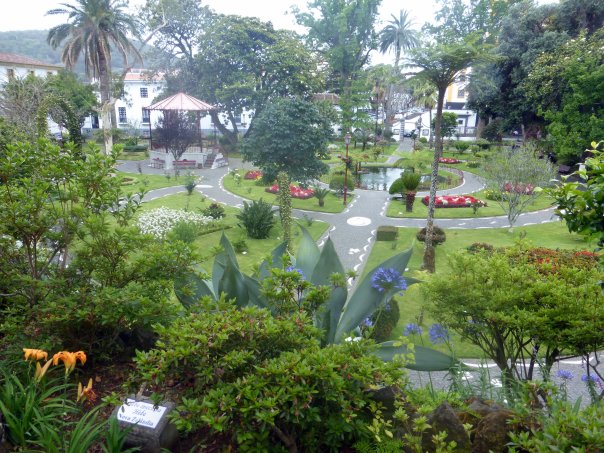
Most of the town (city really) of Angra is now well-deserved UNESCO heritage stuff —-full of really fabulous buildings, decorous stone cobbled streets and exquisite public gardens….one of the most marvellous places I’ve ever seen…and I don’t use the word ‘fabulous’ lightly….though I acknowledge perhaps its beauty is magnified by way of contrast with the architectural deserts of Eastern Caribbean.
Central square in Angra do Heroismo……and public gardens
Two particular things hereabouts remind me of my age. One is whaling; amazing to think it was big business in many places, including Azores, till 1980s, when nowadays it seems so barbaric and so unthinkable to kill magnificent whales (unless you’re primitive or Japanese, I suppose). The other is being reminded of the recent colonial wars that Portugal fought in 1960/70s; with many little Azorean settlements having a memorial for the young who died fighting in Angola, Mozambique or Timor (and I can remember hitching a lift myself with a lorry full of Portuguese troups in Mozambique as recently as 1974 – maybe it’s not recent anymore!) Had we been Portuguese, we’d probably have been conscripted.
……at this point I realise I’m just wittering on…not of much interest to anyone except me…(The photos scattered in this post try to show more)
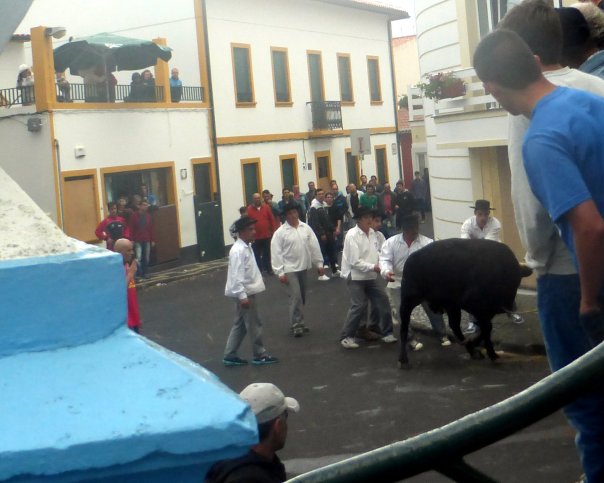
Without the detail, next stop, all being well, will be Scilly Isles or Cornwall (1,200 miles). Just waiting now for a patch of better weather….Meanwhile it’s been good to have the company of Alex and John on a handsome yacht, Free Spirit, and others heading for Europe too. They told me of this tourada (a sort of sociable bullfight in the streets of Angra), picture below.
Tourada – a frequent summer happening in the towns of Terceira
But before I go, I’ll just say that the sharp contrast of Europe’s western islands with the islands further south and west across the Atlantic (Bermuda, Caribbean) makes me truly grateful for my good fortune in belonging on the European side. And whilst the British Isles are my home, and I like them well enough, I know they are merely a part of many European islands, each with their own distinctive histories, cultures, interests, problems and delights, but each insignificant in the wider world. I’ll aim to be back in Britain in time to vote. (It would make me very cross and sad were the ‘other side’ to win, had I not had my one teeny weeny say in trying to stop it.)
And on a less important note, I’ve now owned Henrietta for exactly one year. Nearly 11,000 miles sailed since then, and I cannot think how many different anchorages and islands and countries. Perhaps I’ll add them up one day.
One of the Bermuda radio stations asked the question, “Is Bermuda still boring?”. It seems there had been some concern that people might think so. Personally, I think the answer’s ‘no’. When I was a tiresome child, my mother would often say that it’s only the boring who are ever bored. While usually true, in Bermuda I found the trick was to think of yourself as inhabiting a kind of pastel Legoland.
The best thing about the place was certainly the friendly helpfulness of local people. Almost everyone went way beyond normal courtesy in wanting to help. The rest of Bermuda was pleasant enough. As I said, I just felt I was in a sort of pale imitation of Legoland: neat tidy buildings were pink, powder blue and cream (rather than bright Lego red, blue and yellow), and people smiled and were black, white and brown; there were clear labels like ‘Bank’ and ‘Bar’ on symmetrical buildings. There were yellow sandy beaches and very little litter, and even the uniform palm trees, fronds blowing in harmony, might have come from a Danish drawing board. Of course I shouldn’t judge. I was there for less than five days. It rained hard for two of them.
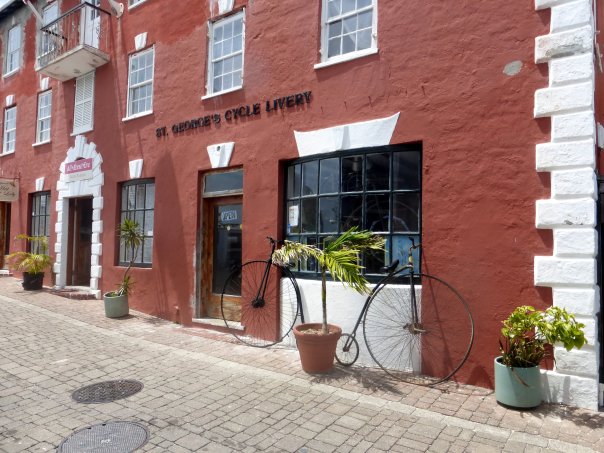
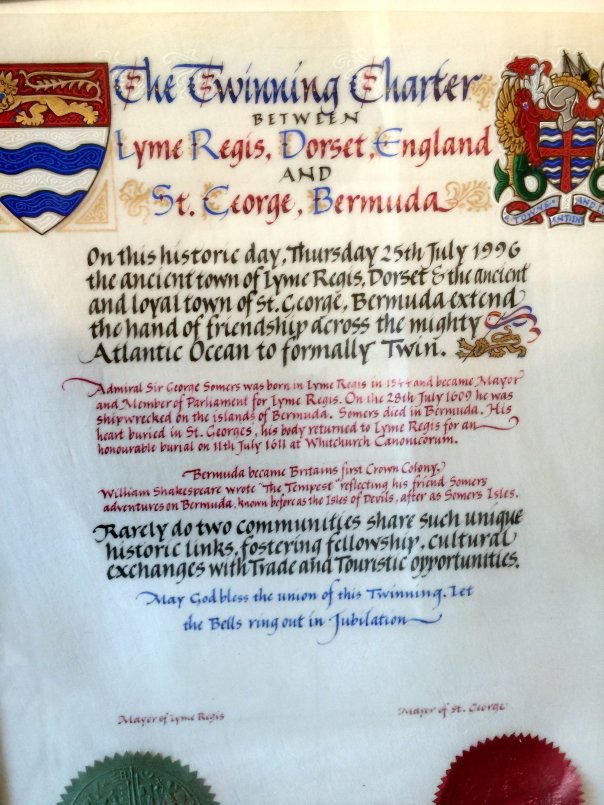
I was anchored up a creek in St George’s Harbour, a big natural harbour with the World Heritage St George on one side. It’s the second town and when the sun shone and cruise ships were in, it was busy with tourists crawling past neatly painted old buildings and perusing high quality nick-nack shops. When it rained it was empty and I went for a super soggy walk around the top end of Bermuda, buffeted by gale and horizontal rain, all a bit reminiscent of some childhood summer holidays in Lyme Regis – which coincidentally is twinned with St George’s.
The capital of Bermuda is Hamilton. It oozes wealth and complacency and alcohol. I visited by bus a couple of times hoping to find something out of the ordinary. But there isn’t much that I found: big smart shops with enough posh wristwatches to garland everyone a few times over, big square colonial buildings, lots of bars with pretty much wall-to-wall ‘happy hours’ and herds of motor scooters. This place makes its money with insurance and reinsurance, and other mysterious forms of money-making paper-pushing, so what was I expecting? I cut short my second visit to Hamilton as the rain was unremitting and two shops in a row had said goodbye with the cheery bastard English phrase, “Have a good one”. (Am I the only one who feels grumpy when this is said too often?)
Then later, as I rowed out to my anchorage a big man on the jetty near his big house shouted in tax-exile American that I was anchored among moorings with big chains that I’d probably snarled. “You won’t be able to get your anchor up; you’ll have to cut the chain, lose the anchor. No way will you be able to get free…..blah blah”. I said I hadn’t wanted to pick up a private mooring in case an owner came along (most were not being used), and he said something along the lines of “Quite right, they’re private”. To save you any more of this, I’ll just say that there are a lot of these dog-in-the-manger moorings in the area, unused but effectively making it difficult to anchor. My anchor was fine by the way.
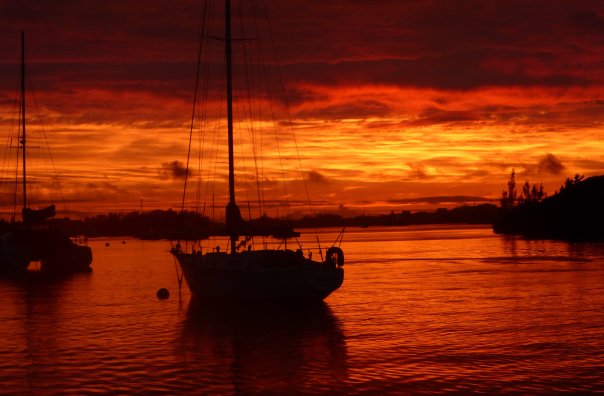
Final evening in Bermuda
To end on a brighter note, I’ll restate that with the one exception of ‘big man with big house’, people were delightful. I was given lifts without asking; people took me to show me round; bus drivers smiled and helped; shopkeepers were out-of-the-way friendly. But I left. Yachtie rush-hour for Bermuda was starting nd whereas there were ten yachts as I arrived, there must have been over thirty by the time I left.
Oh! I should also tell you too that I met a lovely young couple on a huge catamaran, Ocean Swift, which he, not as young as she, had built. They came aboard Henrietta for a meal and told me of working in Antarctica, where he’d built those amazing hut things that rise on their legs as the snow builds up, and in Falkland Islands and places where you and I shan’t ever go. They’d cruised at high speed all over Scotland and Ireland too, so we shared memories and opinions of the wondrous British Isles. Anyway, their catamaran was 44 ft of streamlined fibreglass (he’d even made the moulds for the hulls) and it cruised at about 15-20 knots. Another of the extraordinarily talented people you come across who you sense could fix anything anywhere with whatever was to hand. I said as we parted that our paths might not cross again for a while. They go too fast.
Leaving Bermuda behind…
…and heading East
Sailing out of Bermuda is not like sailing out of most places. You cannot quickly leave their border surveillance system. They have the most amazingly powerful VHF transmitter, radar and AIS detection network I have ever come across, and it’s not until you’ve sailed over 200 miles that you cease hearing their broadcasts and inquisition of approaching boats. (But even with all their powerful equipment and 24 hour staffing, many boats seem to sail in and out not answering radio calls . It does I suppose show how very difficult it is to control your maritime borders – whatever the wishful thinking of Brexit xenophobes.)
And then I sailed east across the Atlantic. It’s about 1,800 miles to the Azores, and not as straightforward as westward sailing in the Trade Winds further south that had taken us the other way to the Caribbean. This time I aimed for an undulating path eastwards, between eastbound gales to the north and calms to the south, which is pretty much what sailors have always done.
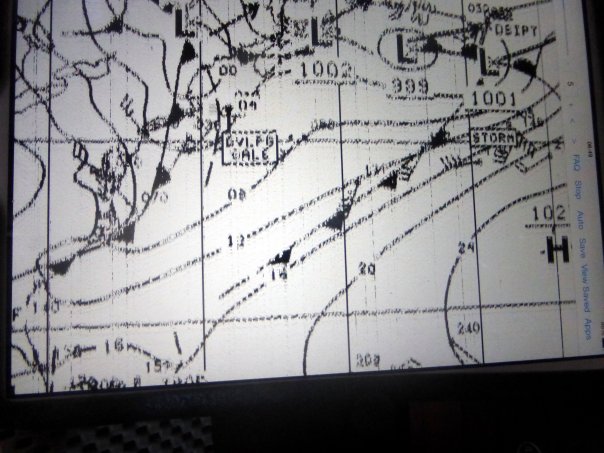
Nowadays I have a radio and try to download and interpret weather faxes. In the old days, sailor folk looked at clouds. So I did that too, and coupled with a brilliant book on weather forecasting, reckon I can see what’s coming – in the next few hours anyway. In summary, there’s been a bit of everything in the spectrum of ocean sailing: some sail-flapping calm, wallowing without steerage, fine spirit-lifting reaches, spray sparkling beats and several hard rough days.
Downloaded weather map (trying not to be too close to that storm)
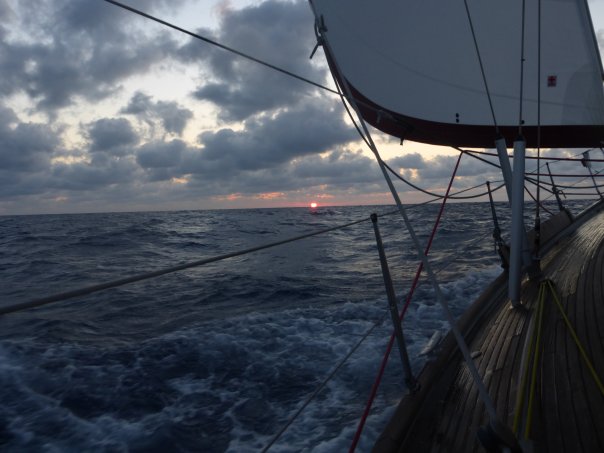
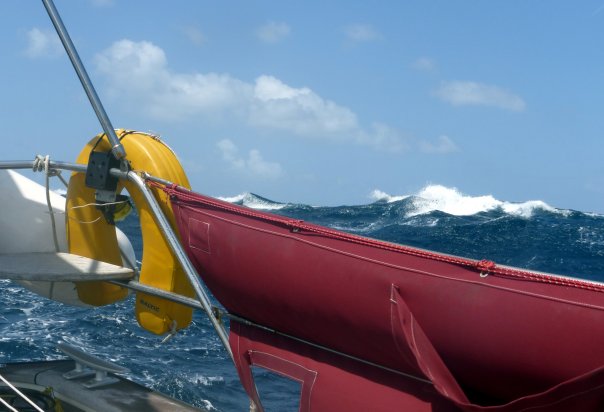
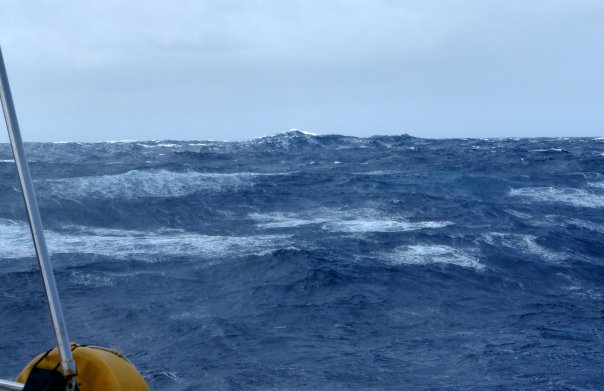
Images from the Atlantic
Rough days culminated in two days and nights when wind never dropped below Force 7 and was mainly F8/9. I knew I was too far north but I was nearly there and unprepared to sail the wrong way for 200 miles completely to avoid the storm. As you may know, one of the great delights of sailing is the contrast from a day of brisk wind and choppy sea to an evening in a calm sheltered pretty anchorage. Nowhere have I felt this contrast more acutely than on reaching, yesterday, the charming tiny friendly marina in Flores after two days and nights of very rough testing sailing.
After a few days of gales the North Atlantic grows very wild, and though my pictures cannot capture the sheer magnificent panorama of massive breaking ocean waves, I can say I was overawed. It’s best not to think about it too much – the ocean waves are too massively powerful and magnificent, and sometimes threatening – but I spent much of the time below in bed reading books, washboards in and everything tight closed, as waves crashed around and for a while we maintained over six knots with no sails up at all. Henrietta probably hasn’t enjoyed it any more than me, but she’s behaved beautifully. Apart from some frayed rope and torn dodger and a few bruises, nothing has failed.
Some rough weather….
Approaching Flores
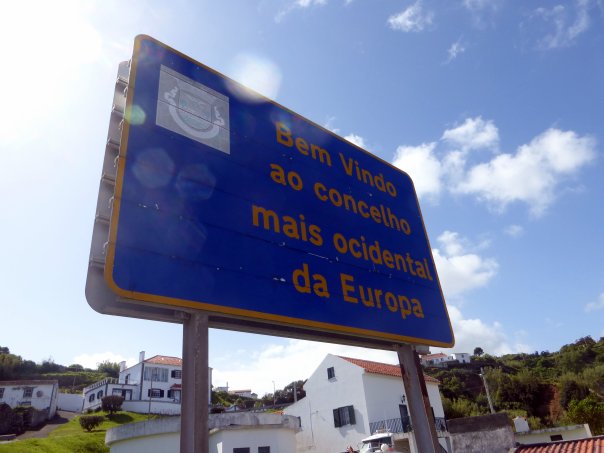
Anyhow, I’m now moored at Flores in the far west Azores, 15 days after leaving Bermuda. Goodness, I love Europe! This little bit of it, the furthest west of the Continent, is fresh tidy honest friendly. The tap water tastes nice, bread is not sweetened and red wine is less than two euros a bottle. The marina captain’s mother does my washing (for a fee) and there’s a shower (albeit cold water). After 12 hours sleep I’m fresh, have friendly French and Norwegian neighbours, and am off to explore.
Secure in Flores (upper pontoon, Henrietta 2nd from left)..at the western fringe of Europe…
Video doesn’t show the lightning as it was….but it shows it isn’t always sunny!
Henrietta can write this post. I’m tired.
H: Yes, M seems a bit listless and subdued, generally rather frazzled I think. He groans and grunts sometimes too, which I consider a clear and pathetic sign of old age and minor injury. Can’t really see why he makes such a fuss though. He’s lucky to be sailing with me, and the sun has been shining most of the time and he’s been sitting and lying about a lot reading and eating. If he wasn’t pottering about with me, enjoying the fresh air and magnificent ocean, he’d be fretting about the British weather and dirt-dwelling anxieties like the EU referendum or rubbish on telly. Better for him to be at sea, I reckon.
Anyway, once again I’ve done the really hard work of sailing us north – 850 miles north from the British Virgin Isles.
For some reason, M thought Bermuda was close to the Caribbean, just up the road as it were, a kind of geological afterthought to the Caribbean. So it was quite a surprise to see they’re so far apart, not apparently linked geologically in any way; indeed with some ocean chasms over 7,000 metres deep in between. To put it another way, Bermuda from Virgin Islands is half way to Canada, or in a European context, the equivalent of crossing the Bay of Biscay from Land’s End twice. (Enough geography for one day, but it goes to show how unrealistic we are about distances once we are away from our home patch. Here’s a quiz question for British pubs: To the nearest 50 miles, how many miles is it from Barbuda – near Antigua – to Bermuda?)
The start of our trip was fine until the first evening, then fine again till the third evening. On the first and third evenings there were some very alarming thunderstorms. I know M was really scared. If I had human feelings I’d have been scared too. The thing was, these storms were huge and covered the whole horizon with near constant lightning flashes and continuous rumbling and roaring and growling. M suffered a sort of sensory overload: the sight of wild lightning over white-crested waves, endless electric flashing in blue white slashing sizzlers down to the sea and brightening the dark clouds overhead; the sounds of fast sailing splashing coupled with roaring and cracking; and the feel of massed raindrops and hot electrified air on naked skin – all this magnified ten times with the arrival of darkness. M was below trying to distract his fears by washing up dishes when a harsh and deafening crack and flash blinded the sky, an explosion right with us. I cannot believe I was hit and know I wasn’t but, whatever, the windvane electrics have stopped working. (M guesses a cut-out in the transducer has been triggered by proximity of shock. M himself was just a bit shakey. Were he not teetotal at sea, he’d have had a stiff drink to calm his nerves.Instead, he put more clothes on; I think he thinks if you’re going to be struck by lightning, it would be more dignified to be properly dressed. Human beings!)
However rare the occurrence of direct lightning strikes, it does not lessen the sense of powerlessness and, whereas sailors can plan and work to lessen the dangers of storms and ships and fog and rocks, there is almost nothing a boat can do to escape the risk of lightning. Us boats, we just cross our fingers – or we would if we could.
After the thunderstorms there was very little wind and what there was was from ahead; and we wallowed around a lot with sails flipping and flopping; very frustrating times. M has a bit of an aversion to the engine; me too – bad vibes; and also there wasn’t enough diesel for more than two days of engine. So wallowing around it was. We looked at clouds, downloaded some weather charts, tacked this way and that, wallowed a bit more. And I know that for a while M thought of abandoning Bermuda and going straight to the Azores nearly 2,000 miles away (but he didn’t fancy up to three weeks with half a cabbage and one carrot to eat, then tinned stuff and lentils.)
Entering St George’s Harbour, Bermuda….customs cleared…
After eight days we got to Bermuda.
Back to M……
Thought Waitrose stopped 100 miles from Bracknell?
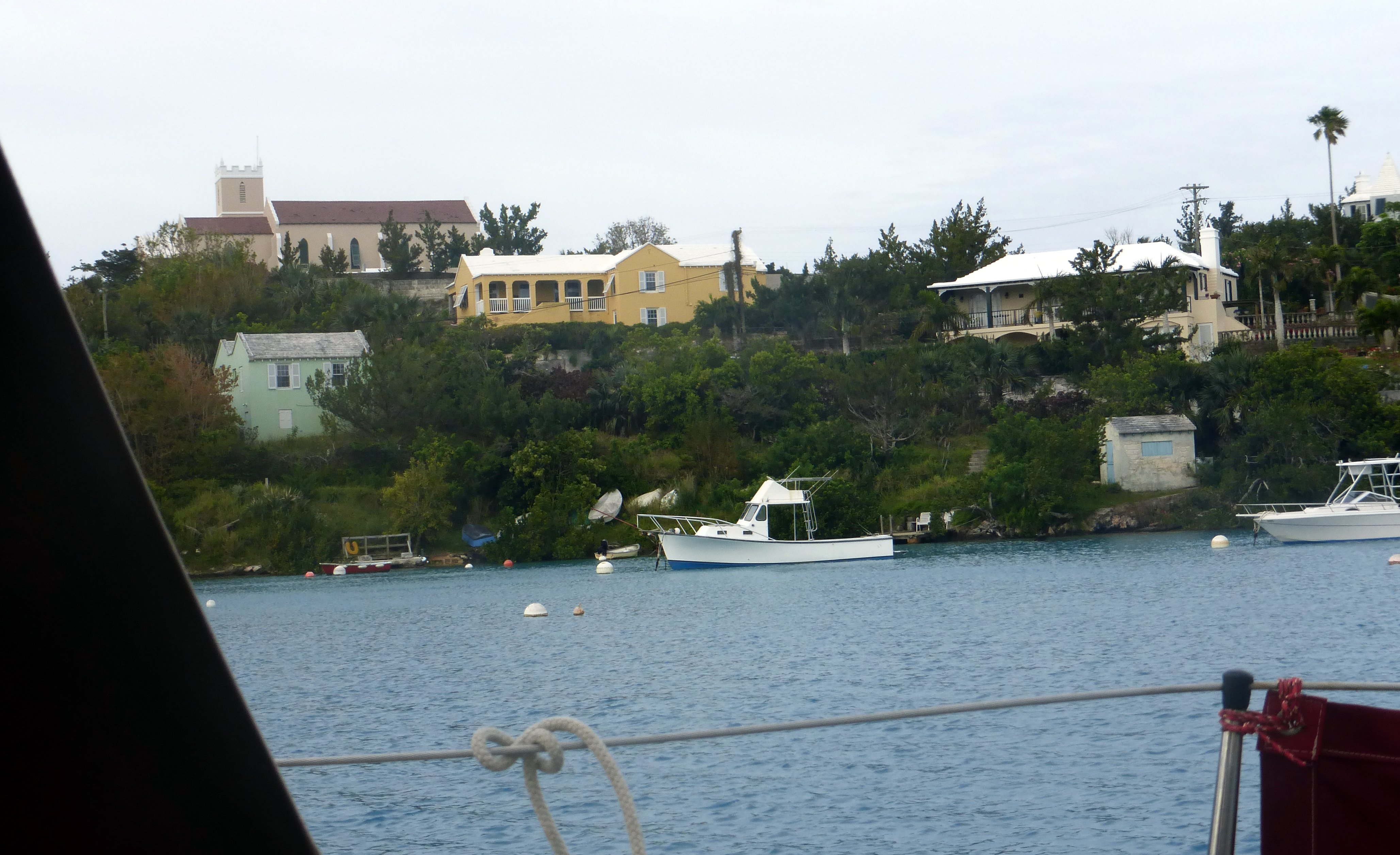
Bermuda seems wealthy. The little town of St George’s, where we cleared in, is immaculate with smart pale-painted colonial style buildings, and bevvies of cruise ship wrinklies wandering hither and thither, and a smattering of ocean sailors (though probably less than ten, as I’m here before most). It’s another UNESCO World Heritage Site and, more useful for me, the local supermarket has Waitrose tea bags.
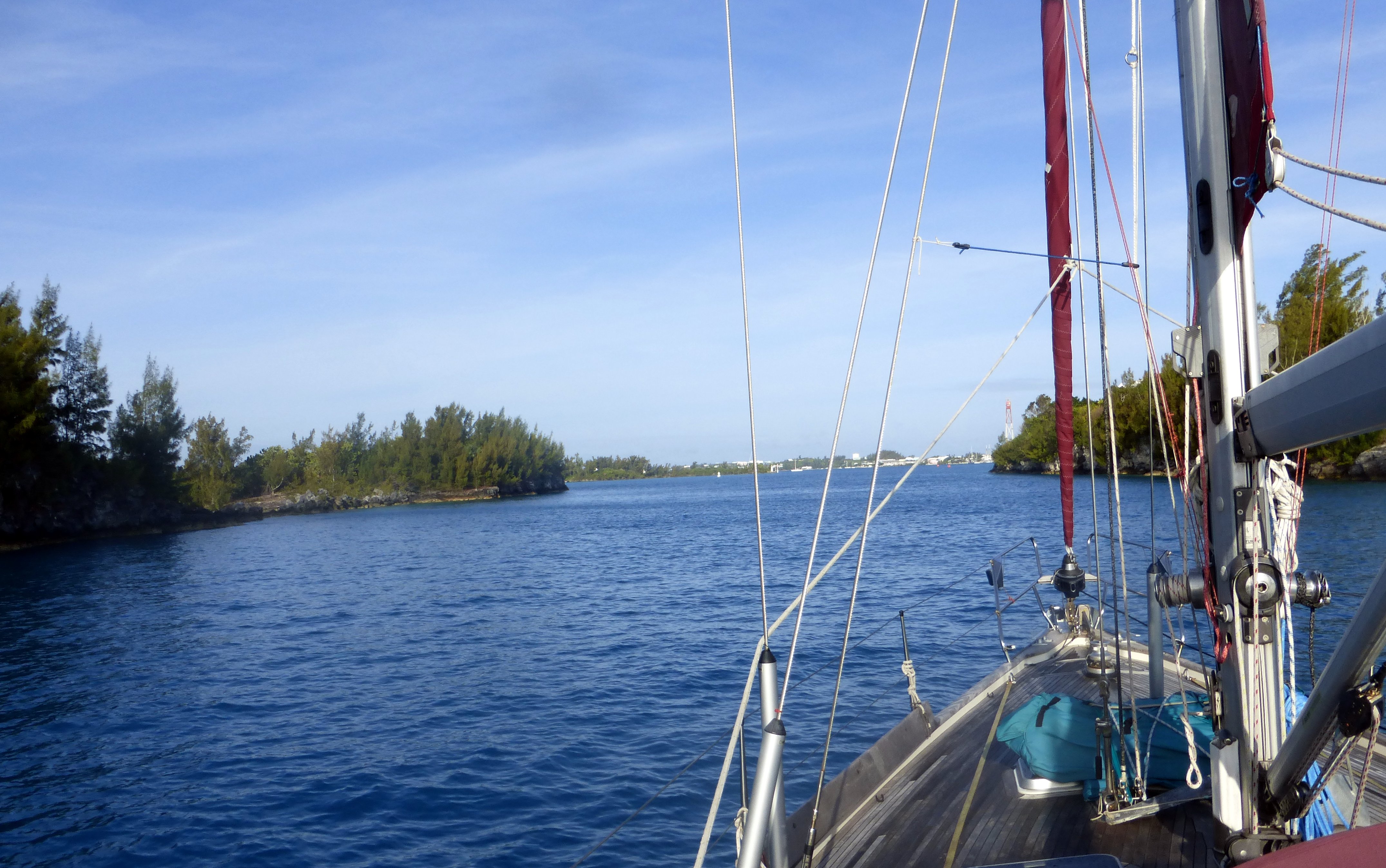
If you happen to sail this way, I should tell you that Bermuda monitors its coasts with big-brotherly diligence. I was called on VHF when at least 20 miles away (told I was being tracked on radar and AIS). I gave them lots of details – even the number of EPIRB (something that took a lot of hunting down as it’s a 16 digit hexadecimal that I don’t carry in my head). Planning to arrive at first light I was asked to delay to let cruise ship through. Anyhow I’ve been such a fine model of maritime good behaviour that the traffic control folk have been helping me ever since: telling me to turn round when they saw I was going the wrong way for customs dock, then suggesting this little narrow creek behind Smith’s Island for sheltered anchorage in the coming gales.
There are some very smart and discreet houses for neighbours, only the sounds of barking guard dogs, and drone of ride-on lawn mowers (and sometimes a jet doing things at the airport nearby). I think we’ll be here a few days as the forecast is not promising. Too early to have seen much of Bermuda, anyway. I’ll head off now to be a wrinkly tourist myself.
OOOHHH! Cockroach bulletin no.2 – None seen. Bait traps all over the place.
For now, I’ve anchored in this sheltered creek, St George’s Harbour
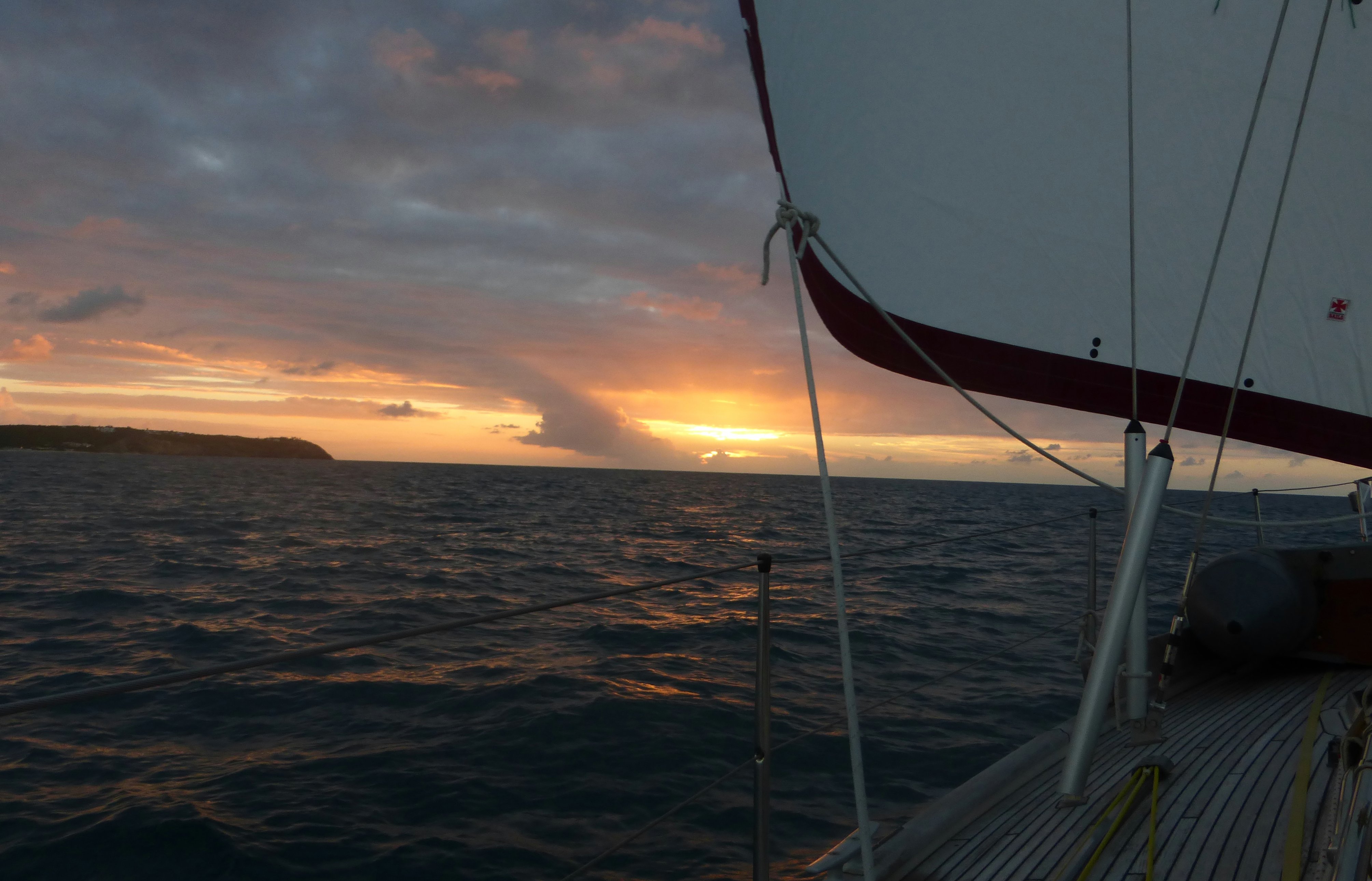
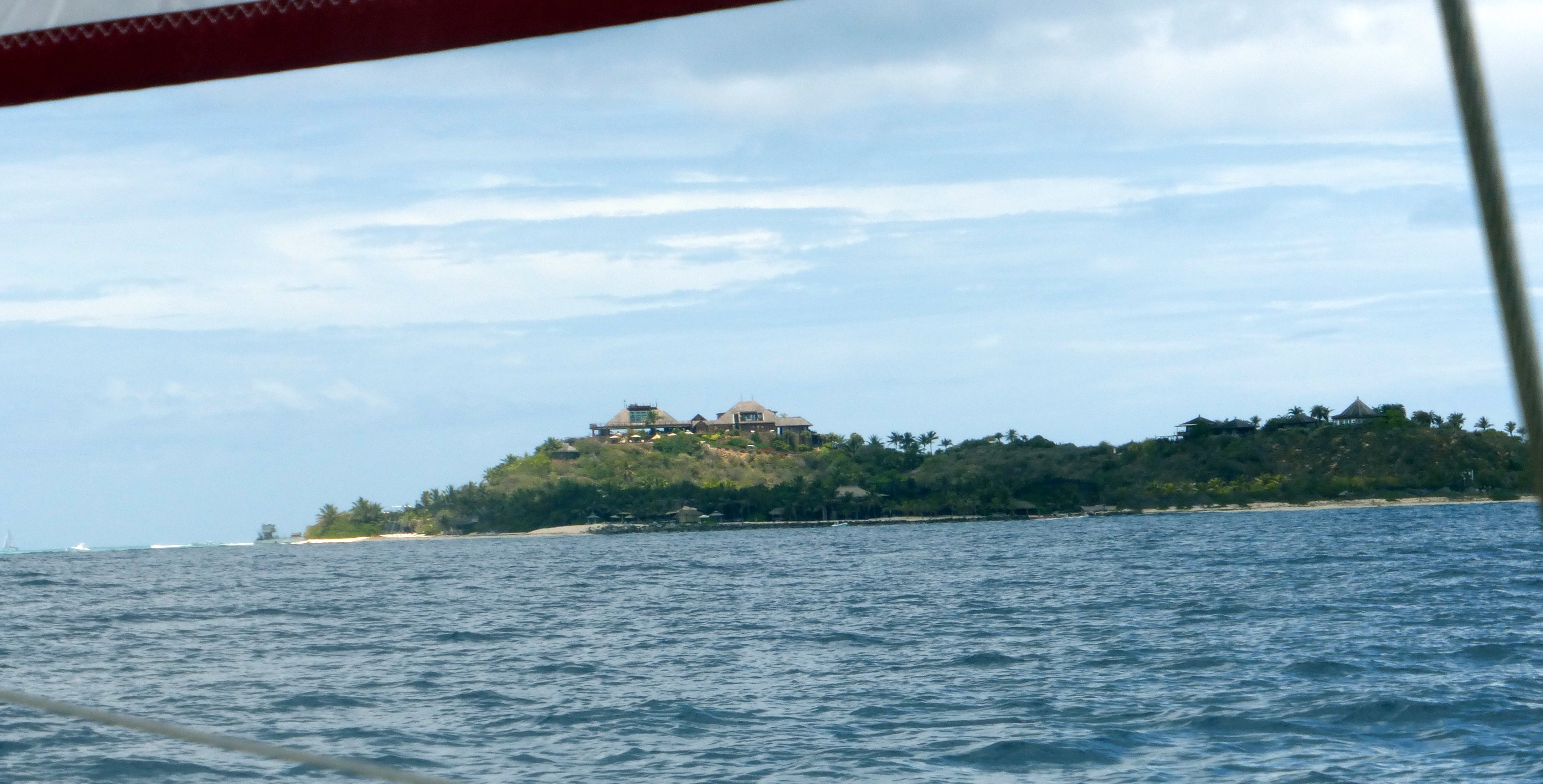
Sunset departure from St MartinArrival next morning, British Virgin Islands (This one is Sir Richard’s Necker Island and private)
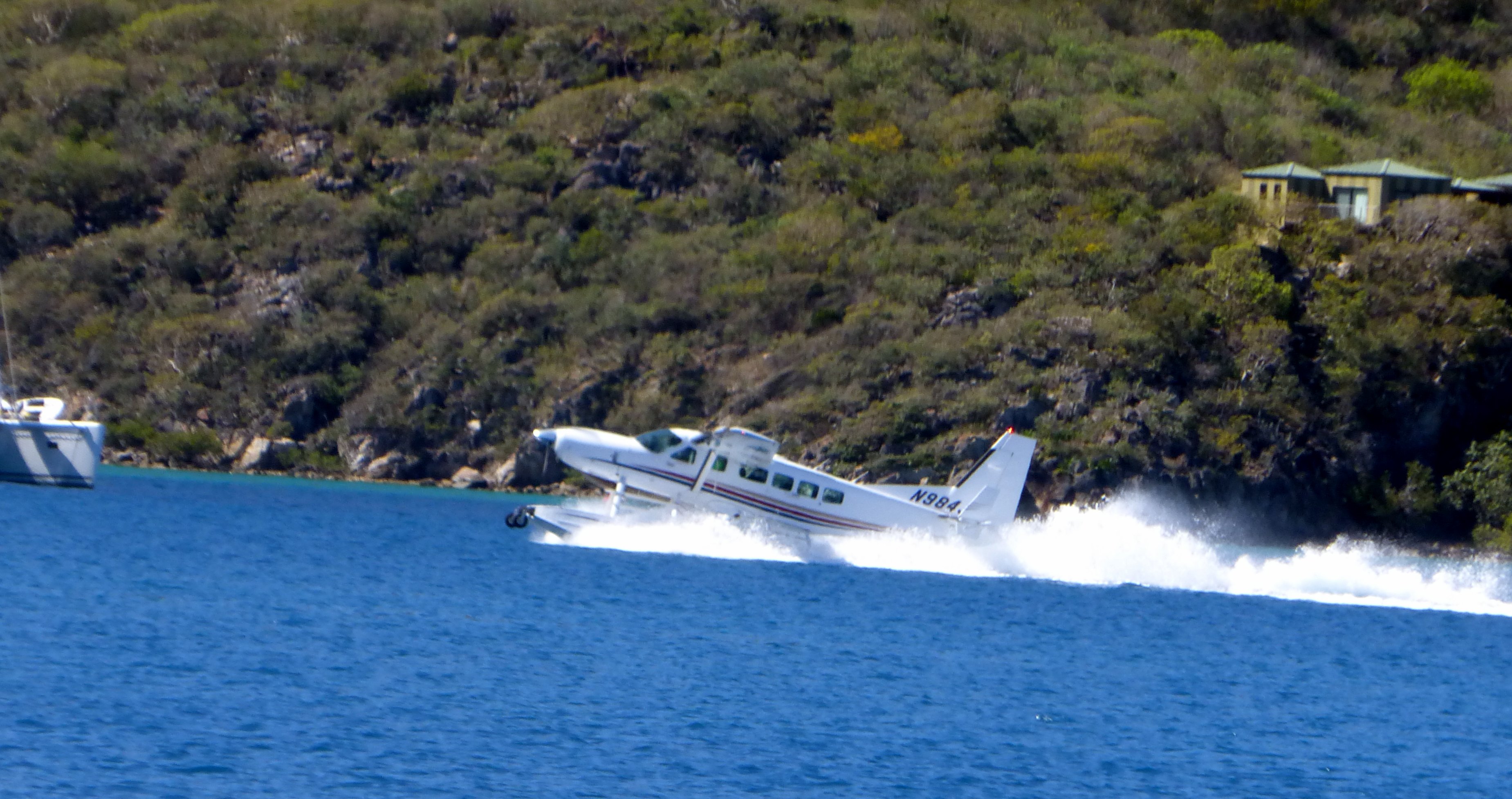
Lots of well-off people travel locally on seaplanes
Not sure if I told you already but I’m now a member of two different boat-related clubs. This is pretty extraordinary for someone who is very much non-clubby. (Clubs for the most part seem contrary to the spirit of independence and self-reliance that are surely among the attractions of sailing. Clubs too can become exclusive, cliquey and self-important, even sinister or threatening to outsiders. They should I suppose be approached with caution.)
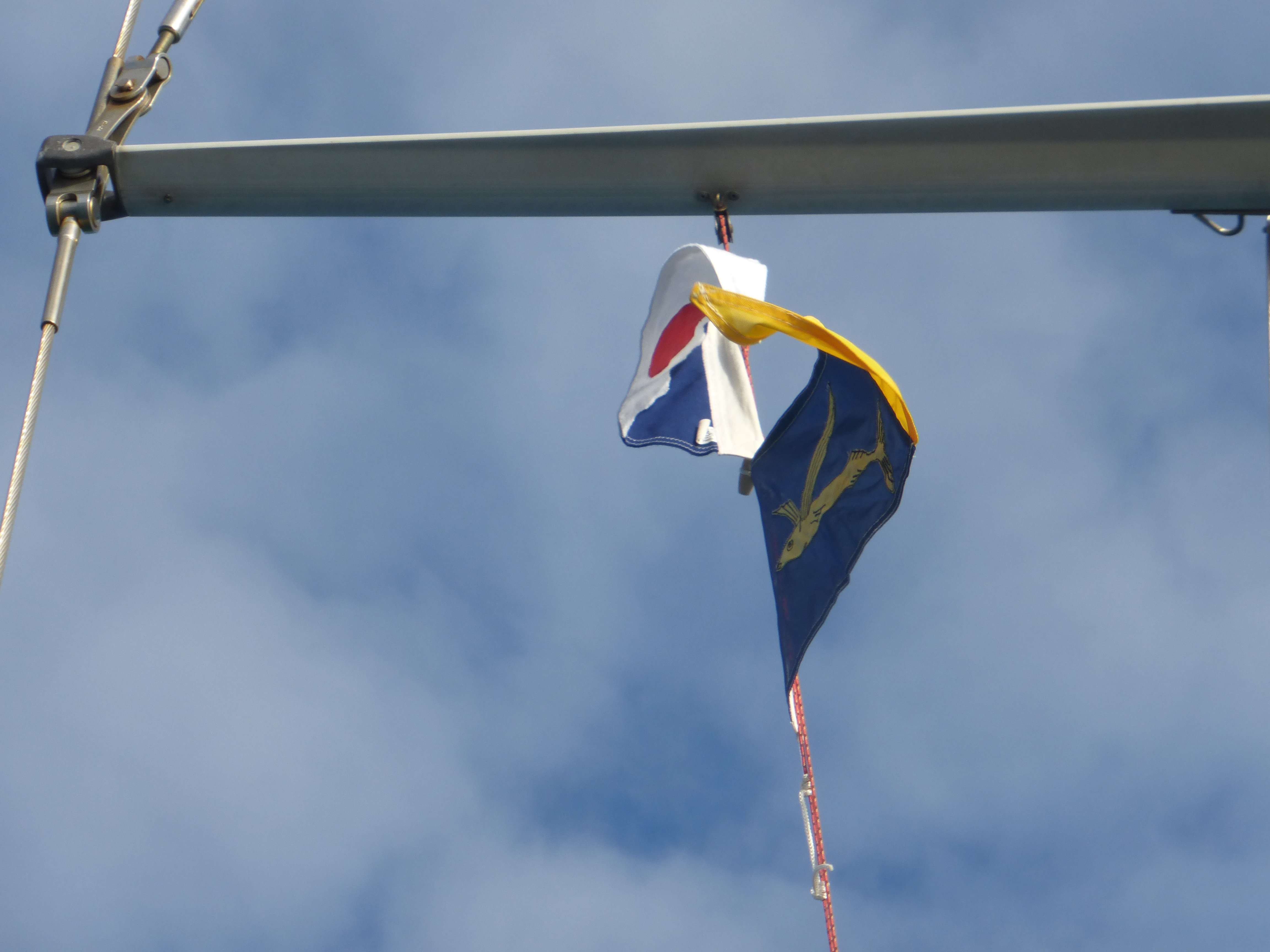
New club burgees
Whatever my opinion, I’m now a member of both the Cruising Association and the Ocean Cruising Club. Impulsive decisions perhaps, but I’ll give them a try. A good-natured fellow sailor (in fact more than one) persuaded me I was missing out by not joining; they’re a very good way of meeting fellow sailors and learning lots of useful stuff of course. And sure enough I have now met many experienced and knowledgeable sailor folk, and delightful people, through these groups. Furthermore I have two additional colourful burgees to flutter from aloft.
This is all by way of telling you that I’d been sailing northwards to attend a Cruising Association gathering in the British Virgin Islands (BVIs in local parlance). When, a month ago, I sent an email saying I’d like to be there, I had a reply to say I shouldn’t expect too much: last year only two boats turned up, and one of them was a day late. I thought this sounded like my sort of low profile club.
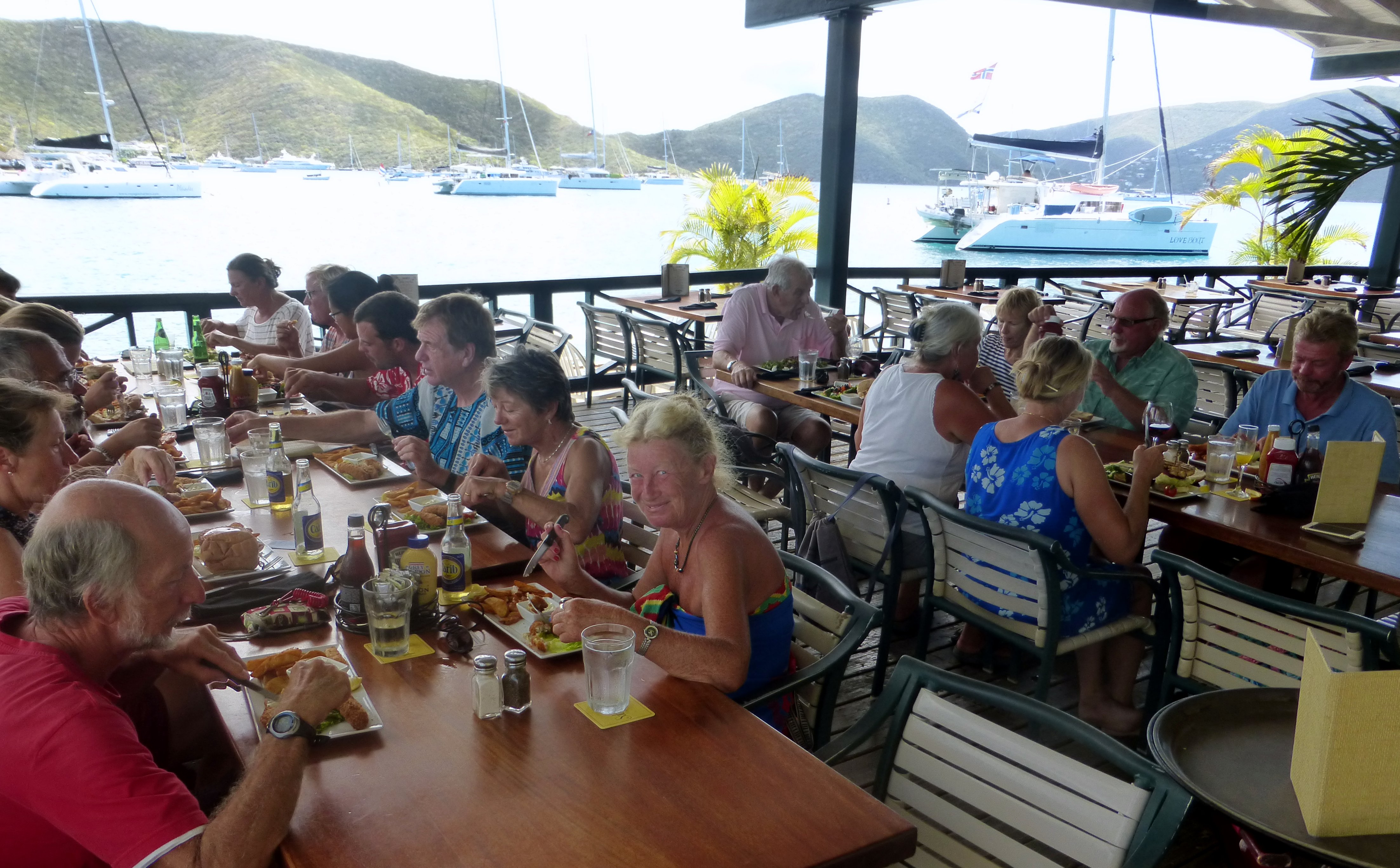
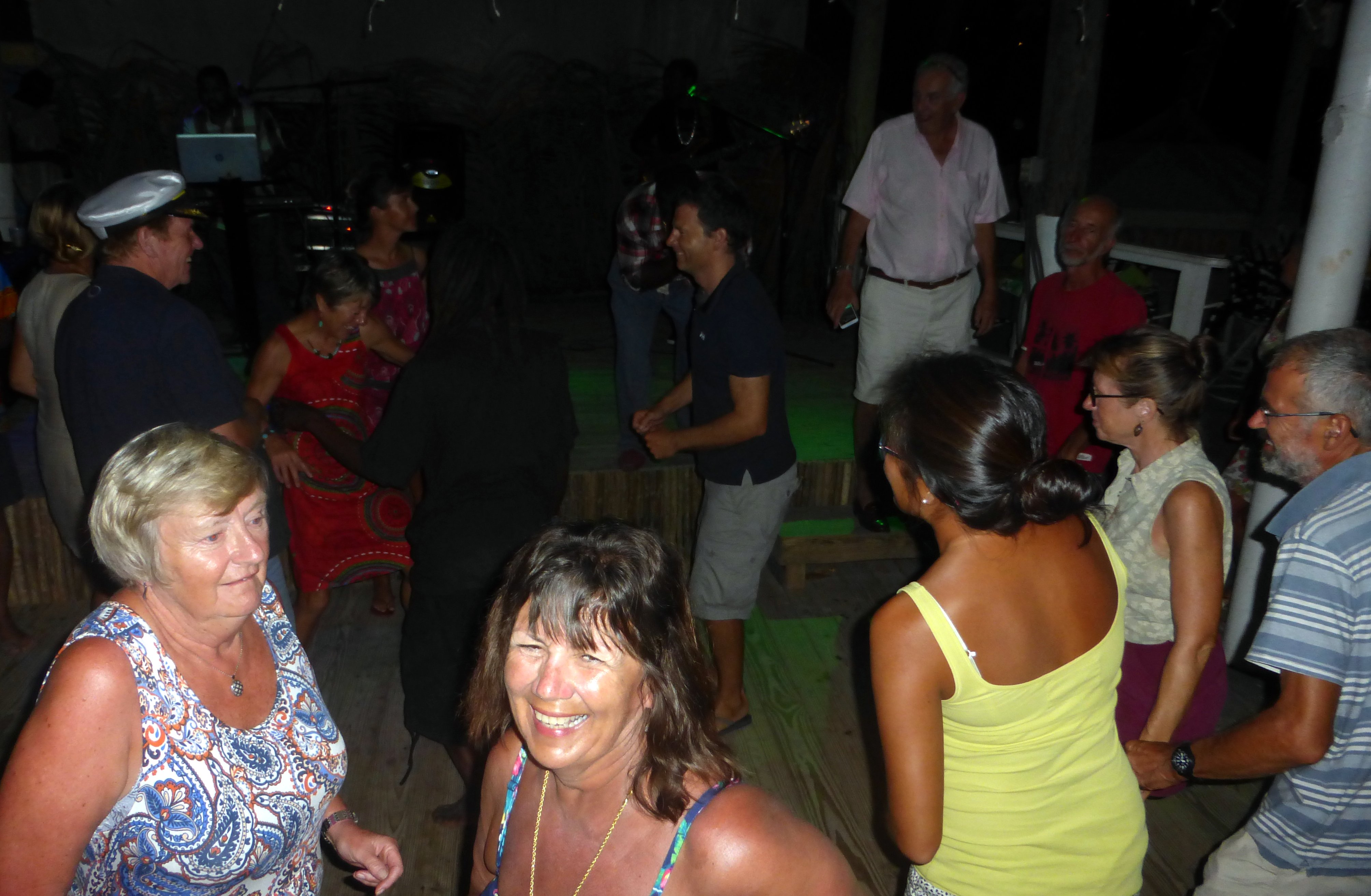
Two tables with Cruising Association lunch at Saba Rock, Virgin Gorda….dancing for some, Cane Garden Bay, Tortola….lunch venue
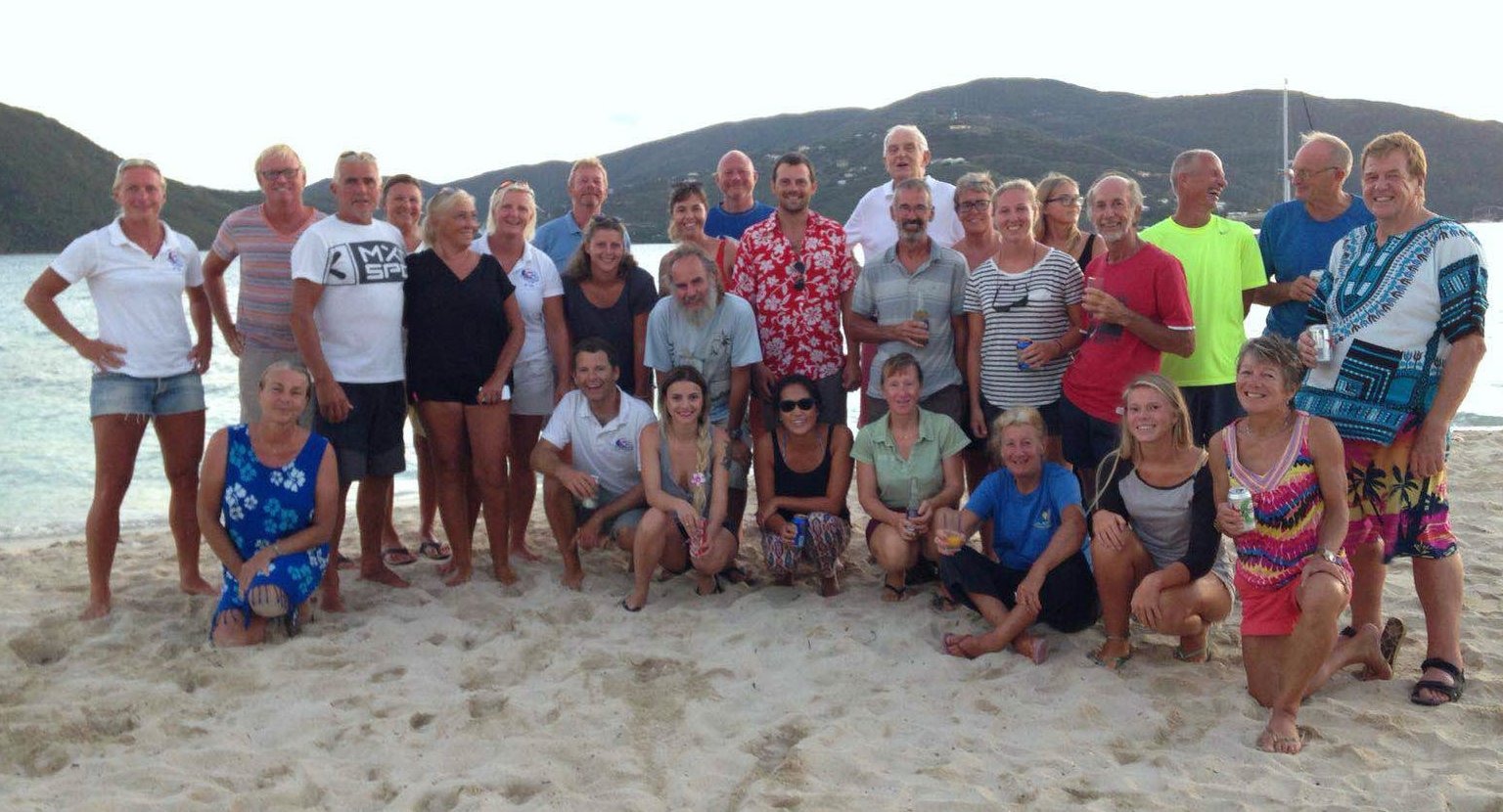
Anyway, after a long slow overnight sail from St Martin, I reached Virgin Gorda to find lots and lots of Cruising Association boats loosely gathered at the agreed anchorage. There followed an unprecedented few days of sociability. With at least six different nationalities, and I guess over 25 friendly sailors on about a dozen boats, with an age span of four or five decades, I’ve delighted in two delicious meals ashore, a party on the beach and final on-board gathering, at three different anchorages on three different islands, over about three or four days. We’ve now pretty much scattered to go our own ways; but for me, it’s always heartening to rediscover that I like people; I really do – I’m just a loner by circumstance not inclination, I suppose.
…gathering on the beach
I’ve now moved from BVI to USVI. The stars and stripes courtesy flag is a bit small but it’s up there, dangling limp from the starboard spreader. I am surrounded with Americans of all shapes and sizes, but almost universally warm, friendly and approachable. (Americans want to be liked. For the most part, they seem likeable.)
America in the Caribbean (St John, USVI)
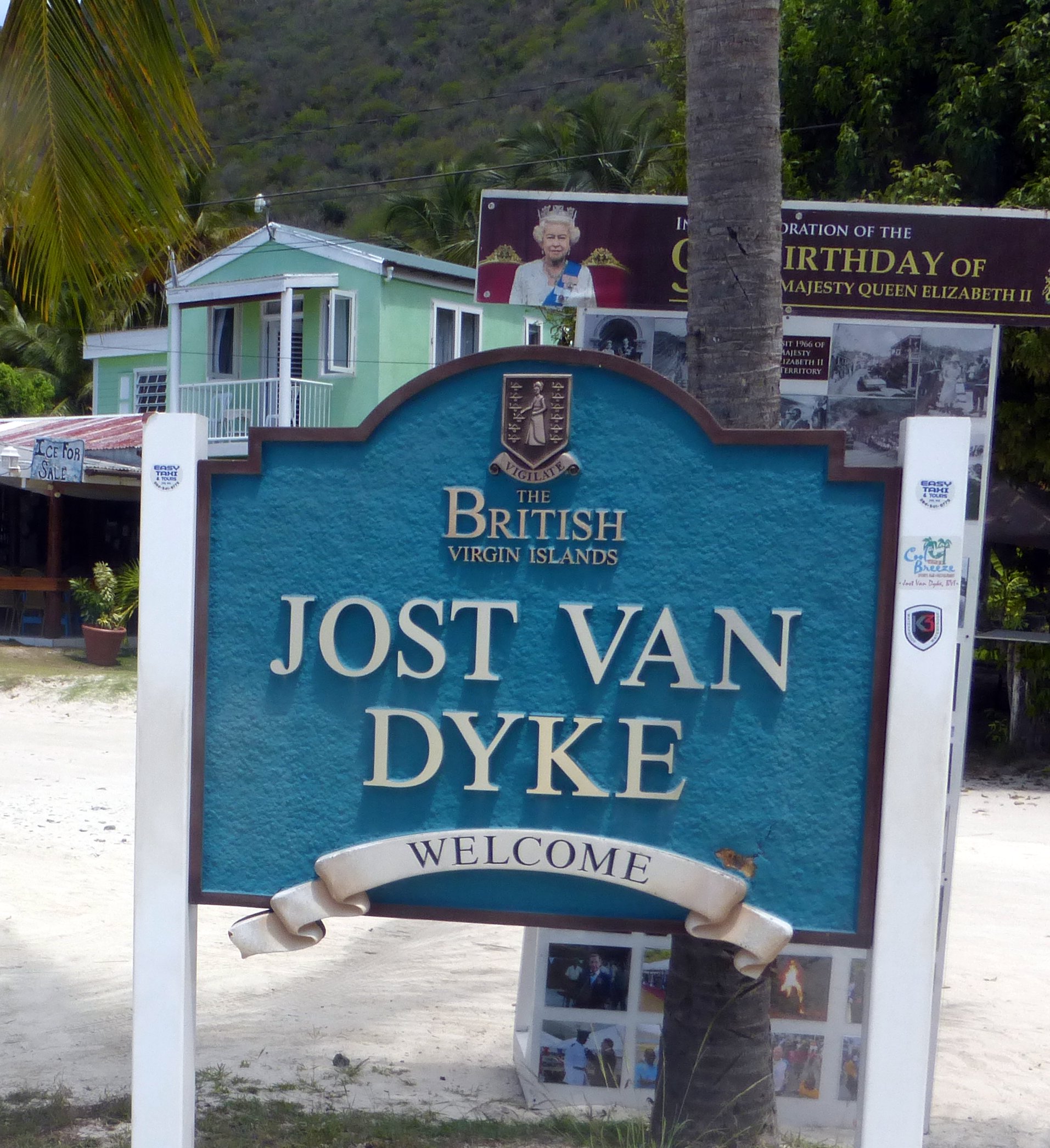
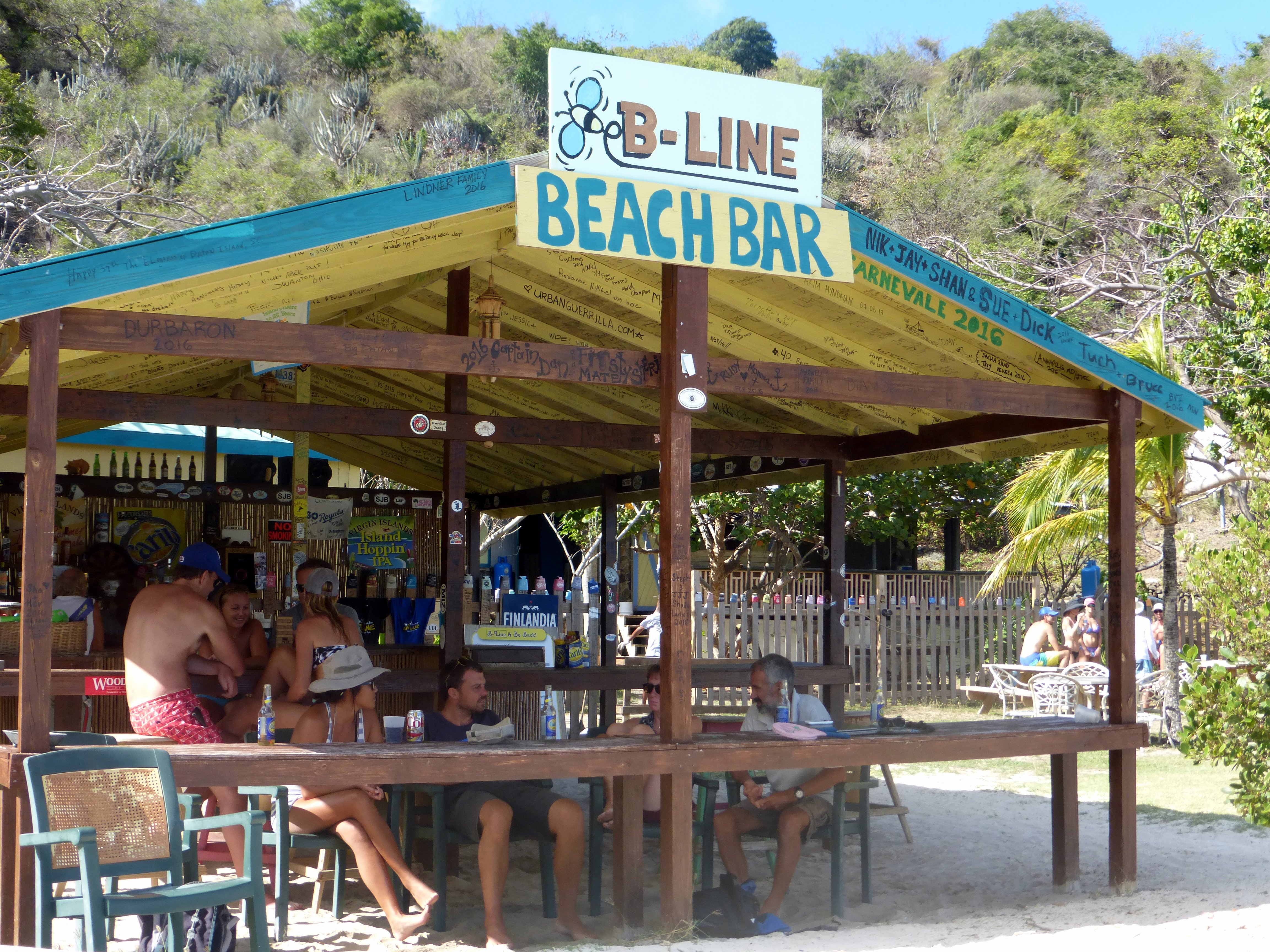
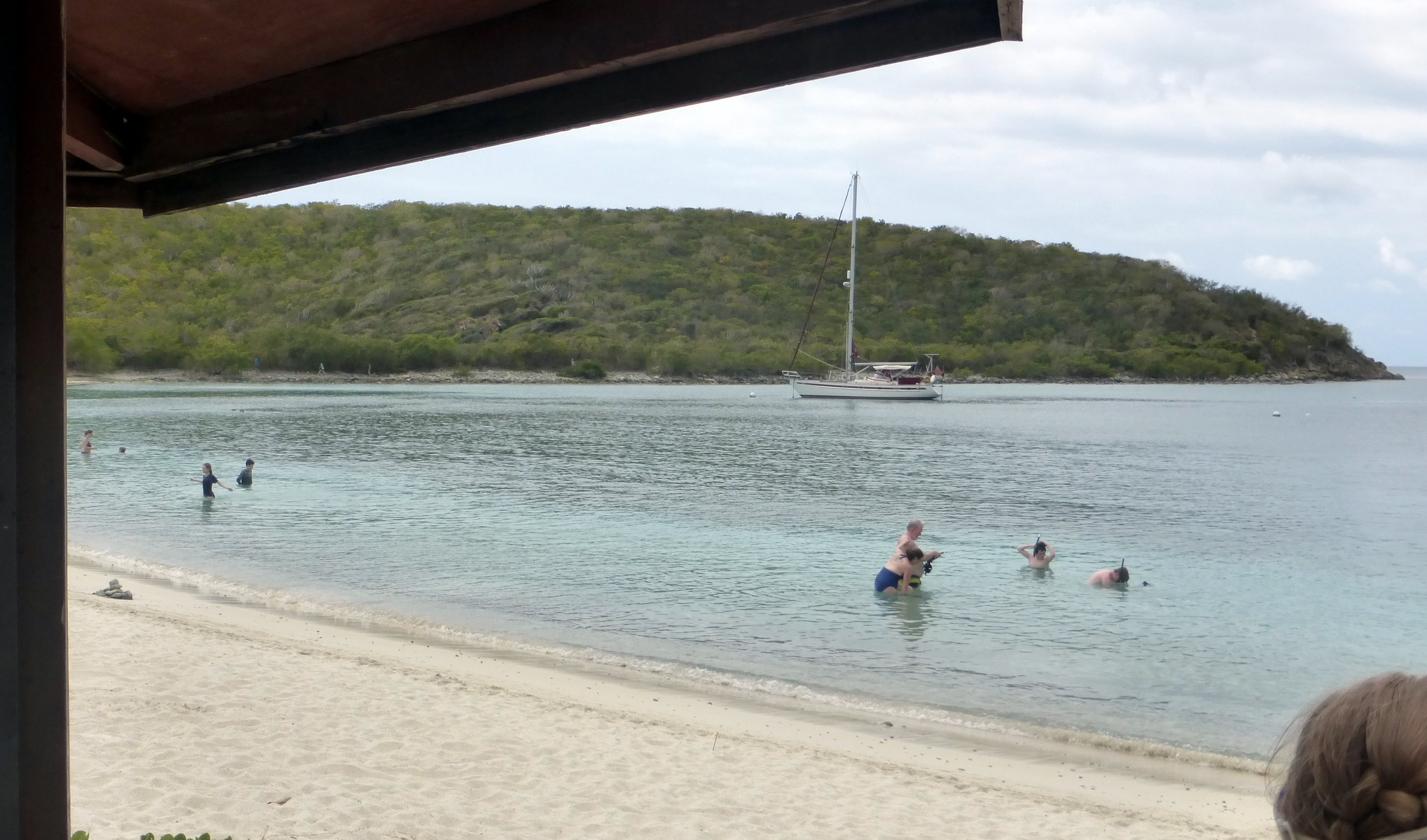
A little BVIA perfect little bar on Little Jost van Dyke, BVIA quiet anchorage in National Park, USVI
What to make of the Virgin Islands? Well, I suppose unless you have visited them, they all look more-or-less the same. Like a herd of dairy cows, from a distance they appear roughly similar. But again like dairy cows, once you get close and look carefully and wander round them, they are very different from one another, each with its own identity and colour and idiosyncrasies.
So far, it’s St Croix in the USVI that seems the most idiosyncratic so I’ll tell you a bit about it. St Croix used to be Danish until the Americans bought it. It’s 40 miles south of the other Virgins and my pilot book says it’s the biggest Virgin, twice the size of ones you may have heard of like Tortola and St Thomas, which makes it nearly as big as the Isle of Wight. And it is surrounded by the largest island barrier reef system in the Caribbean, and thus has fantastic diving and snorkelling – and some challenging navigation. (Incidentally, they pronounce it St Croy (with American accent) not St Kwa (with French accent). “Christiansted”, the capital, is apparently “considered by many the most beautiful town in the Caribbean”; though that seems crazy to me. It’s not that amazing.
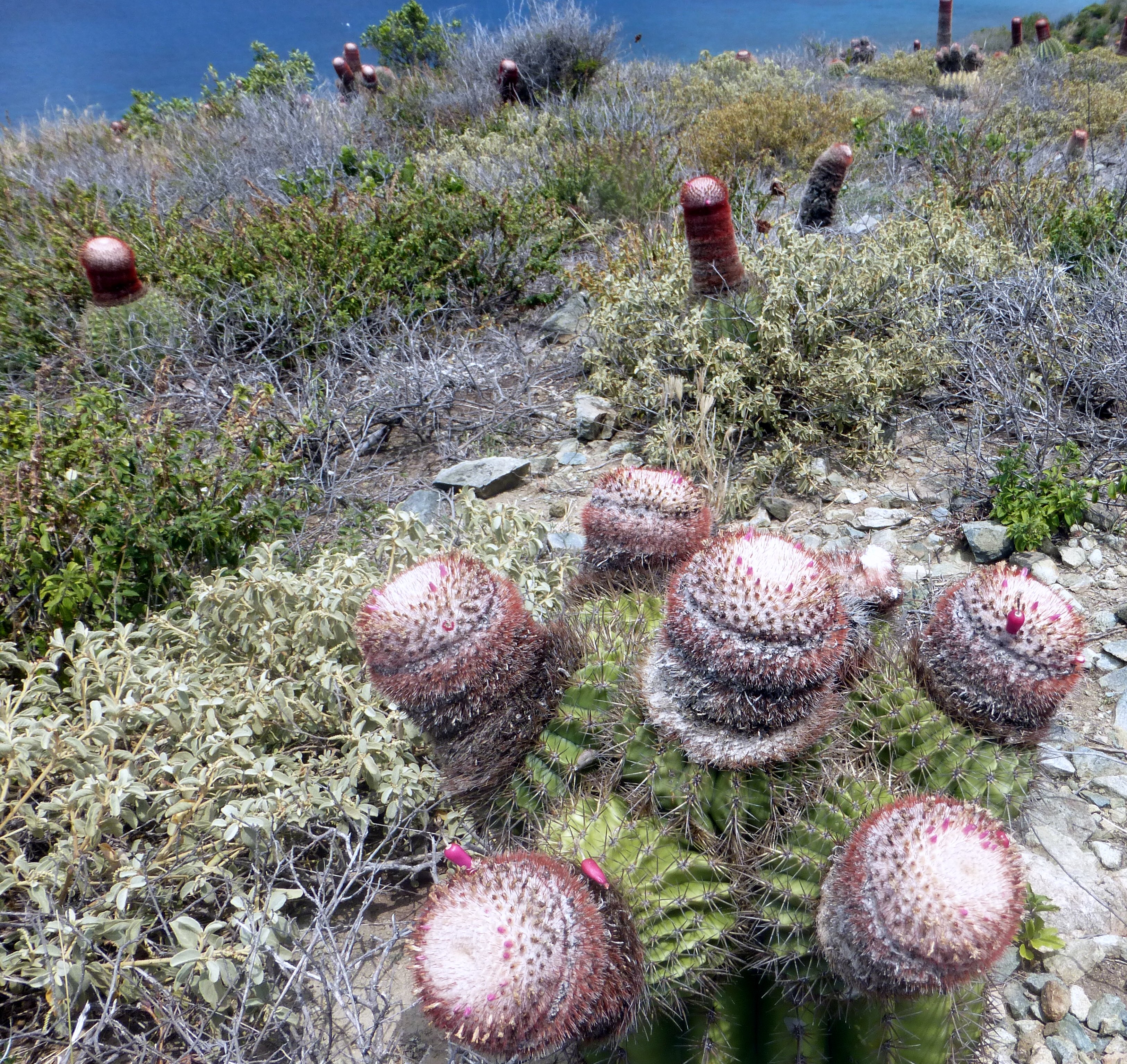
A fine array of phallic cacti, USVI
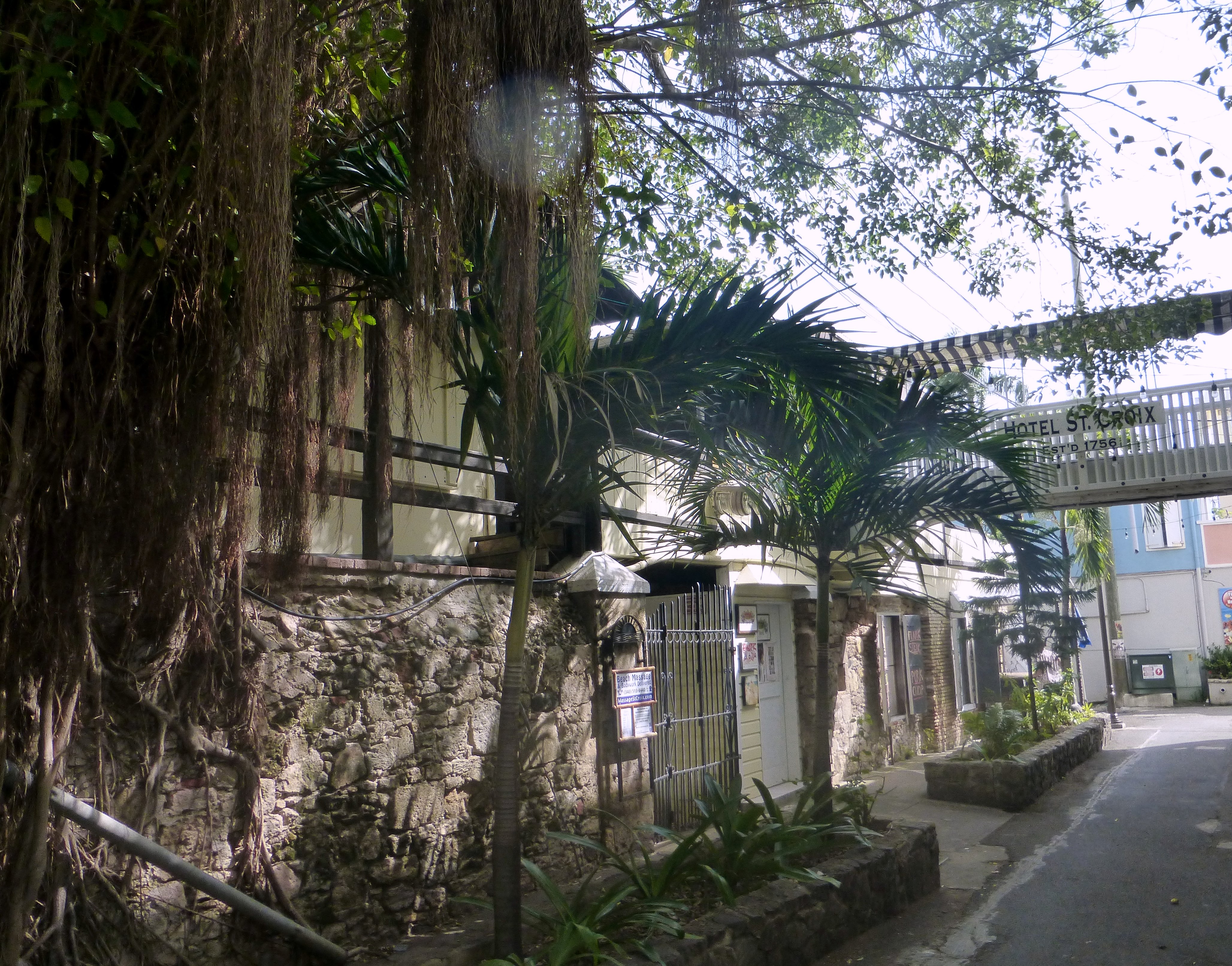
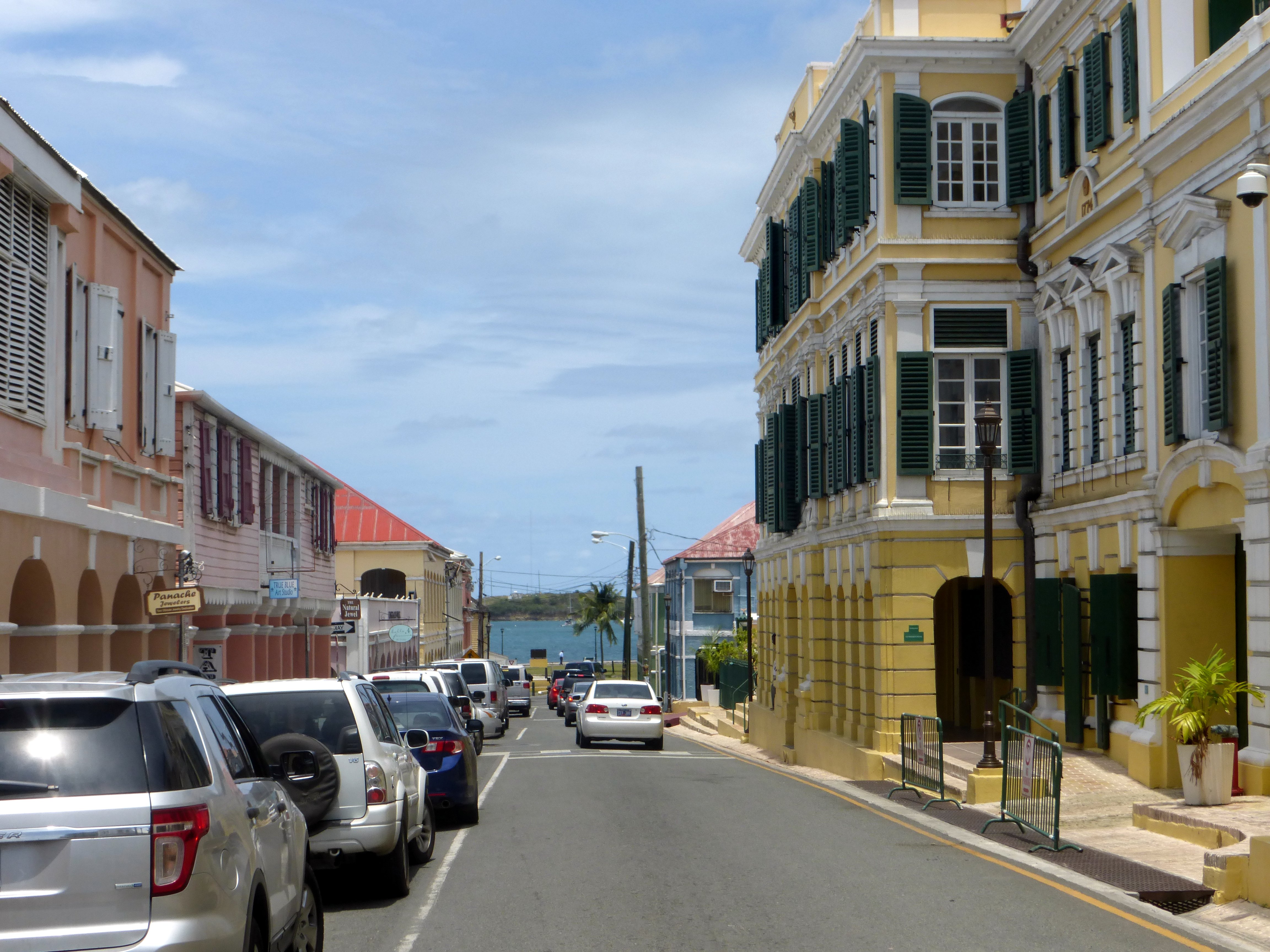
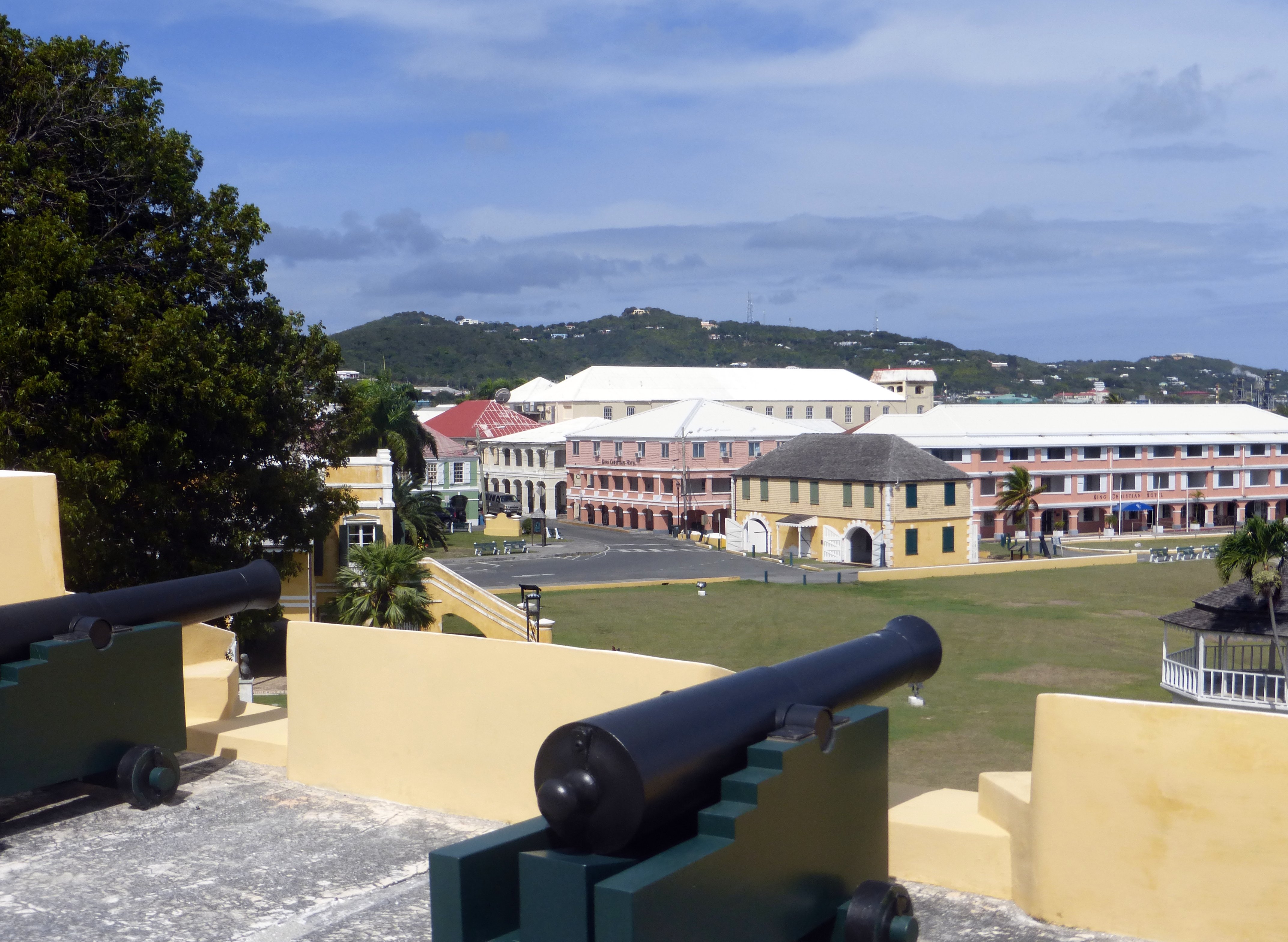
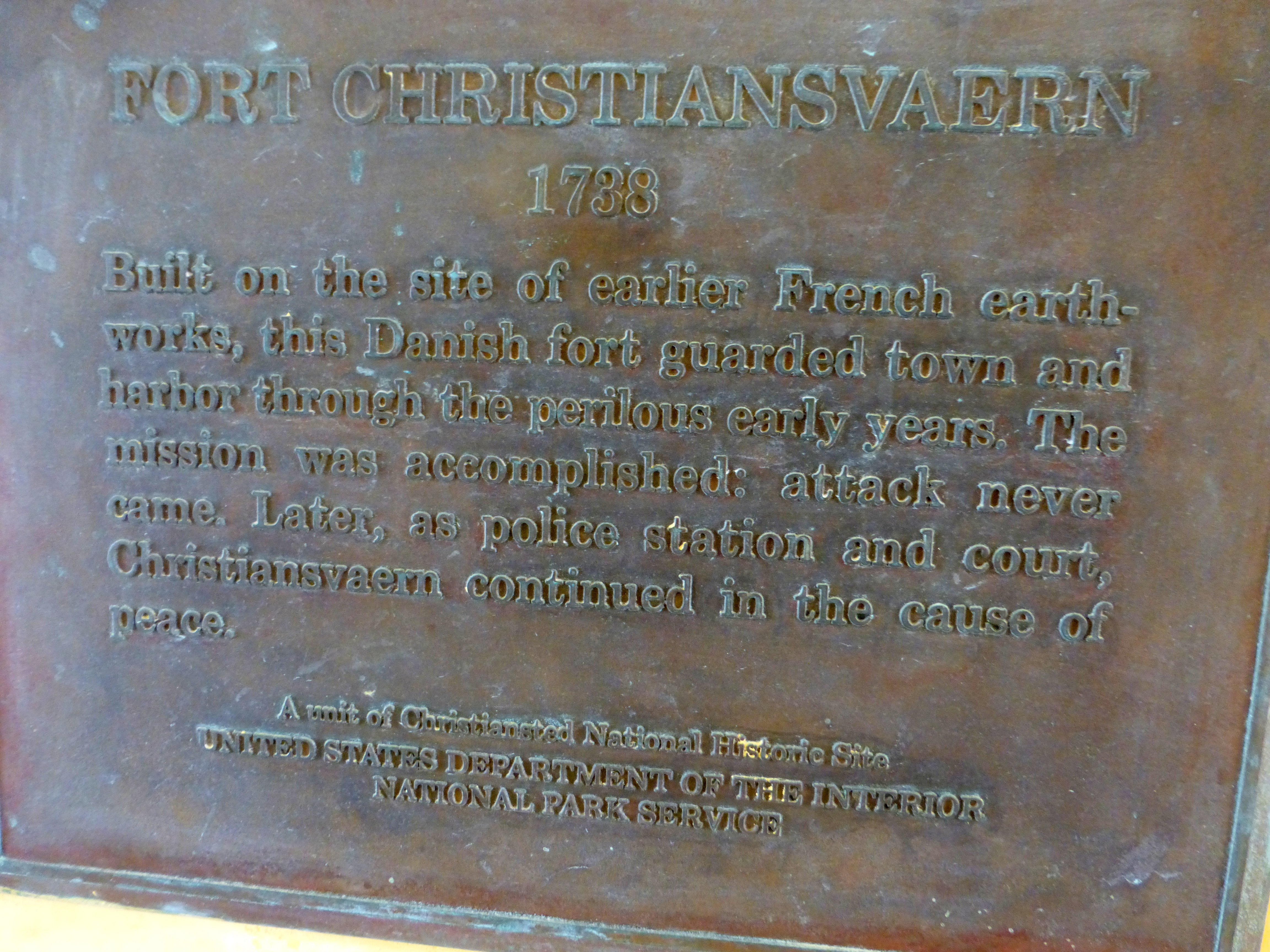
You may have known, but I didn’t, that the USVI are American Territory; in contrast the BVI are of course independent. I had even needed my US visa to visit. I like it here in St Croix because it’s quite empty, a bit artyfarty (St Ives crossed with Palm Beach), very friendly even by Caribbean standards, and it seems to cheerfully blend the USA with the island’s history. There are some really fine Danish colonial buildings: shaded colonnades and courtyards, pastel coloured half-timbered houses, open spaces. All now overlain with American efficiency, shopping malls and eating places and big cars…..though they drive on the left but keeping their left-hand drives.
Some pictures from Christiansted, St Croix, USVI……..
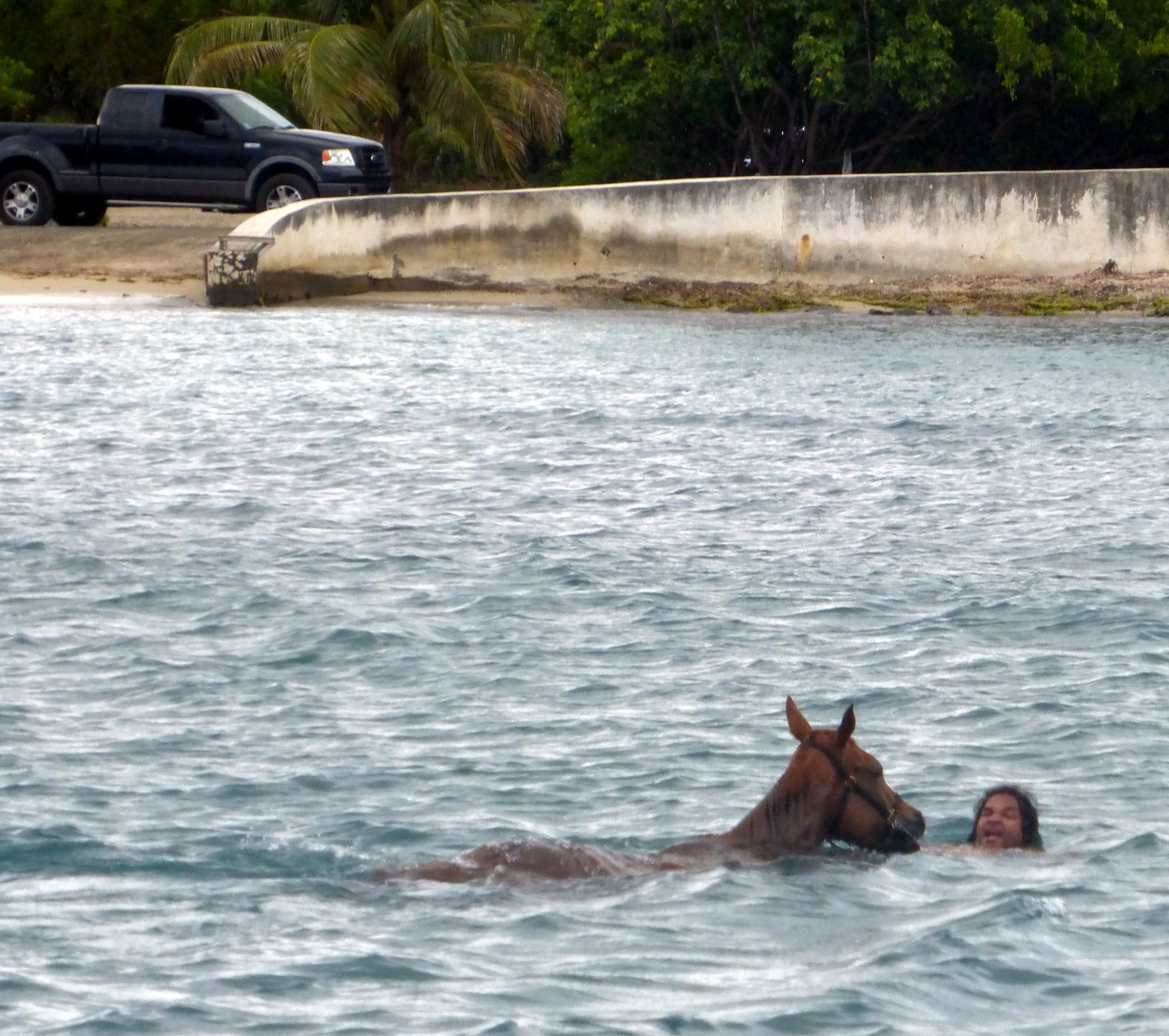
For some reason there don’t seem to be any charter boats and the big catamarans that dash about elsewhere in the Virgins are absent. Instead, as I write this a horse has just swum past with its owner, snorting as it goes – we’re anchored at least 100 metres offshore. Horse swimming seems to be very popular here. Horses not catamarans!
Early morning swim for a St Croix horse
Rambling on a bit again so I’ll stop…
NO! First I’ll tell you about the cockroaches. (Trouble with single-handed sailors is they don’t have people to talk to all the time, so some of us drivel on with the blog – and our personal diaries – quite a lot. Hence, you’re going to hear the start of the cockroach saga.)
Cockroaches. It started a few days ago when one came out of the bag with potatoes and miscellaneous vegetables. I reacted quickly I thought, grabbed spray and sprayed, slapped briskly, smacked wildly, lashed out with weapons at hand etc. But not quick enough for the little beastie, who disappeared, scurrying ever so fast into a cupboard. Next night I had Spanish friends aboard for a meal; and el cockroach was spotted again, lurking furtively by the sink. Quickly and with the combined energy of English and Spanish forces, the intruder was ruthlessly despatched and buried at sea (thrown overboard). European unity can deal with any problem.
Is that the end? Trouble is, I do not know the reproductive system of cockroaches. Might that dead one have needed a mate to give me baby cockroaches, in which case that may be the last chapter of the saga? Or, do cockroaches come preloaded with millions of fertile eggs, in which case Henrietta will be overrun, and I just await the patter of tiny excited insect feet? Meanwhile, a friend has advised a bait of boric acid and milk, so we’ll try it. Anyway, I don’t really know why I’m making such a fuss. These are tiny cockroaches, not a bit like the brontosauraroaches that used to invade Javanese bathrooms. I’m not a wimp; I just don’t want uninvited visitors.
That’s it for now. I’ll give an update if it’s needed.
Life on board Henrietta has become busy, after a few slow weeks. It’s worn me out a bit so not much time to update you. The itinerary, south to north, has been Dominica, Les Saintes, Guadeloupe, Antigua, St Barth, and now, St Martin.
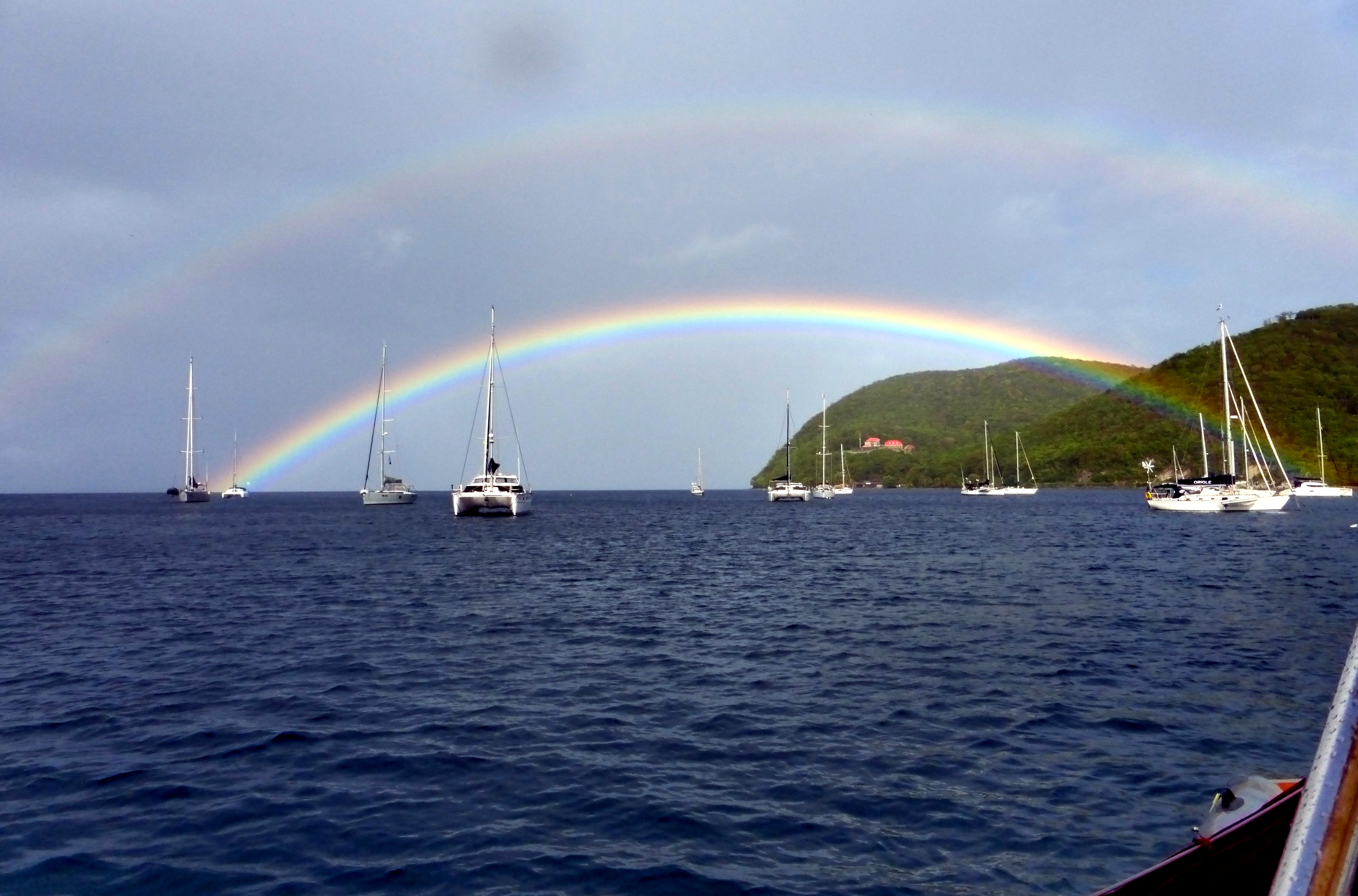
Portsmouth Harbour, often wet so many rainbows
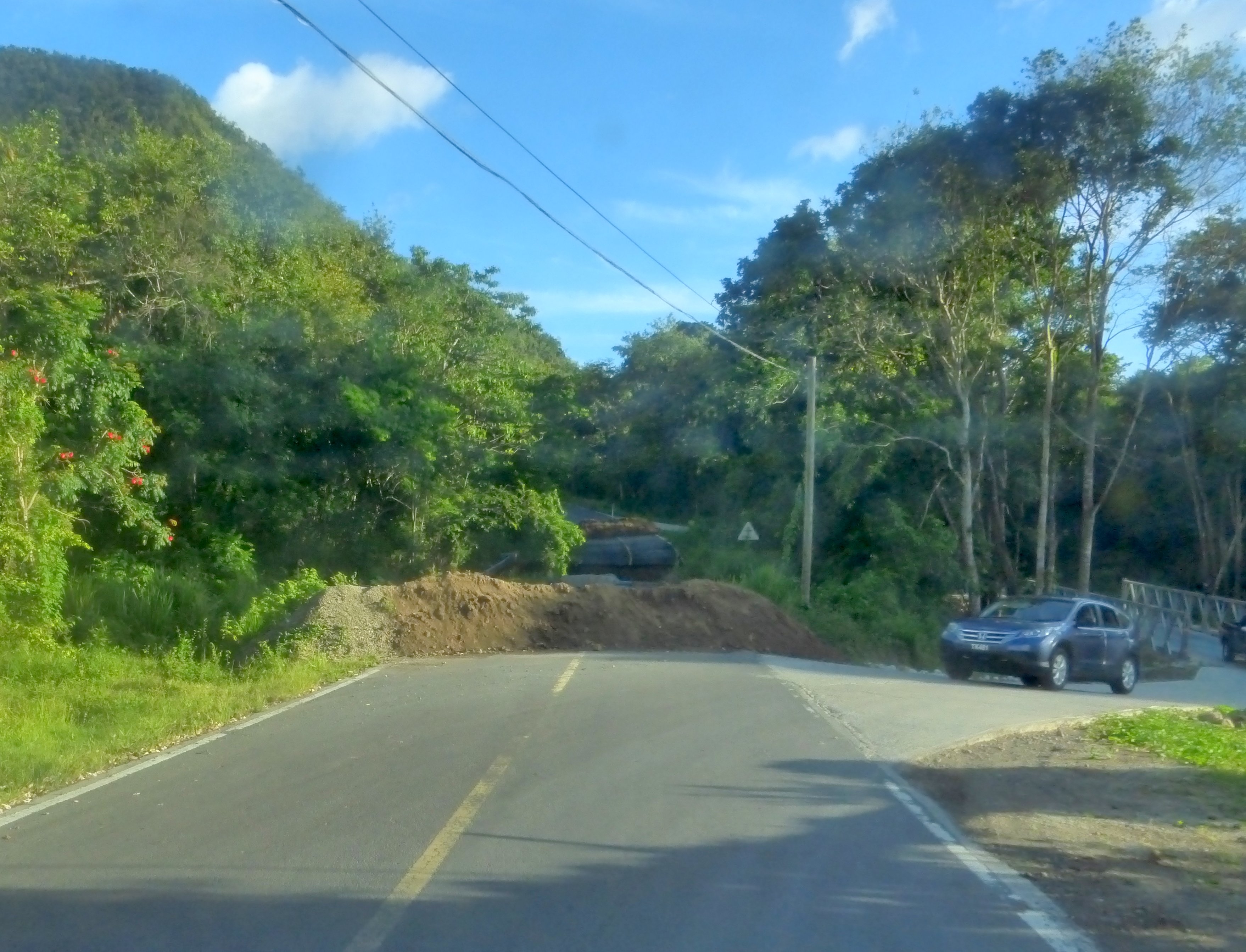
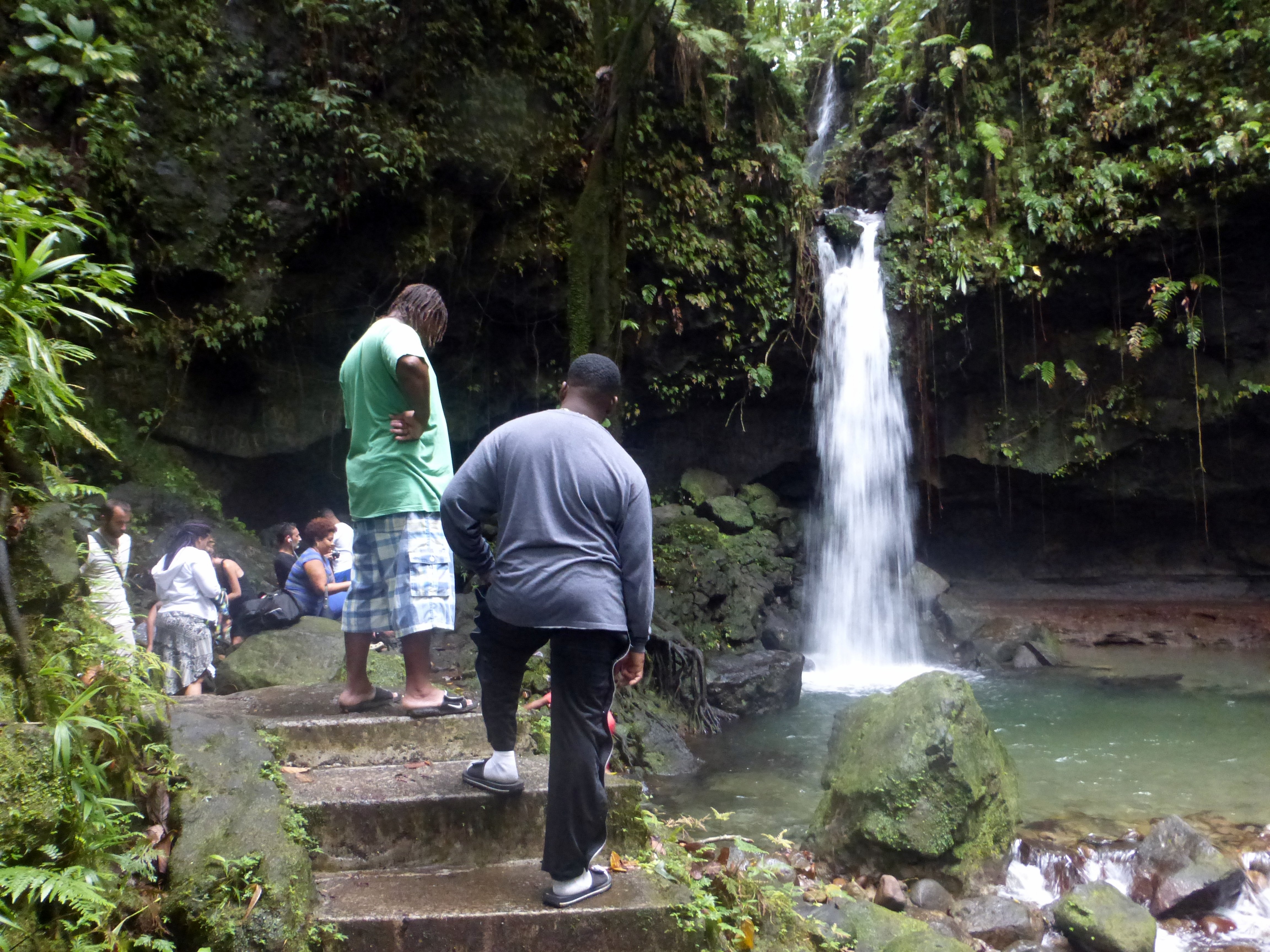
Summarising – Dominica: delightful, thanks to warm friendly people and wild unspoilt lush mountain scenery. It’s a poorer island still rebuilding after the havoc of last year’s storm (12 inches of rain in six hours had washed away roads, bridges, homes and more). Fellow sailors included three other singlehanders (and I’ve not so far met very many). One, a young and quiet ‘retired’ USAF man, ex Afghanistan, whom I asked, “Have you ever broken the sound barrier?” gently said “Yes, F15s do that. A few broken windows here and there”, and I felt I shouldn’t ask more questions. He volunteered that he liked the slower pace of his boat with minutes to react to hazards, not milliseconds; and also that Mr Trump was not his cup of tea. Another, a dignified Swiss gentleman, a retired lawyer singlehanding a vast yacht, speaker of numerous languages, tidily dressed and a good looking vegetarian was trying to find his girl Friday – fascinating stuff! My neighbours when I returned after a day out were the Chandlers on Lynn Rival. With their unwanted celebrity status following Somali kidnapping I did not acknowledge recognising them, only noting that we’d both joined the Cruising Association. I could go on and on, but (a) this is meant to be a summary, and (b) you don’t really want a diary of everything I did and everyone I met. Suffice to say, I liked almost everything about Portsmouth (the main anchorage) and the island of Dominica. Indeed, it was so active with walking, touring and viewing and so sociable with colorful, generous, interesting fellow sailors that I sought solitary respite and moved on to Les Saintes, a few miles north.
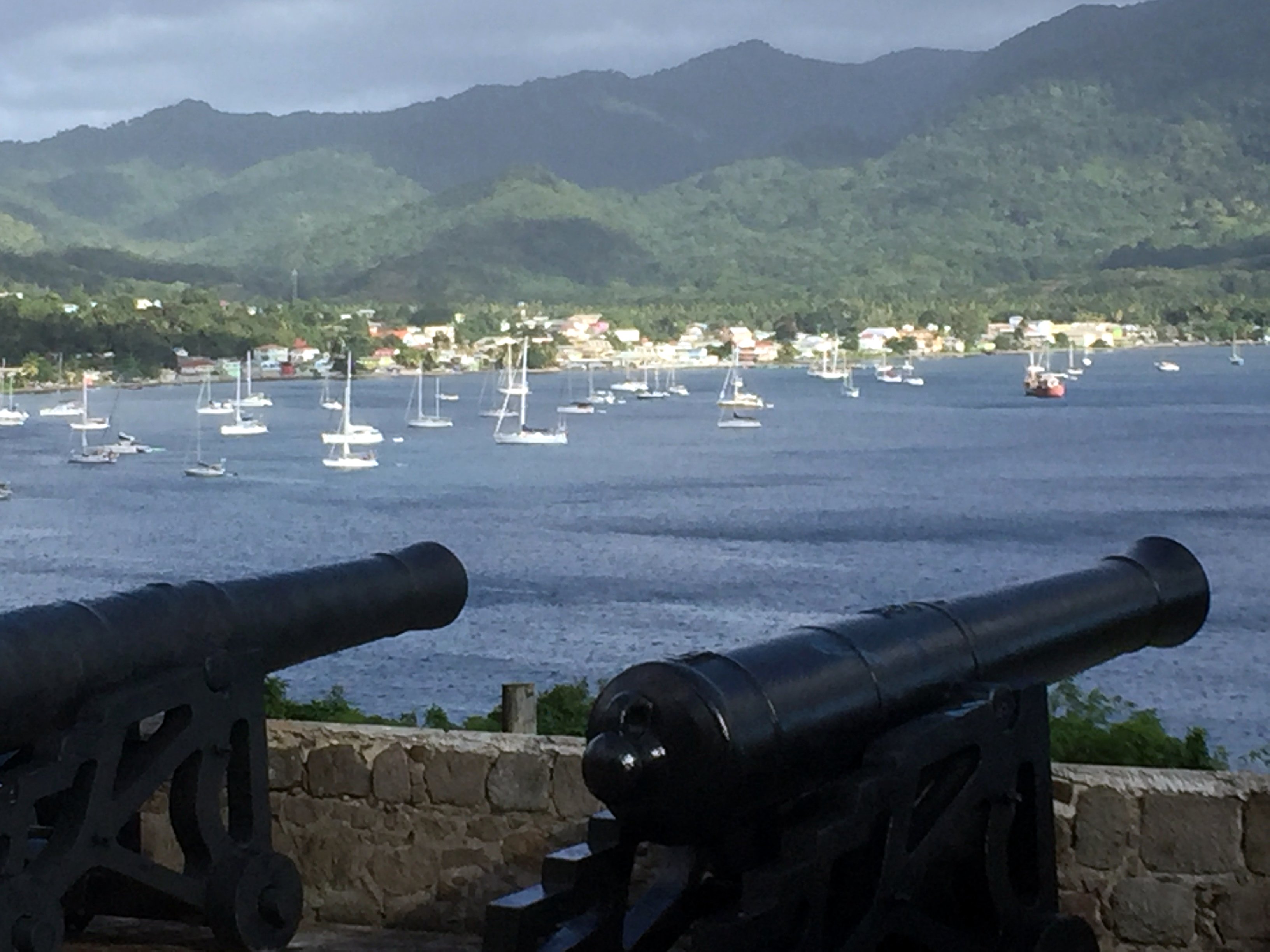
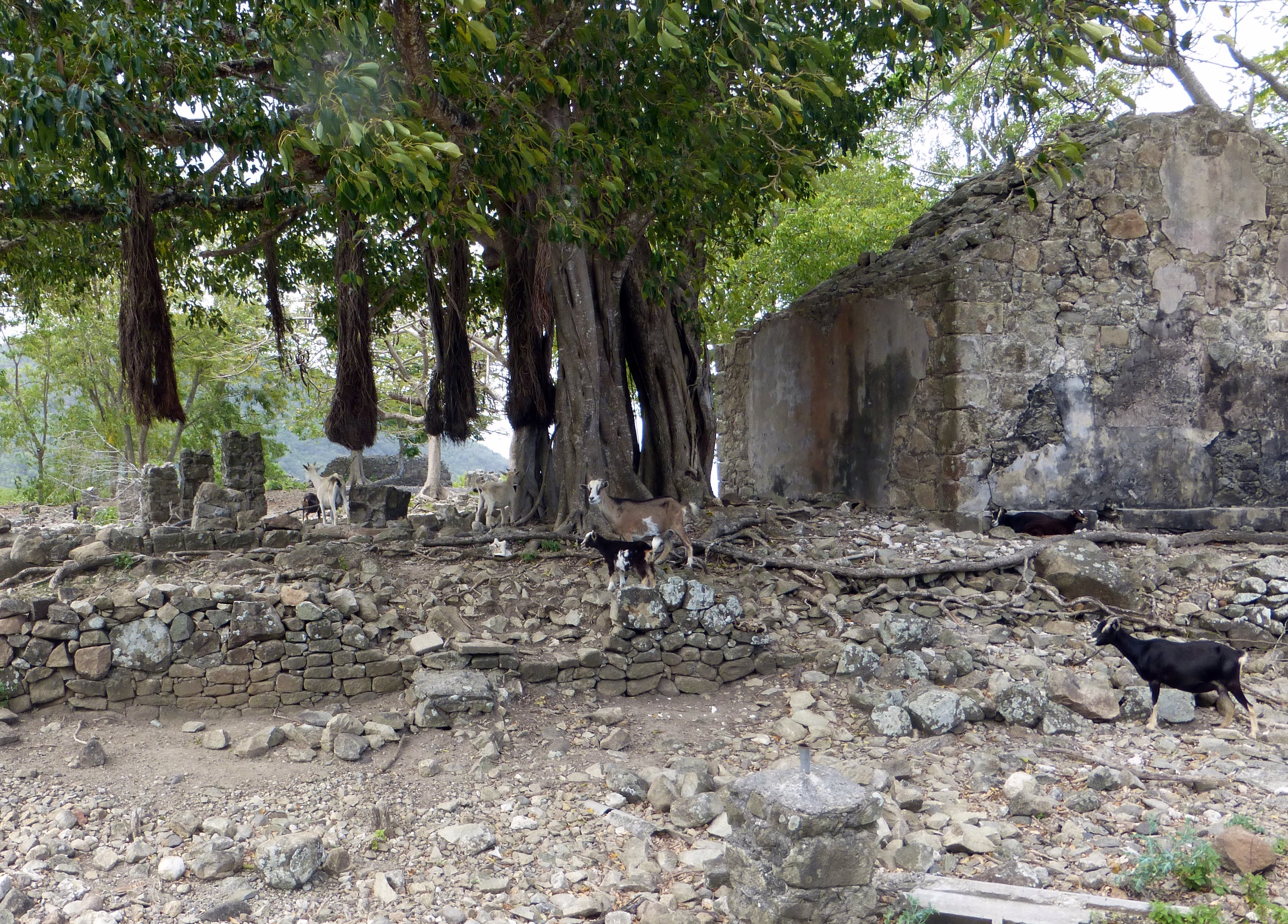
More pictures from Dominica ….Roads still closed following last year’s floodsAnd a fine pool where we swamIlet a Cabrit, Goats have taken over the ruins of Fort Josephine…..
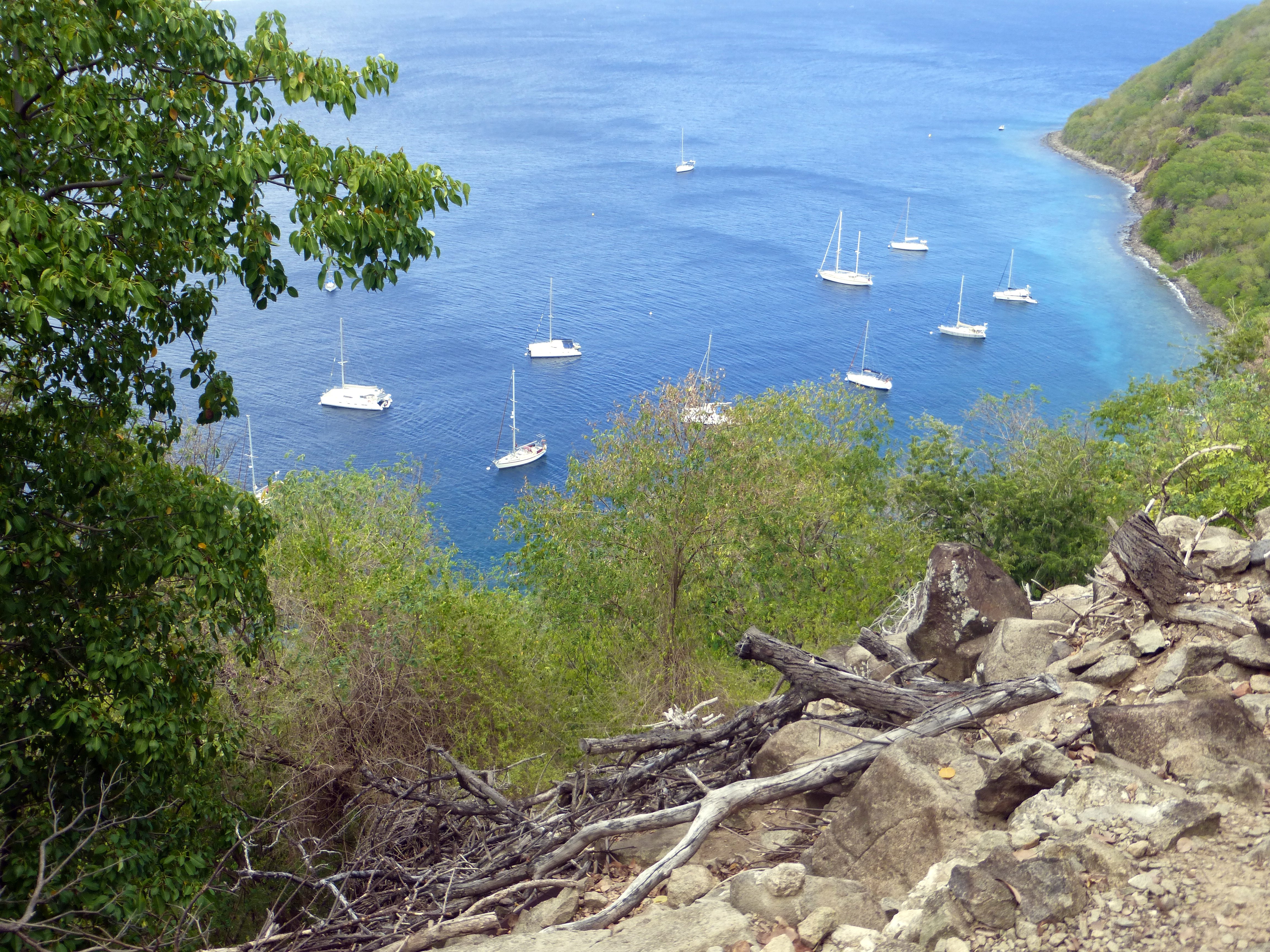
…which has a commanding view of the bay
Iles des Saintes includes Bourg des Saintes, which is a busy colourful thriving French town with anchorage, chic boutiques, quality restaurants and crowds of day-trippers. It also includes Ilet a Cabrit, a tiny island unoccupied except for happy healthy goats. It used to have a few forts to keep away the unruly and aggressive English, but now they’re just crumbled ruins covered in goat droppings (the forts, not the English)
Handsome and wise…
Then, north again for a couple of windy days and nights swinging wildly in the popular Guadeloupe anchorage of Deshaie. (It was the fourth time I’d been there, but it’s convenient for customs clearance – an ever-present chore with entry/exit in all these new countries.)
On next to Antigua and the unexpected pleasure of meeting up again with crews of both ‘Tern’ and ‘Tudor Rose’. The former I first met in the Canaries, and they kindly have me aboard for rare treat of a truly exceptional veggie supper. The latter, not seen since Portugal, includes Simon and Holly and Scrumpy (their wonderful spirited Jack Russell); they’re refreshingly young, indomitable and enterprising – though plans a bit modified now Holly’s pregnant. Click here for a link to their blog.
Next stop, St Barth. (About 80 miles north of Antigua, it was further than I can sail in daylight, so crept out of Jolly Harbour, Antigua in middle of night so as to arrive at St Barth in daylight.) To suggest, as does one of the tourist brochures, that St Barth may be”…hip and sophisticated or…discreet and laid back” seems to miss the main point. I reckon it’s just plain super-rich. It oozes wealth and quality, pure platinum. There’s a yacht size limit in the harbour of 60 metres and that keeps out the vulgar giga zillionaires – who might be Russian I suppose. Anyway, St Barth makes St Tropez look shabby. And if you’re one of those people who think labels matter, this is for you. Personally, I only wanted coffee, a baguette and a new pair of swimming trunks. And sure enough, I enjoyed my coffee and then saw a lovely pair of trunks, azure blue and patterned with many colourful fish, I asked, “Combien pour ces pantalon?” (which is schoolboy French, I know), “185 euro, Monsieur”. At which point I smiled and must have looked weak and pale, as Madam added in English “ah! but they are very fine,.Monsieur”. I’ll wait for Marks and Spencer’s, I think.
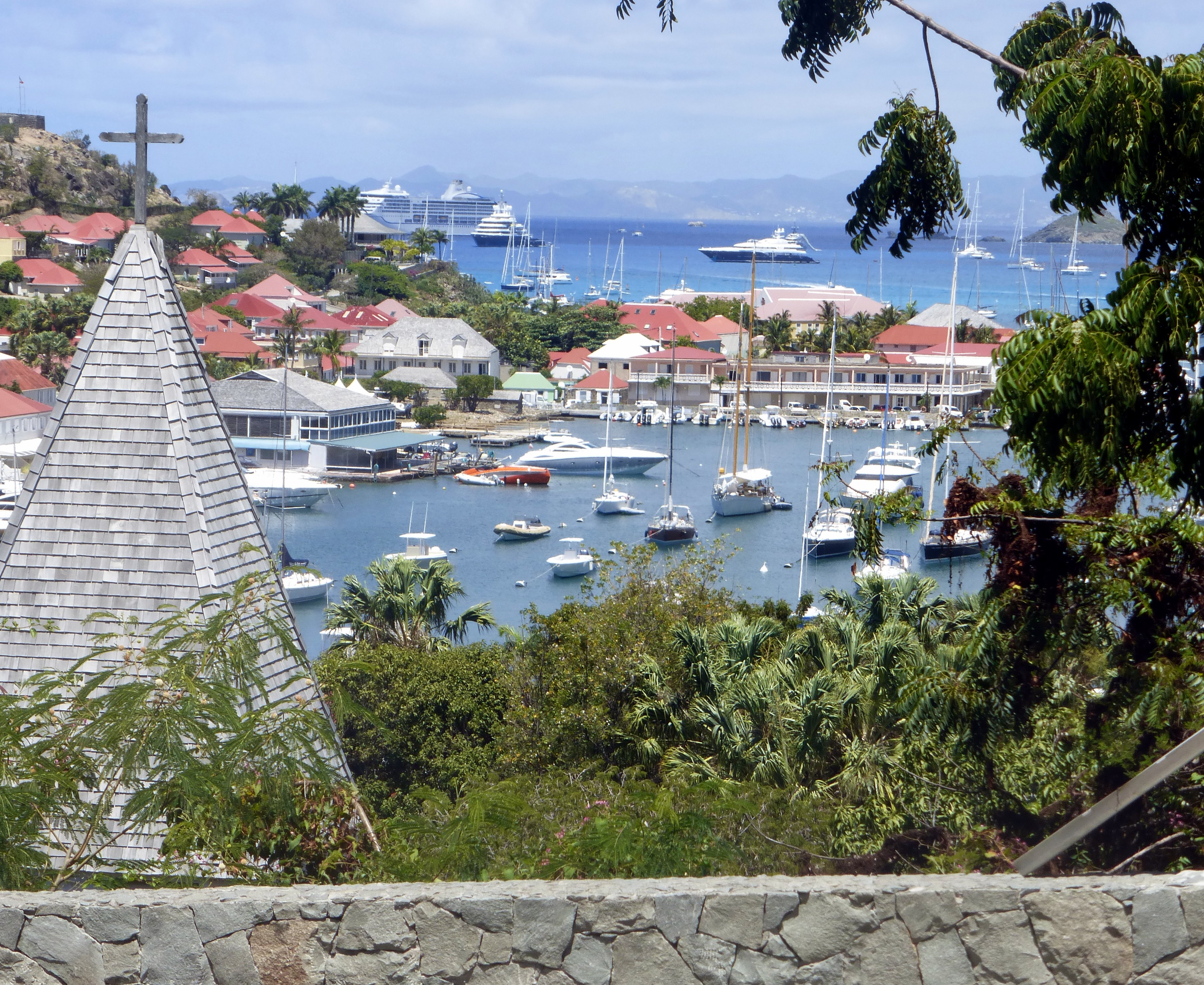
Gustavia Harbour, St Barth…home of posh stuff…
.
St Barth has that delicious peaceful hush about it that comes with great wealth. I think it’s because very rich people get others to do the shouting for them. It would be undignified for billionaires to raise their voices.
St Barth also has a lot of ‘bespoke’ places that can do ‘bespoke’ things for you – if you are rich enough, that is.
Trouble is, I’ve always had a problem with ‘bespoke’. It reminds me of a childhood spent living next to a big housing estate where a young lout named John B. used to live. He and his gang of fellow louts used to follow me on their bicycles as I cycled down Victoria Road, Wargrave. They’d then overtake, shout insults and hurl sticks and things into the wheels of my bike, trying thus to ‘despoke’ me. And in my mind, ‘despoke’ and ‘bespoke’ have forever been intertwined.
You, of course, may choose ‘bespoke’ because you have a big wallet and impeccable good taste. To me on the other hand, you may simply be yob, slob or snob.
Marigot Bay, St MartinPeaceful anchorage and strange cactus, Ile Fourchue
And now, after an overnight stop at the uninhabited little island, Ile Fourchue, I’m in St Martin, near the top of this chain of islands. St Martin is part French and part Dutch (St Maarten). I’m anchored in the French bit (better bread) but was advised to go to the Dutch bit for a haircut (better/cheaper haircuts). Therefore caught bus to Philipsburg, found very much a back-street barber….very friendly and with three foot dreadlocks that he’d taken 14 years to grow. He was from Dominican Republic and spoke lots of Spanish, little English, no French. I speak no Spanish. Upshot was I’ve now got virtually no hair: most vigorous haircut of my life. (No photo to follow.)
Today is 9th April, my father’s birthday. He’d have been 100 today, but he died more than 42 years ago, when he was only 57.
I think of him often as I sail around as I know how much he’d have loved some of these adventures. He never had my good fortune though. For a start he was born in 1916 when his father (my grandfather) was in the First World War trenches. When my grandfather received a telegram telling him of the new arrival, his fellow officers said it was a shame he’d not see the new baby son – casualties were so high at the time – though in fact my grandfather did survive – until he was 96.
And then, my father grew up through the 1920s and 30s with the traditions, conventions and constraints of the British middle classes at the time; hence he was almost bound to enter the army. That’s what men like him were expected to do. There weren’t the many choices open to my generation. Not that he disliked army life; he probably enjoyed much of it. After all, it gave him wonderful opportunities for cricket and hockey, both of which he played very well. It’s just that I think he was at heart a pacifist. He was fully involved with the British Legion after he retired from the army, so he believed in that; and I know he was always solicitous of his men’s well-being; and he kept many friends from his army days. In those days too, before, during and after the Second World War, you did travel the world, (I know for example that I was conceived in Pakistan, borne in Singapore, and lived I think in Germany, Egypt and London – all before I was five).
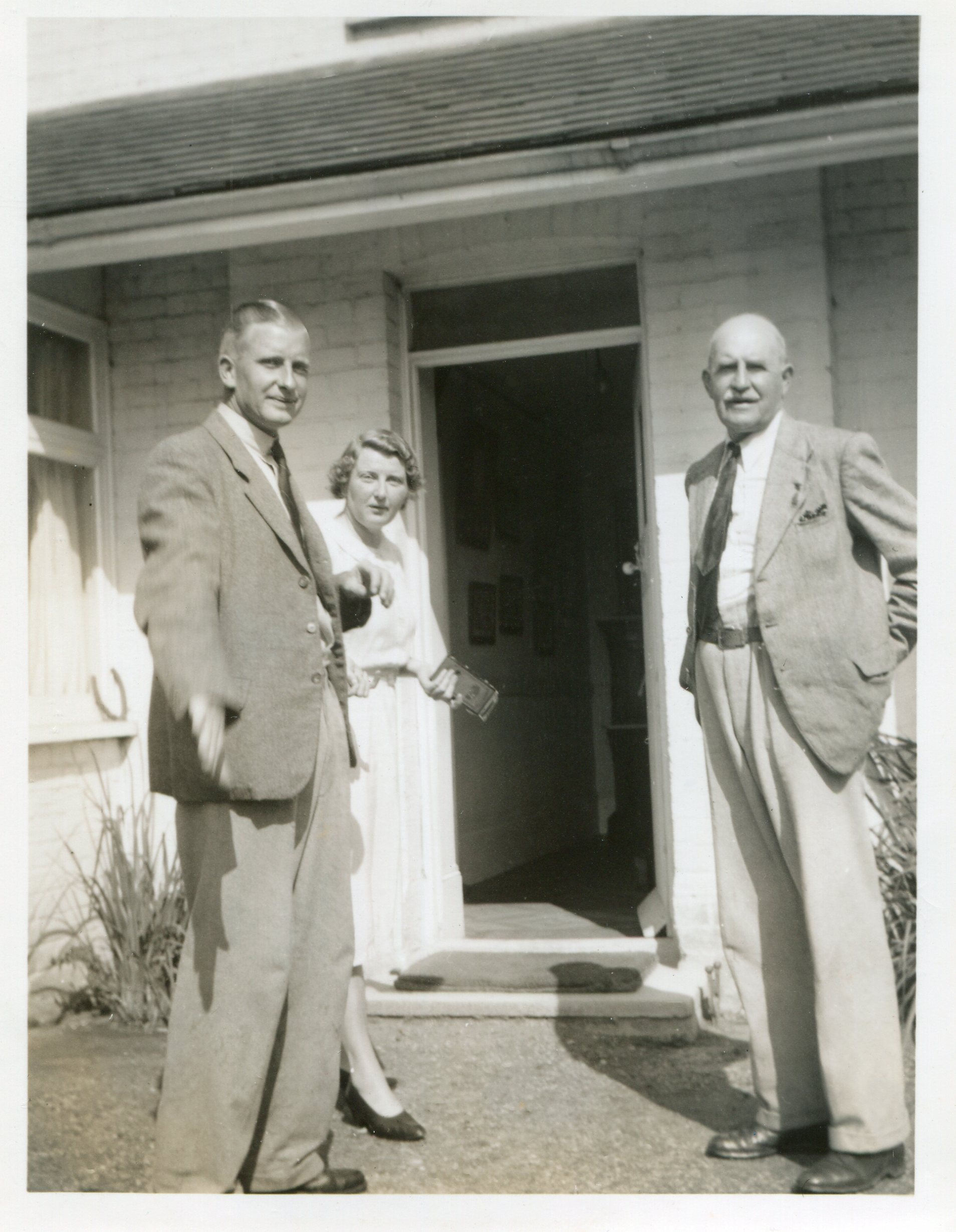
l to r, my father, Aunt Adeline, and Grandfather Sweet (1930s)
But army life can’t have suited him very well as, apart from his peace-loving nature, he was never keen on senseless obedience and unchallenged conformity and, after attending a War Office colonel’s tea party in the early 1950s, he impulsively announced he’d leave as soon as he could; “….otherwise” he told my mother, “we’ll become like them” (N.B. I like to think the modern army has done away with the ritual aloofness that he’d so disliked). He and my mother were, I’m sure, devoted to one another and had been married in 1945; she accepted without question his decision to leave the army.
Unqualified for civilian life, but using his knowledge and interest in sport, he tried work as a sales rep for Slazenger or Dunlop, before acknowledging he couldn’t sell anything. ‘Sales’ was clearly a dead-end for someone with his qualities of honest generosity and openness. Instead he became a driving examiner, commuting for many years on his little Lambretta motor scooter into Reading. It must have been soul-destroying work, but for five and half days a week, he persevered year after year with patient good humour.
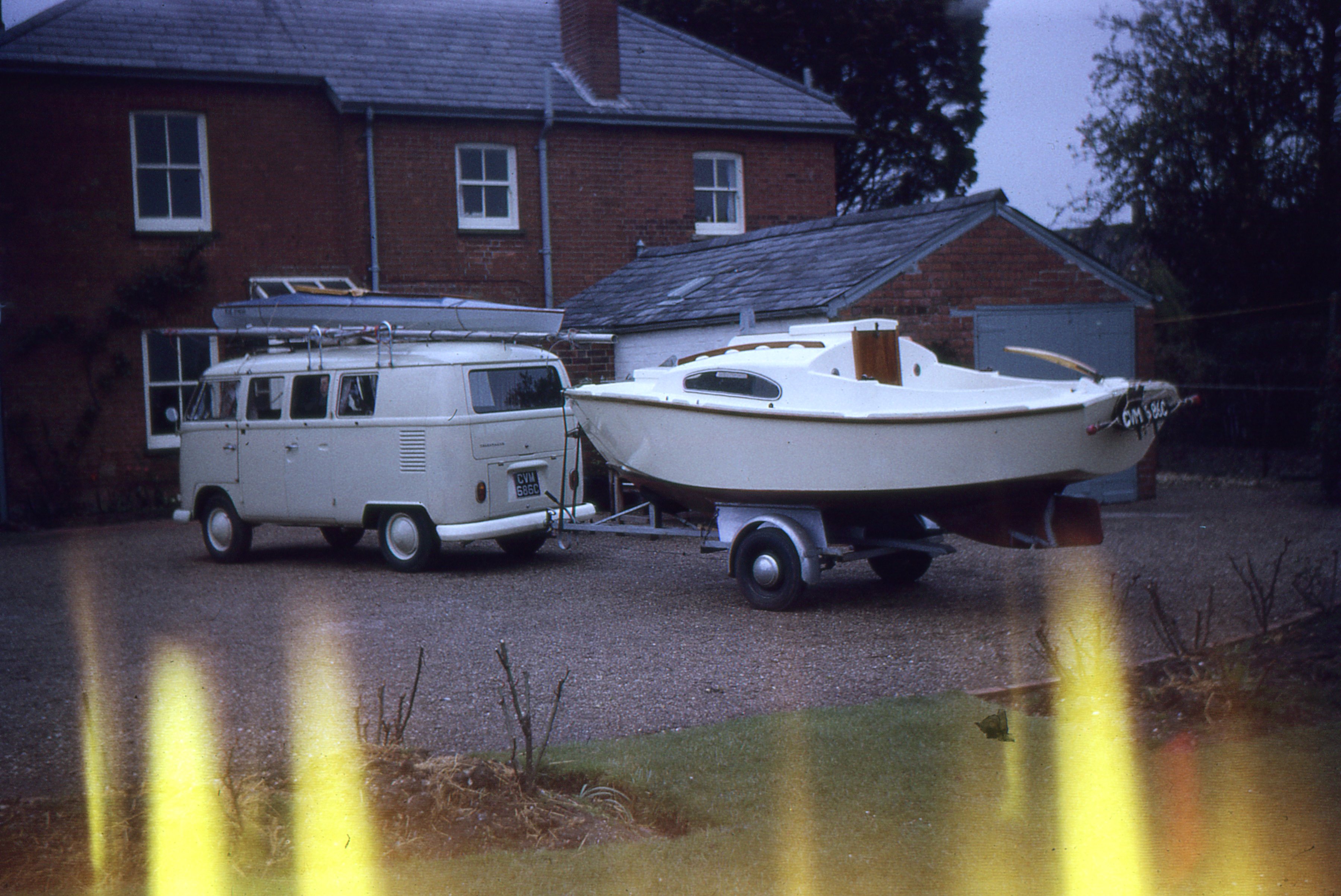
At that time, we were all introduced to the idea of owning and sailing boats. An early heart attack meant my father was advised to give up cricket. He took up sailing, instead – I believe it was deemed less stressful. We had a little all-purpose dinghy, Henrietta II, that we used on the River Thames, or trailed down for holidays in Chichester Harbour or Lyme Regis. Just imagine: five of us, plus dog, tent and camping gear in a 13ft dinghy, with temperamental Seagull outboard and inefficient gunter rigged sail, for weekends in a tent on some sand dunes at East Head, Chichester (National Trust own it now and camping’s not allowed.)
Eventually my father stopped being a driving examiner; and we moved to the South Coast (after a brief and dismal year near Bedford); where he started a driving school. We had a mooring on the river at Lymington in Hampshire (home for our 17ft Silhouette, “Henrietta III”). Then, a few years later, I’m sure with a happier and more comfortable life than ever, he died. I was a 23 year old engineer in Africa at the time and never knew until long after the funeral was over.
I’ve always felt sorry that I knew him so little. Partly that’s because, as a typically self-absorbed teenager I was insensitive to the qualities and needs of parents, but also because he was by nature a quiet and modest man, and didn’t talk much of his childhood or early adulthood; he wouldn’t have wanted to bore you with his own thoughts and concerns. I think too he was essentially shy, unambitious, and reserved. He never wanted to make a fuss or boast about anything.
Whatever his abilities and limitations, when I think of my father now, I know two things for certain. I inherited his joy of sailing; and I’ve been a million times luckier than him in being able to indulge my passion. (He would never have dreamed that one day, one of his sons might have a yacht like the current ‘Henrietta’. I’d never have dreamed it either.)
(Only writing this update because it’s pouring with cats-and-dogs type tropical rain. Being a bit whimpy, I’ve decided to stay aboard and not wander the mountains of Dominica.)
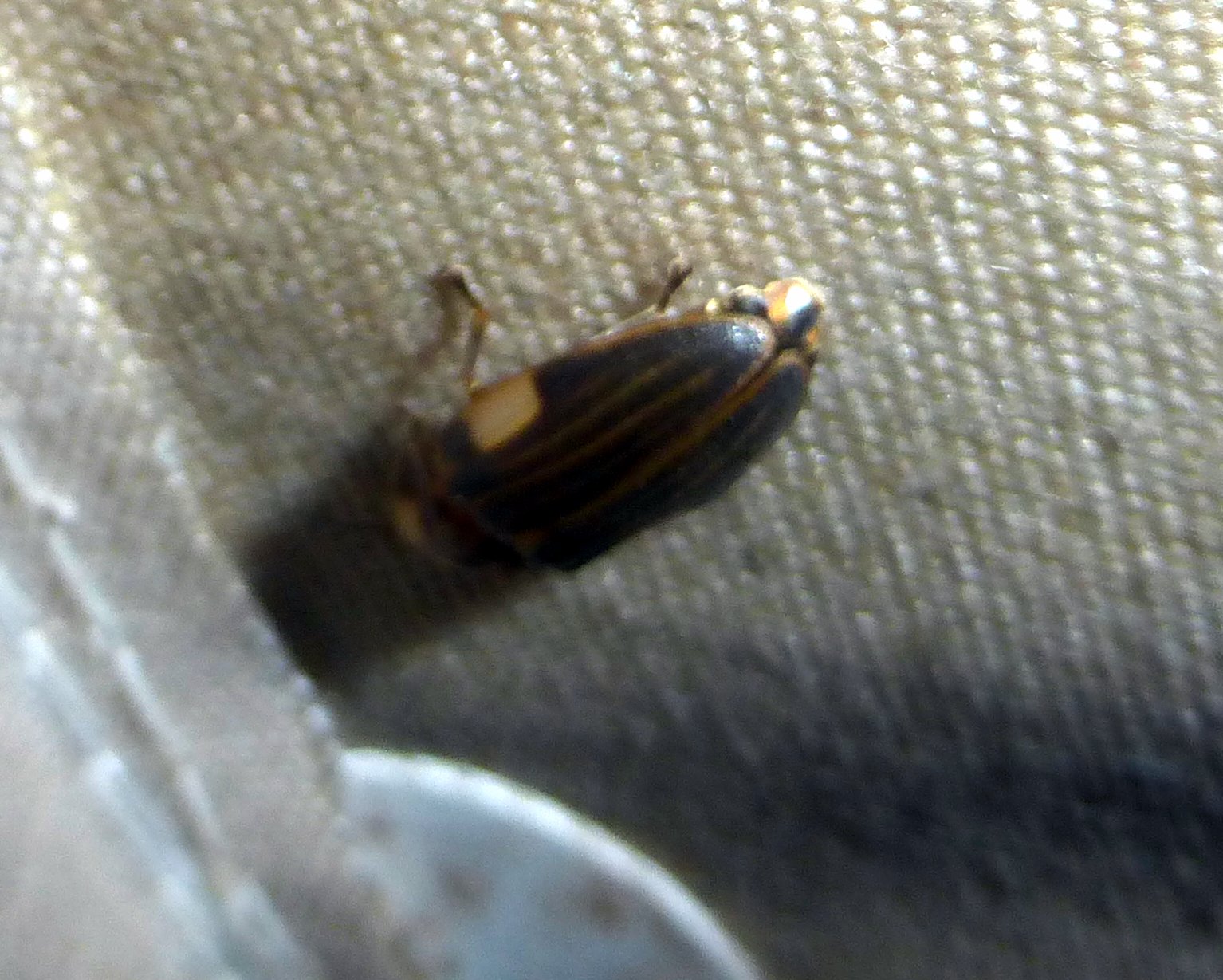
First just look at this photo:
Super lightning bug
It is the most amazing little bug, a fabulous tiny bit of beatle nature – even if the photo is not too good. Why amazing? Because it has a flashing light on its bottom. It really does. A bright and insistent little beacon on its bum! I was sitting peacefully in the cockpit the other night, sipping rum and admiring the stars and watching peaceful boats rocking on their moorings, when suddenly I spotted a little flashing light right in front of me. I blinked and blinked again, thinking I might have overdone the rum….. then realised it was some sort of lightning bug (they’re not that unusual!). Took this photo.
Leaving science aside, it is exciting beyond words to come across such gems of nature when they’re not expected. To meet a turtle in the sea in a popular turtle-watching spot is one thing, but it’s so much more marvellous when you come across one unexpectedly, in a place where they’re not talked of – as happened off St Pierre a few days ago, where one lingered swimming with me for ages – magic moments!
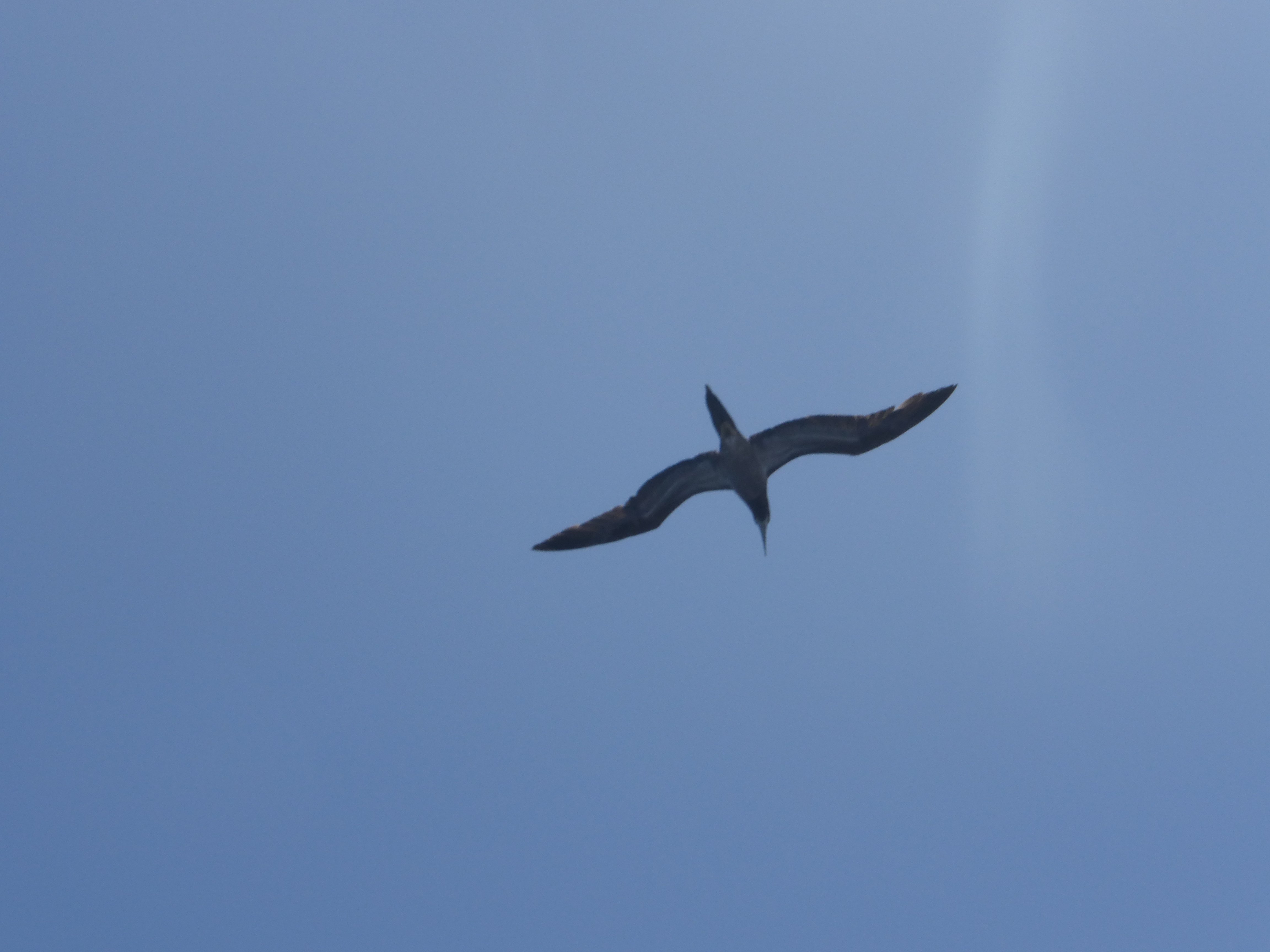
Brown booby fishing as I sailed north
Thinking of lights, I want to tell you about a cruise ship which passed the other night, when I was sailing from Trinidad towards Martinique. (Cruise ships are forever scurrying back and forth overnight, ensuring their passengers reach the next Caribbean port-of-call around breakfast time.) This particular one, “Celebrity Summit”, on its way to Barbados, about two o’clock in the morning, was going to pass a mile or so away and I’d not have been concerned except it seemed to be flashing search lights at the sea and sky (and me). I called them on the radio to ask if there was a problem….”No problem, sir; they are having a party.” I gather it was a laser light display, stabbing bright coloured beams into the sky and everywhere else, presumably while night-owl passengers bopped away on the outside top deck. It does add variety to the night watch to have such incidents. But Nelson would have turned in his grave.
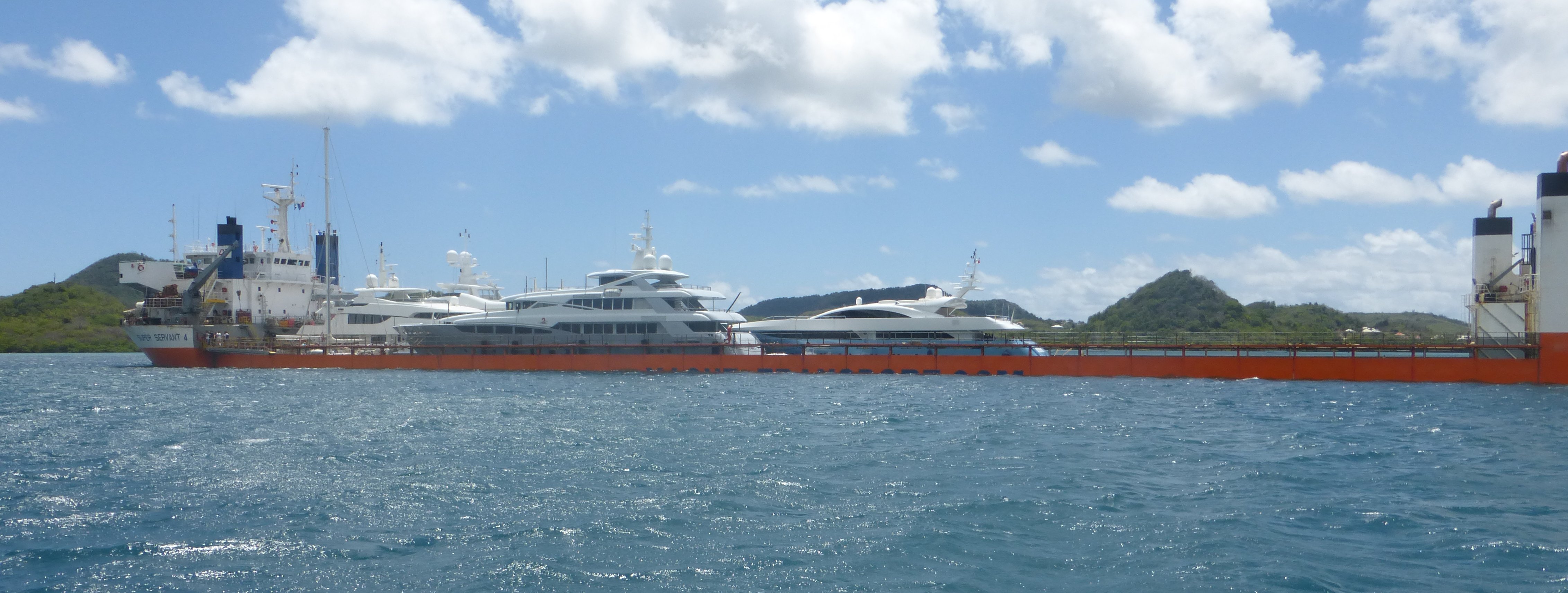
Boats going home the ‘other’ way (loaded aboard a big ship, which lowers itself to let them in)…parked up and ready for water to be pumped out…..
Days pass quickly. I’ve enjoyed Martinique and can’t think where the time went. It’s been good, as ever, to meet new sailing folk on the way, especially, at last, the crew of Baloo, another yacht from SW England. (I guess four out of every five British boats are from Devon or Cornwall. No wonder those counties are so sparsely populated. Everyone’s away on a boat.)…it’s still pouring with rain…..
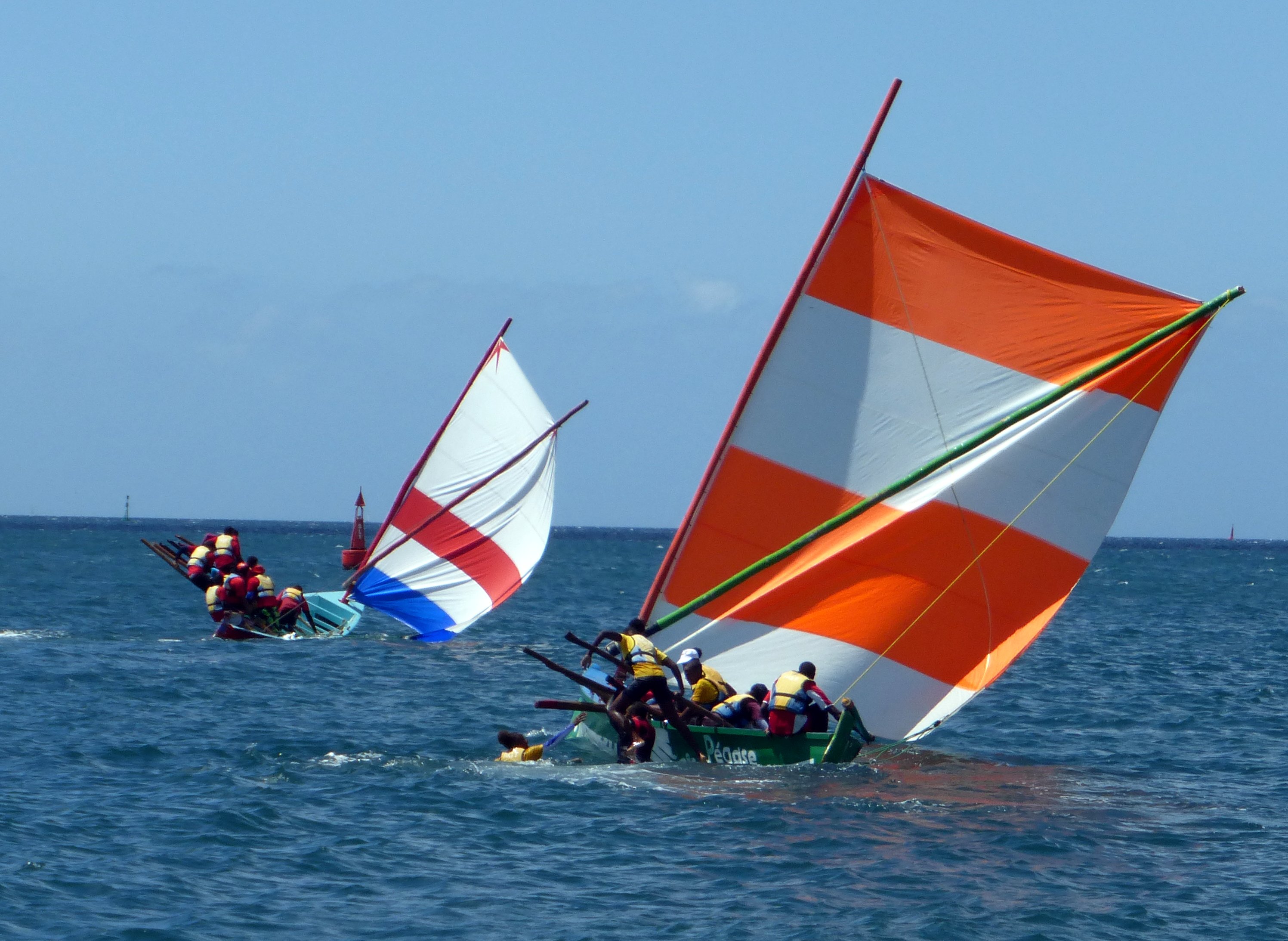
Here are some pictures of local sailing racing off Fort de France (Martinique’s capital). It’s clearly a dramatic business with crew leaping in and out on loglike ‘sliding’ seats, frequent capsizes etc. We had our hearts in our mouths as they raced through our anchorage.
Racing is a precarious business!
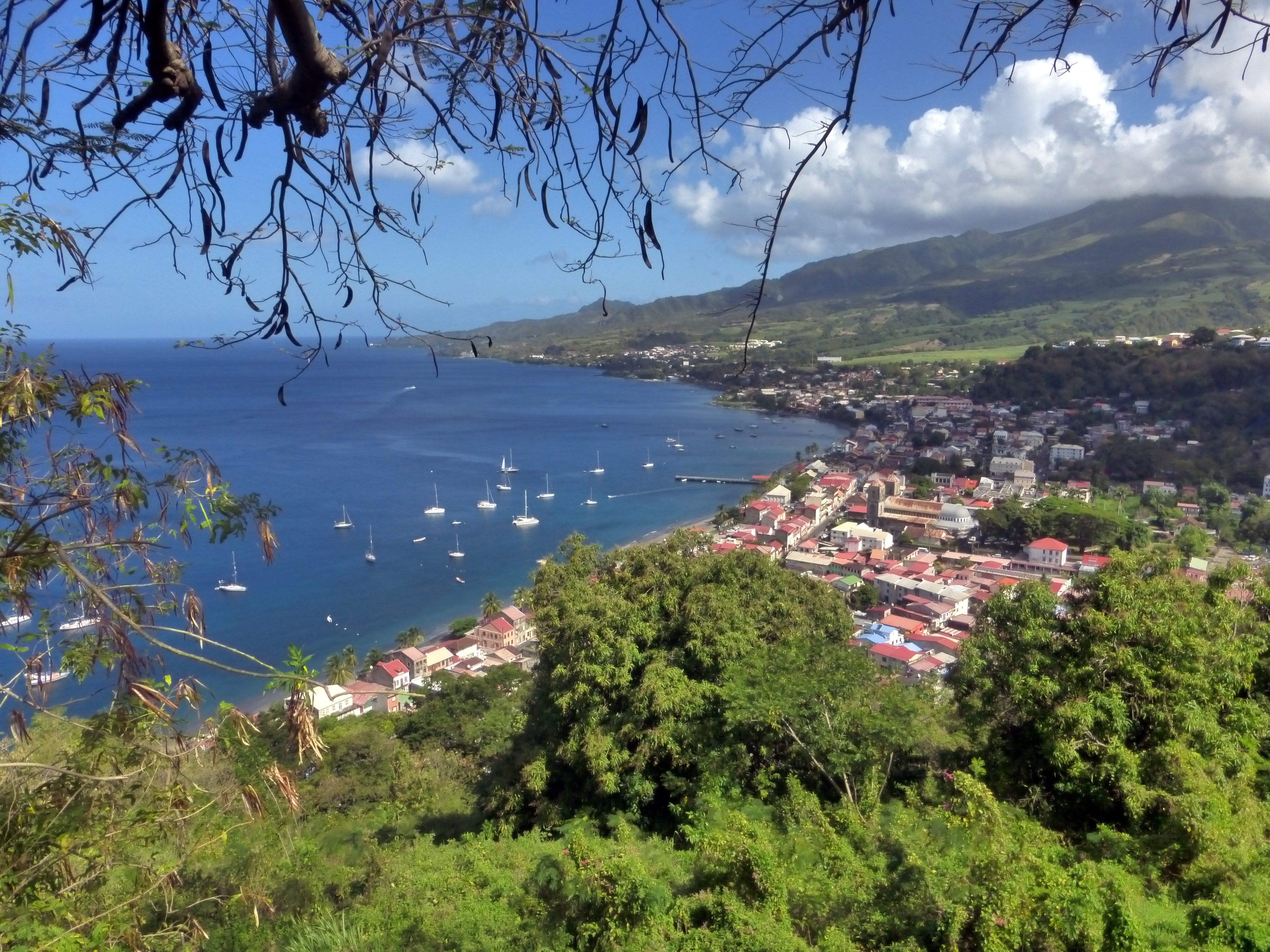
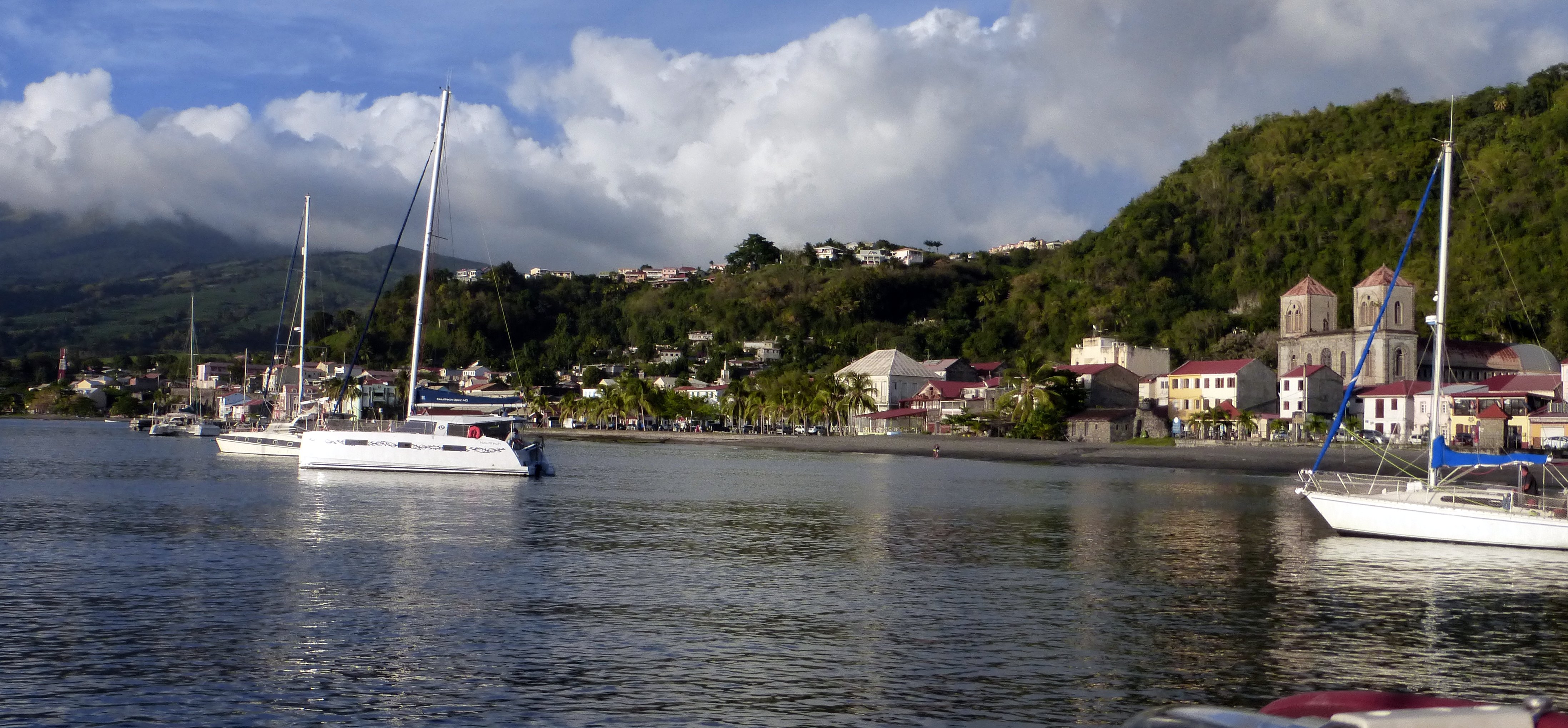
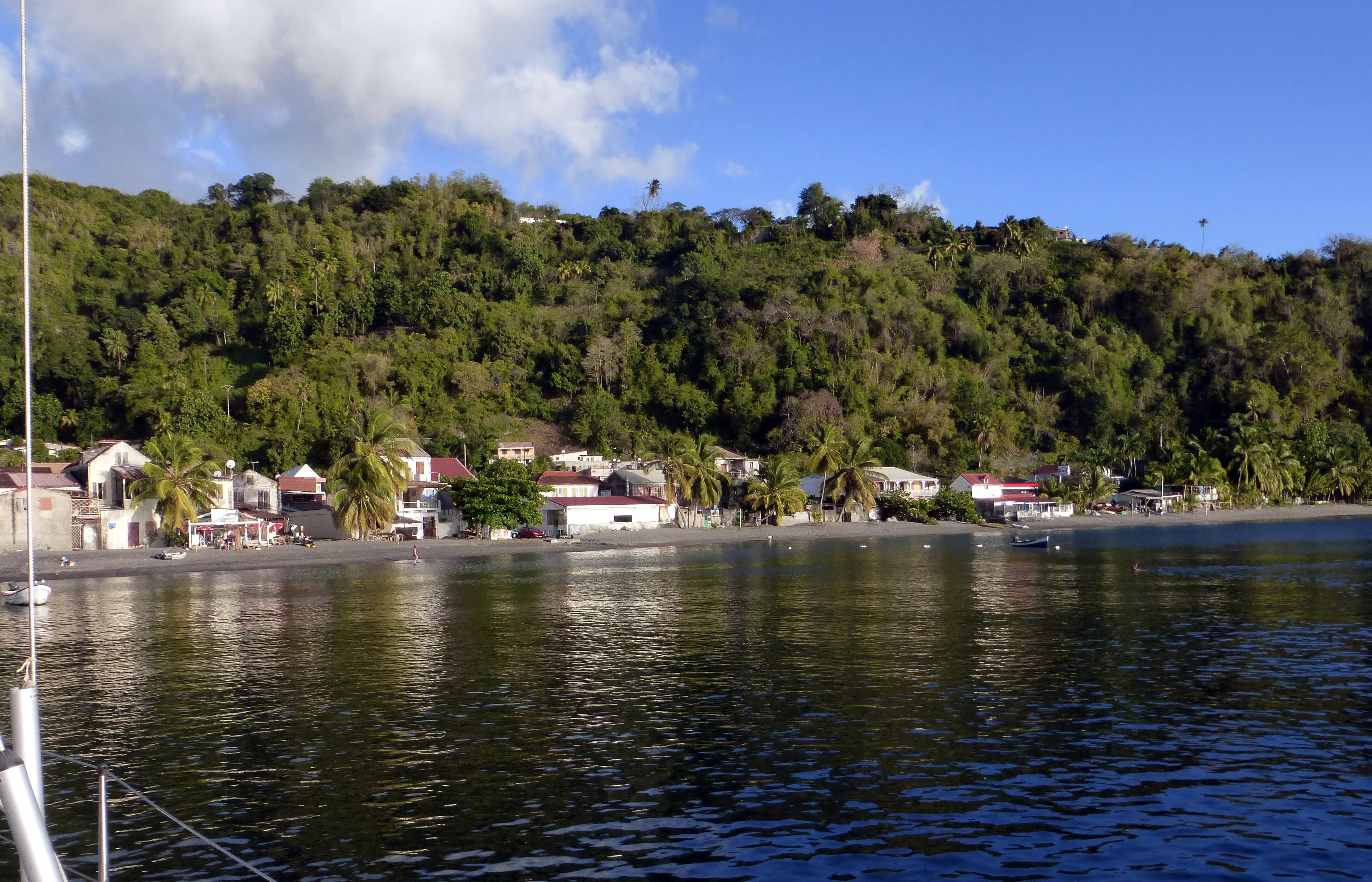
Just as the unexpected gems of the natural world are the most exciting, so too the gems of the man-made world. Anyway, the little new town of St Pierre on Martinique was, for me, a bit special and exciting. It’s the rebuilt town, now quite small, that replaces the ‘Paris of the Caribbean’ town, pop. 30,000, which was incinerated in a volcanic fireball in 1902, killing almost everyone and sinking the ships at anchor offshore. (A tiny museum recounts the event with a series of appalling photos). St Pierre nowadays has a charming sea frontage where luxuriant jungle foliage blends with higgledy-piggledy buildings bordering a dark grey sandy beach. There’s an appealing mix of French chic and Caribbean shabby. It was there I met my friendly turtle. And also spoilt myself with fine 15 euro plat du jour in a little restaurant (tablecloth and two wine glasses each). The couple who owned and ran it had met here and have settled. He cooked like a Michelin chef; she waited with friendly charm and the husky French accent of the inveterate smoker.
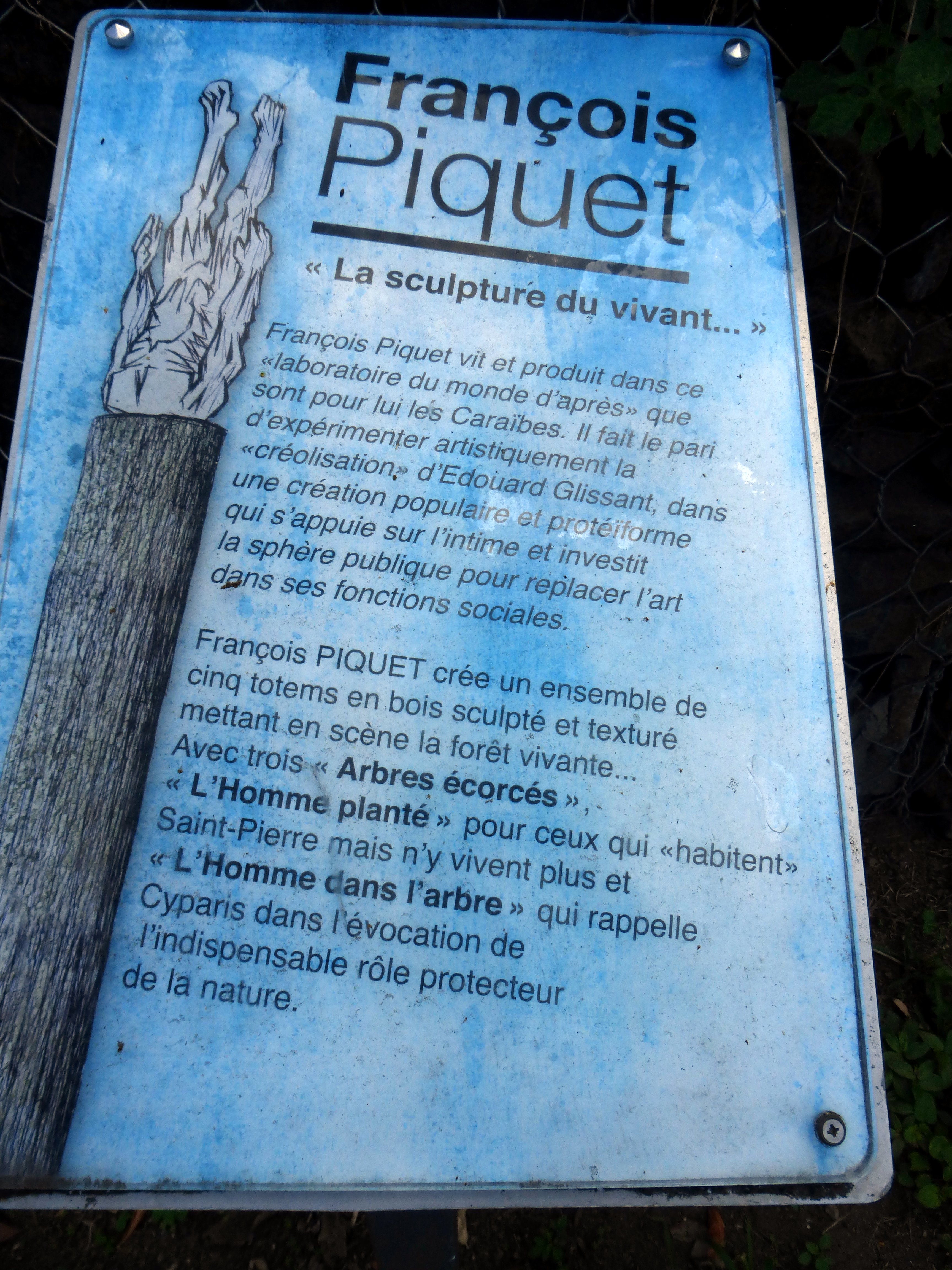
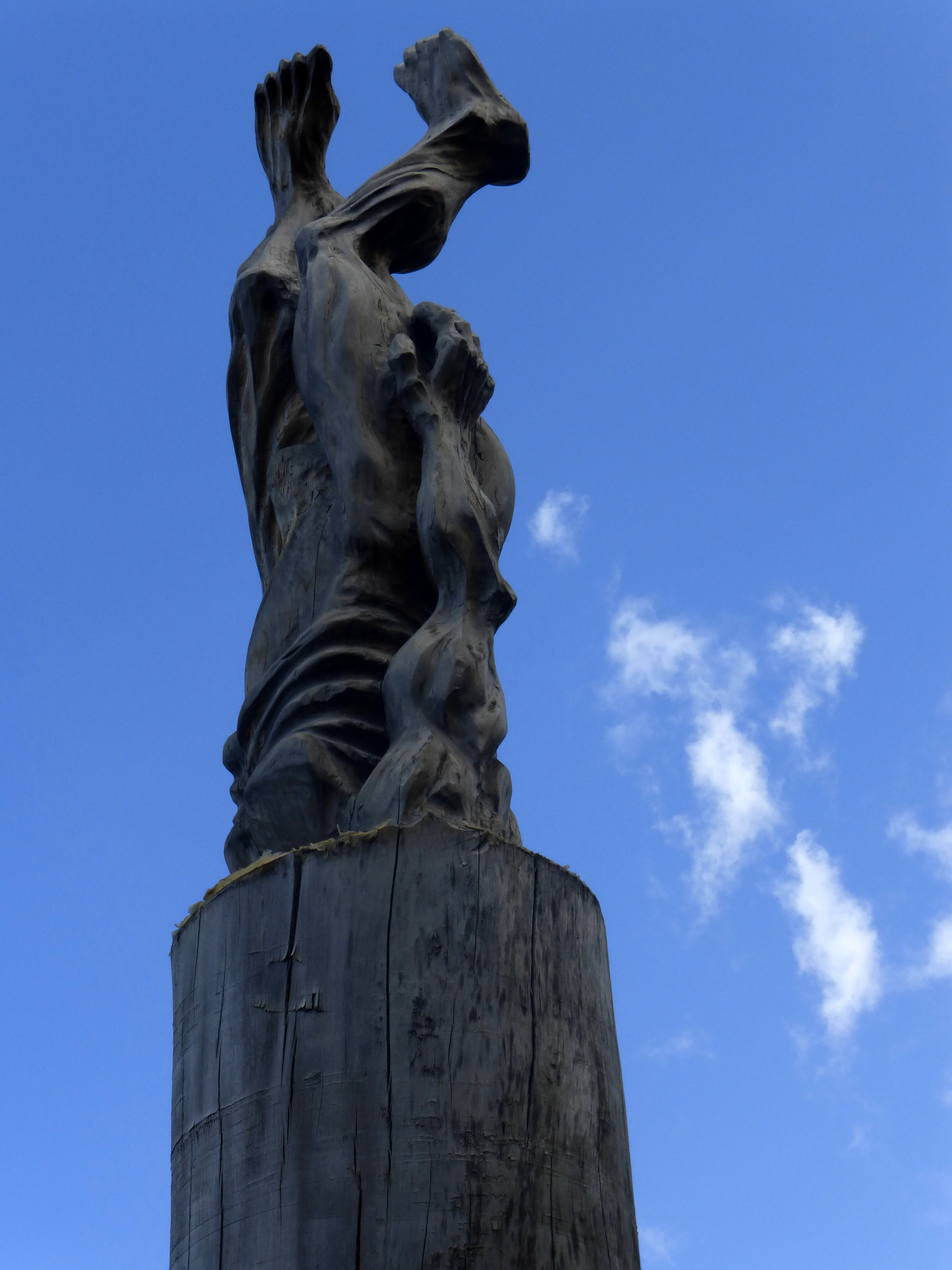
Pictures from St Pierre (volcano top right, anchorage on the left)Sculpture for arts buffs…seems a bit grim to me….
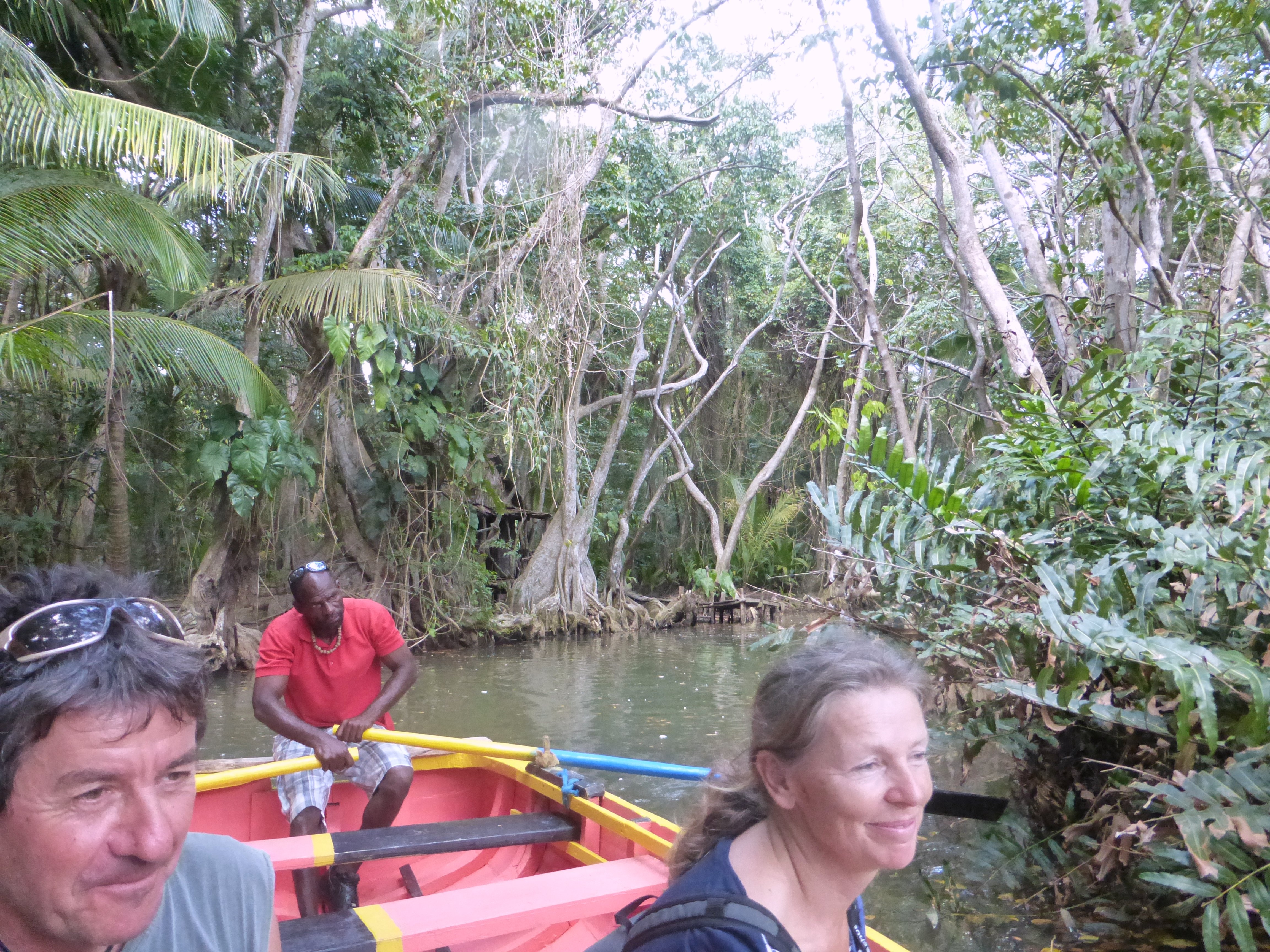
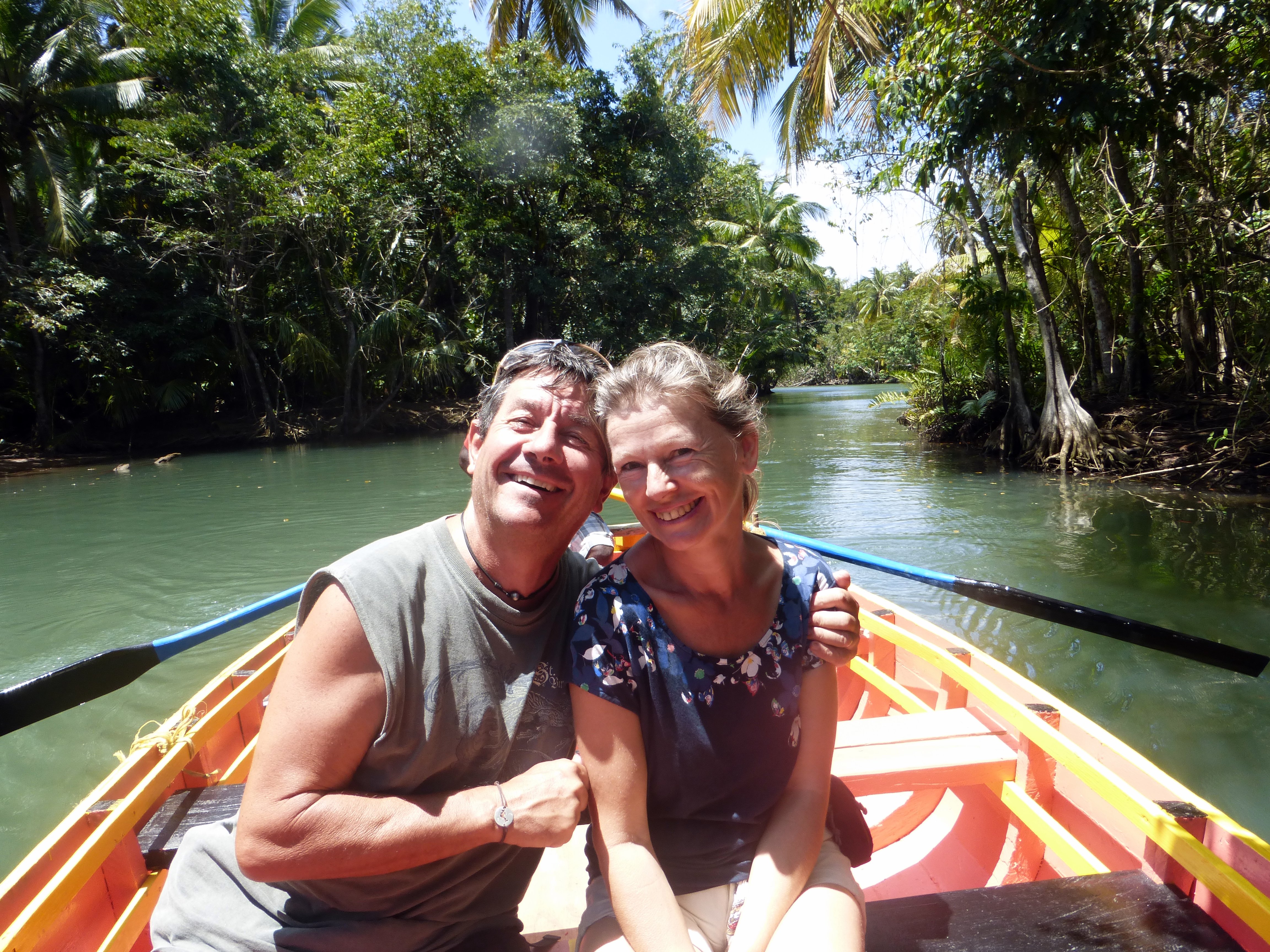
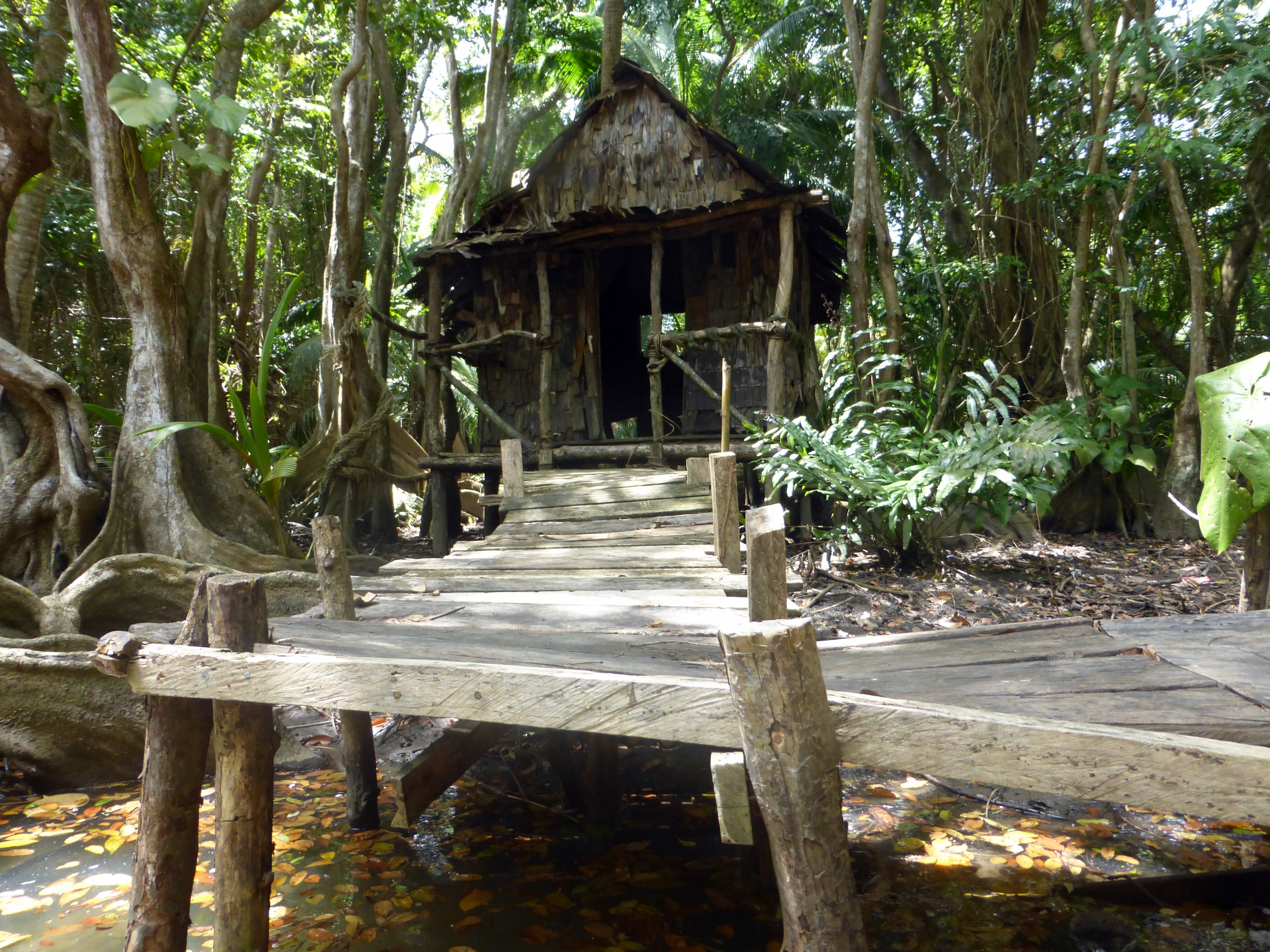
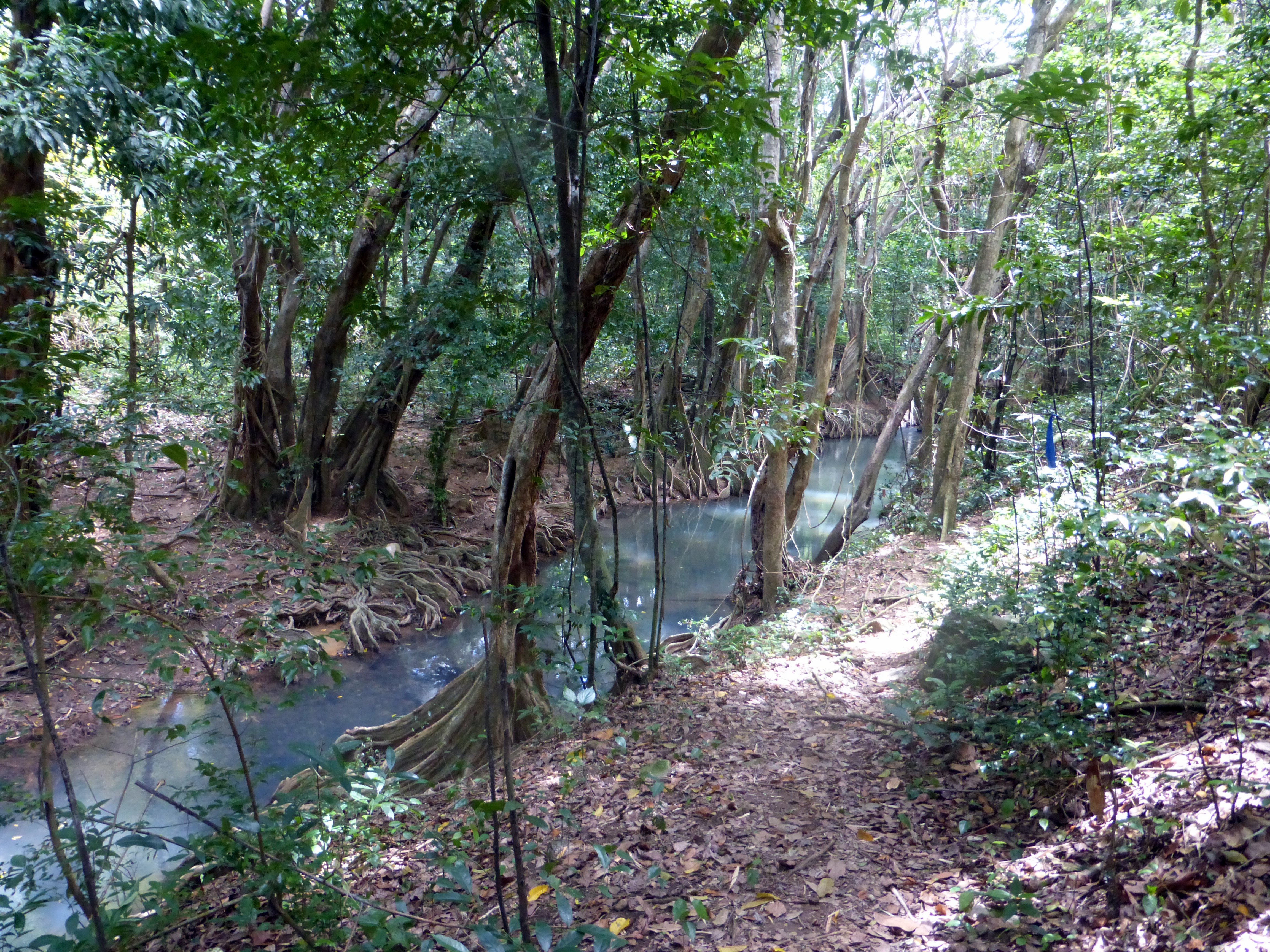
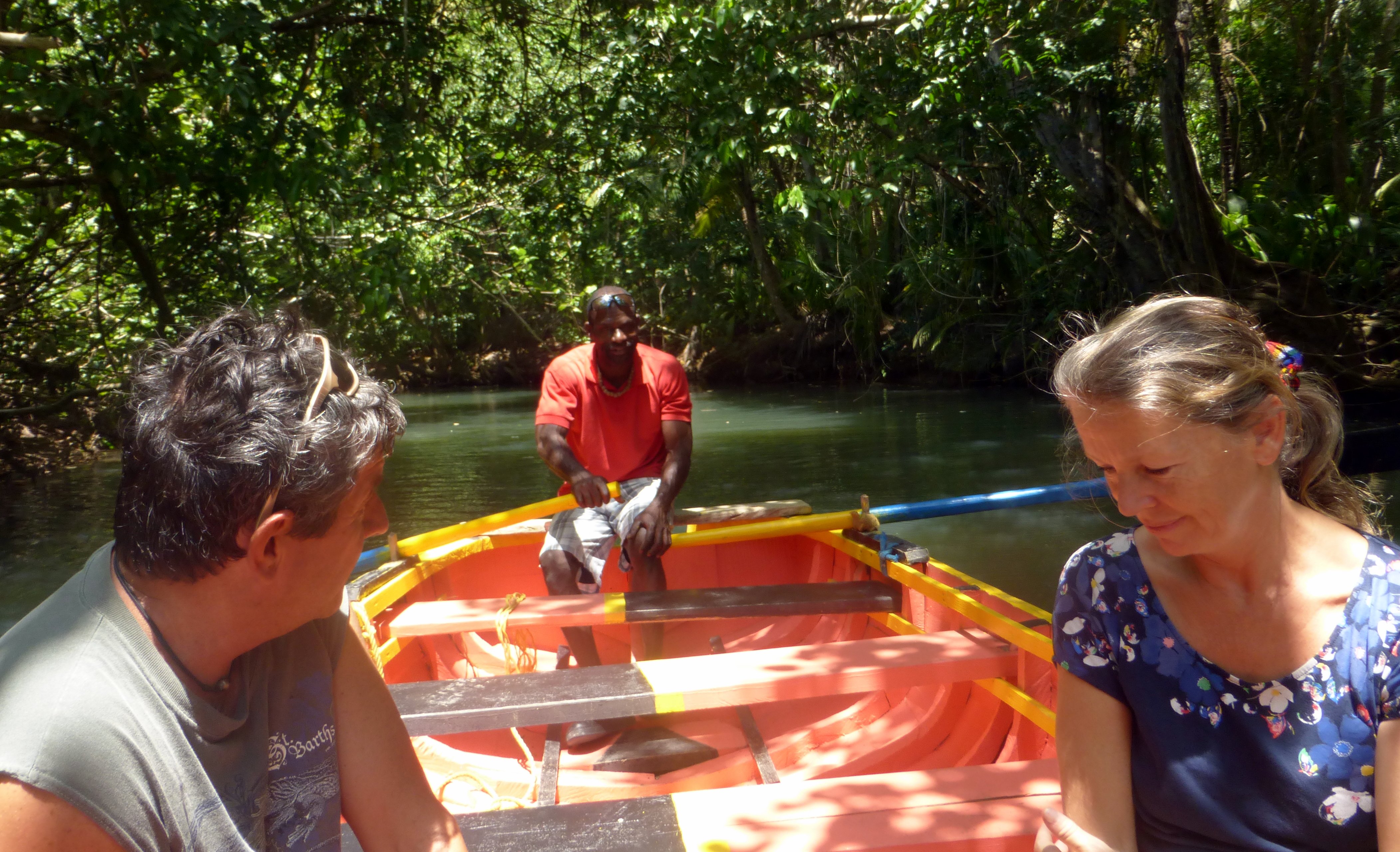
From St Pierre, it was about 50 miles north here to Portsmouth, Dominica – another day, another country, another new courtesy flag. I arrived a couple of days ago, did the Indian River trip yesterday – a standard tourist outing, but very worthwhile and enriched for me more by the French couple who were with me and our guide, ‘James Bond’ (more to do with his girl reputation rather than daring-do), than by the knowledge that Johnny Depp and Keira Knightly were here too (filming one or other of the Pirates of the Caribbean films). Here are some photos.
Indian River (James Bond on oars, plus romantic French friends)Posing for a photo….
I’ll cut this short as the rain has stopped and I’ll head off and go to be a tourist .
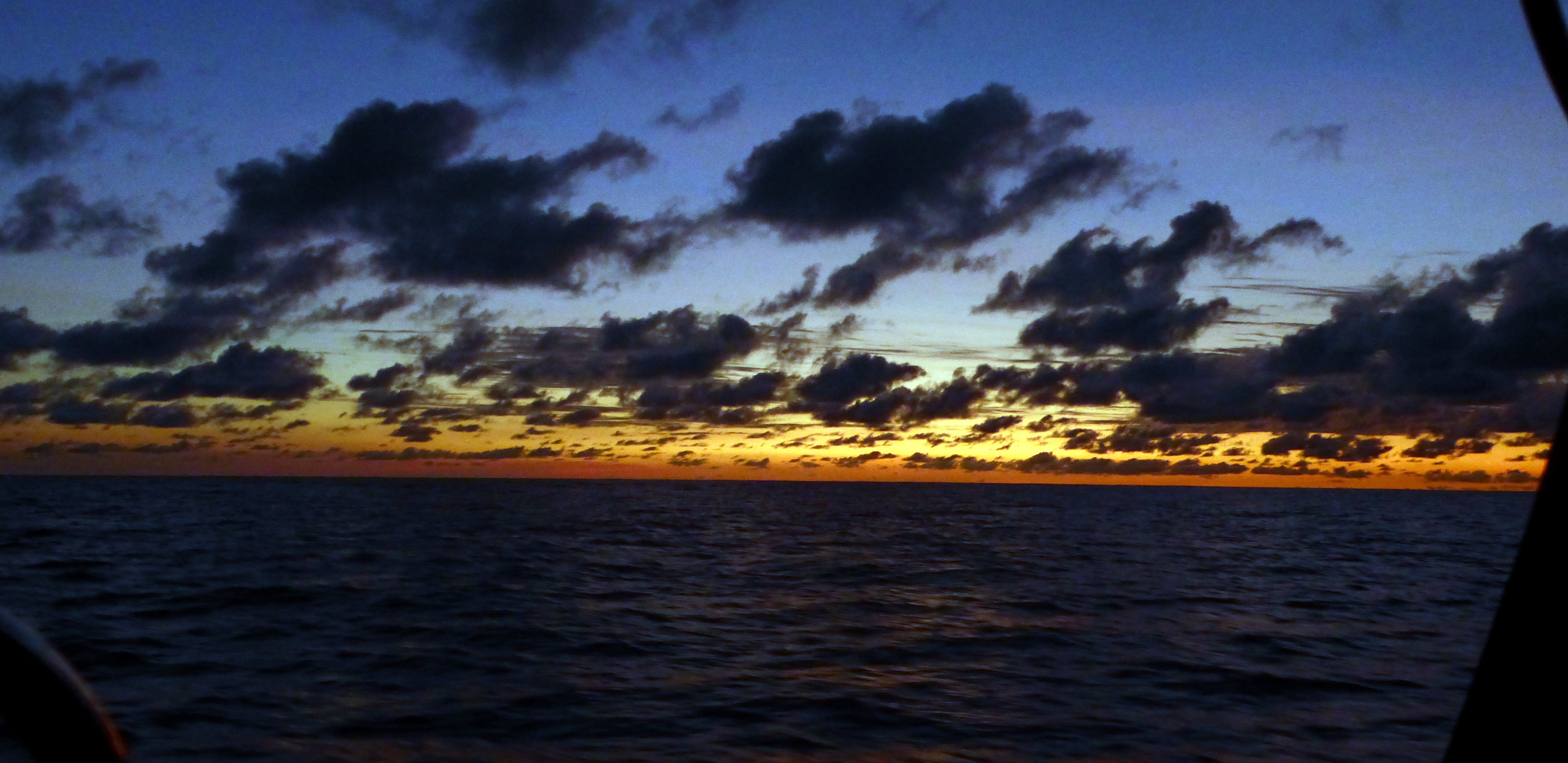
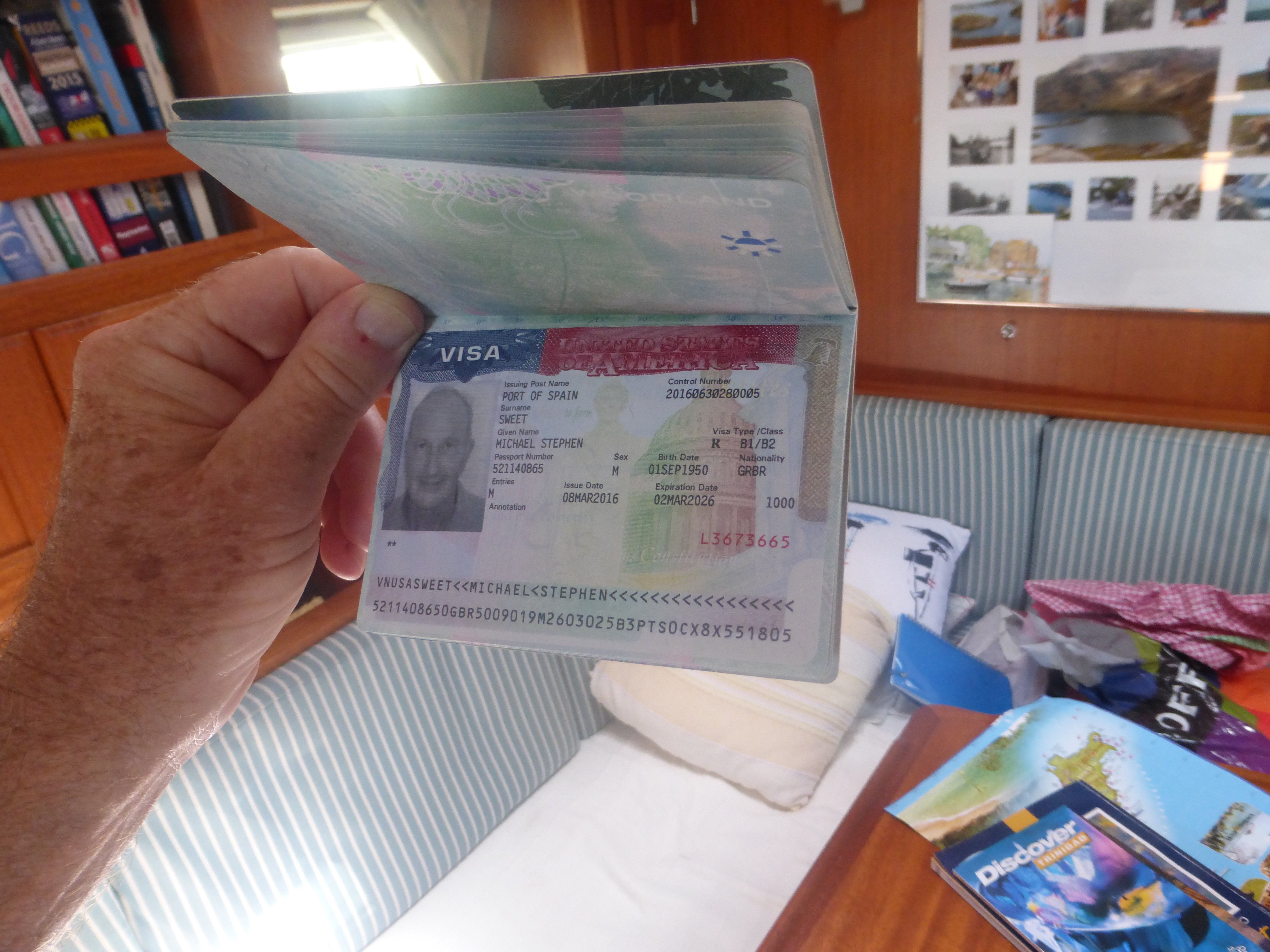
Chaguaramas anchorage, Trinidad (doesn’t show the oil and flotsam lurking)Another fine sunset on the sail northwardsThis is what that visa looks like
At last I have a visa to visit the United States of America. What a palaver! It took 11 days from submission of application to interview, then another eight days to get passport back (info. just in case you’re a ‘yottie’ who might want to know how long it takes. Allow at least three weeks, despite what the website says.) The ‘Interview’, which was in a large open plan office on a sidestreet in Port of Spain, took a bit more than 30 seconds. It went like this: Immigration officer (a bright neat courteous young American behind a glass screen) says, “Good day and how are you today, sir?”; (I dislike being called ‘Sir’ but don’t say so). I say, “Fine thank you”; he says “..and what are your plans when you visit the States?”; me (vaguely), “Oh, I plan to sail up the East Coast “; …”OK, your visa is approved.” That’s it! No searching questions, nothing. I try to plea for speed with actually issuing the visa, because US is meanwhile keeping my passport and I’m a bit stuck without it. I cannot believe it’ll take another week……but noone questions Homeland Security. I waste my breath.
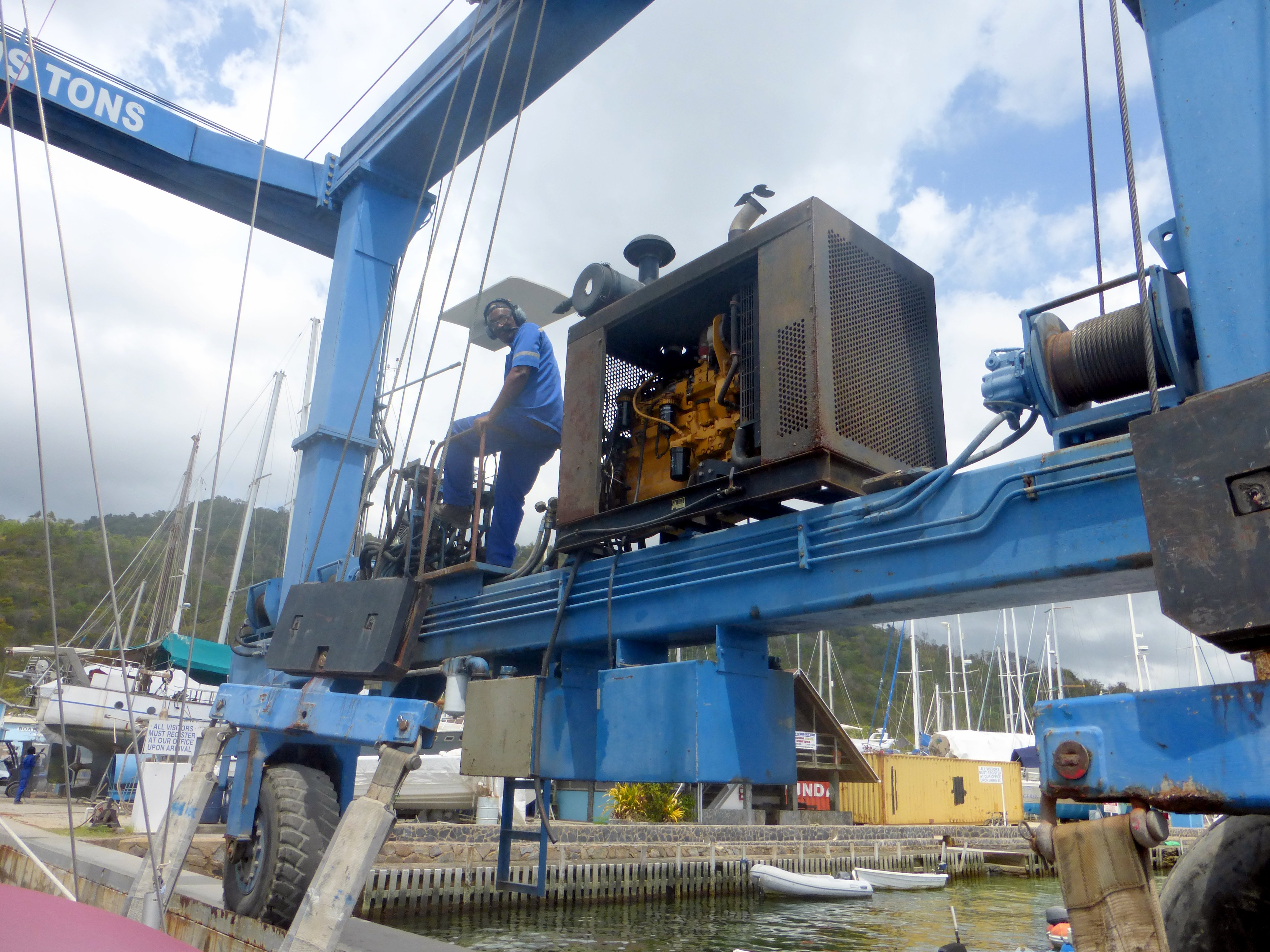
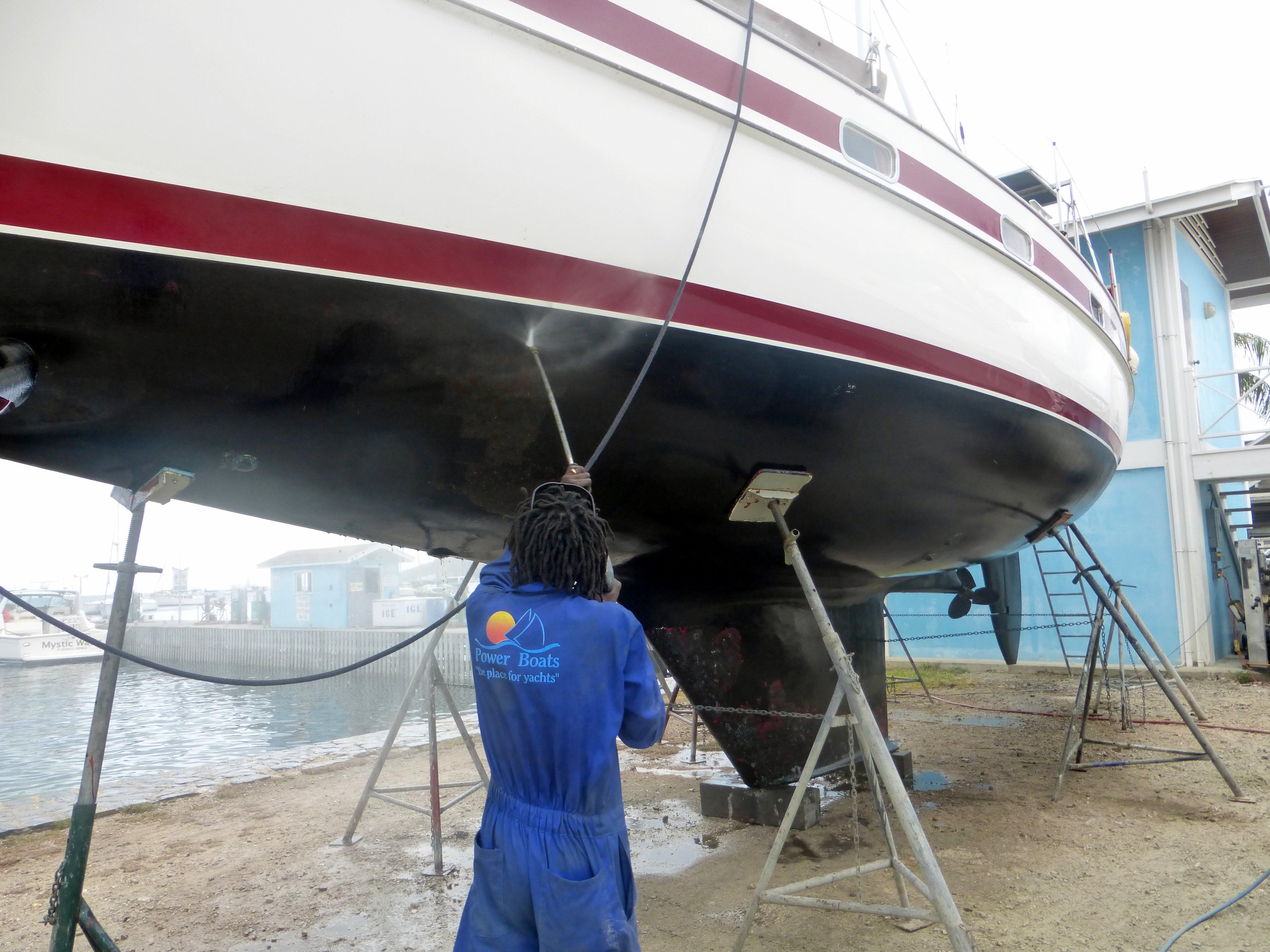
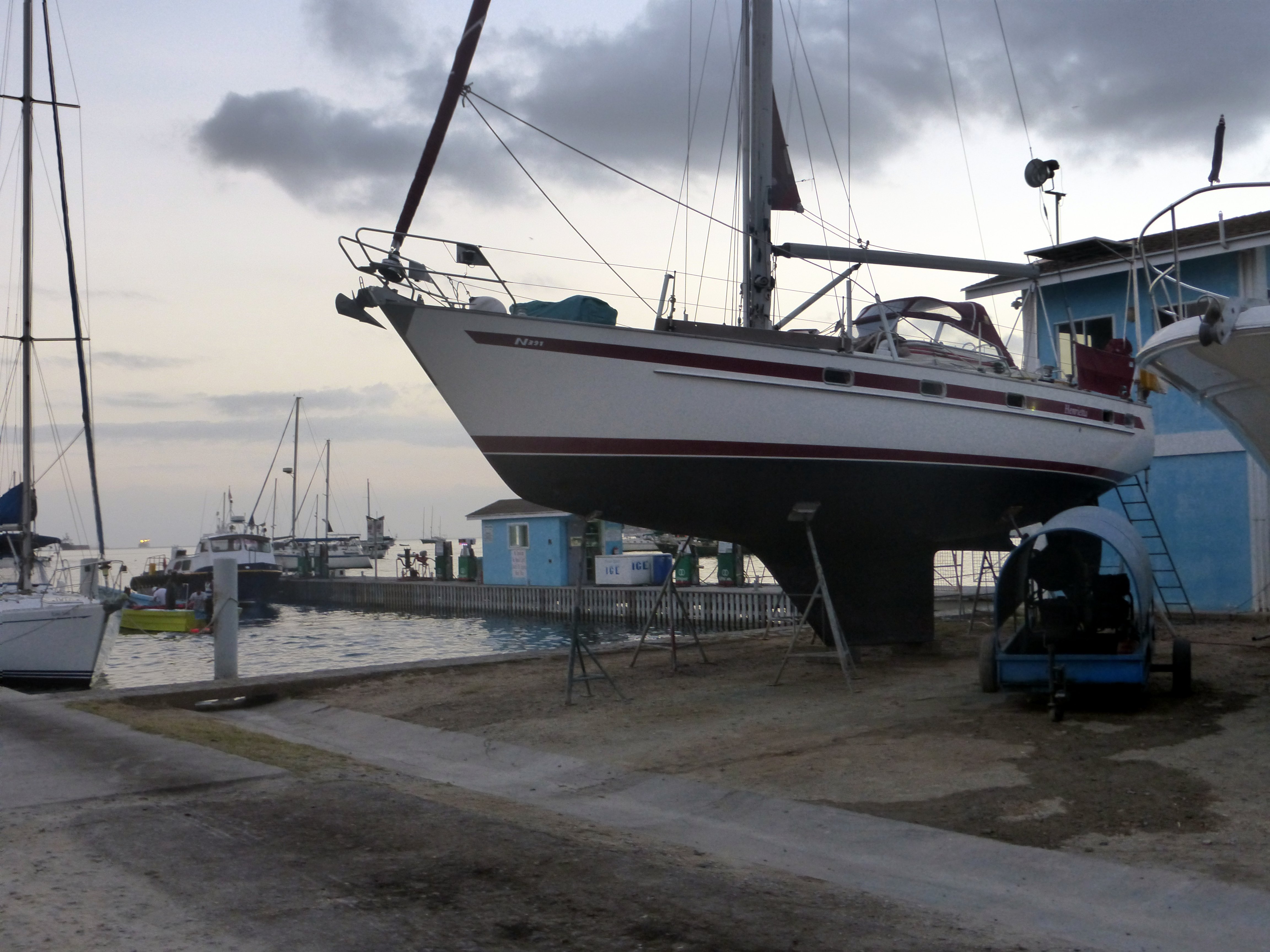
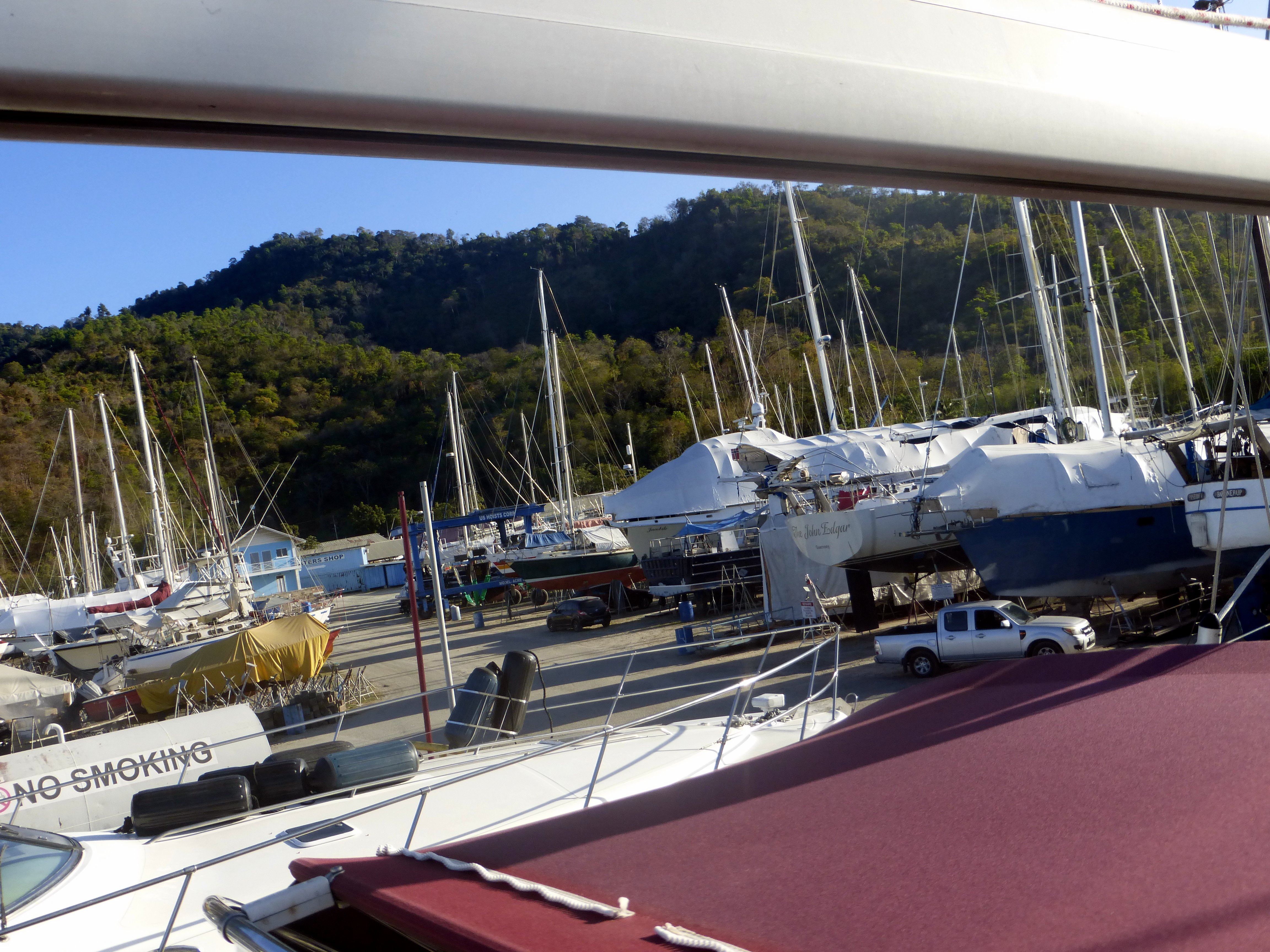
‘Anyway, I enjoyed most of my spell in Trinidad, the longest stop by far since Devon last July. “Henrietta” had a week ashore in Power Boats huge boatyard, and almost every single item on a lengthy “things to do” list was done, giving a rarely experienced – but short-lived – feeling of satisfaction. The yard was a friendly sort of place with that happy boatyard atmosphere you find all over the world (at least the bits of world I’ve seen). Various skills and lots of amateurs muddle along helping one another fix their loved and cursed vessels; polishing, hammering, grinding, paint and varnish and resin, chatter, mutter and curse…and sometimes the roar of the powerful hoist raising another boat from the water. It’ll be really busy in a couple of months I’m told, when many come out of the water for hurricane season, but quite tame whilst I was there.
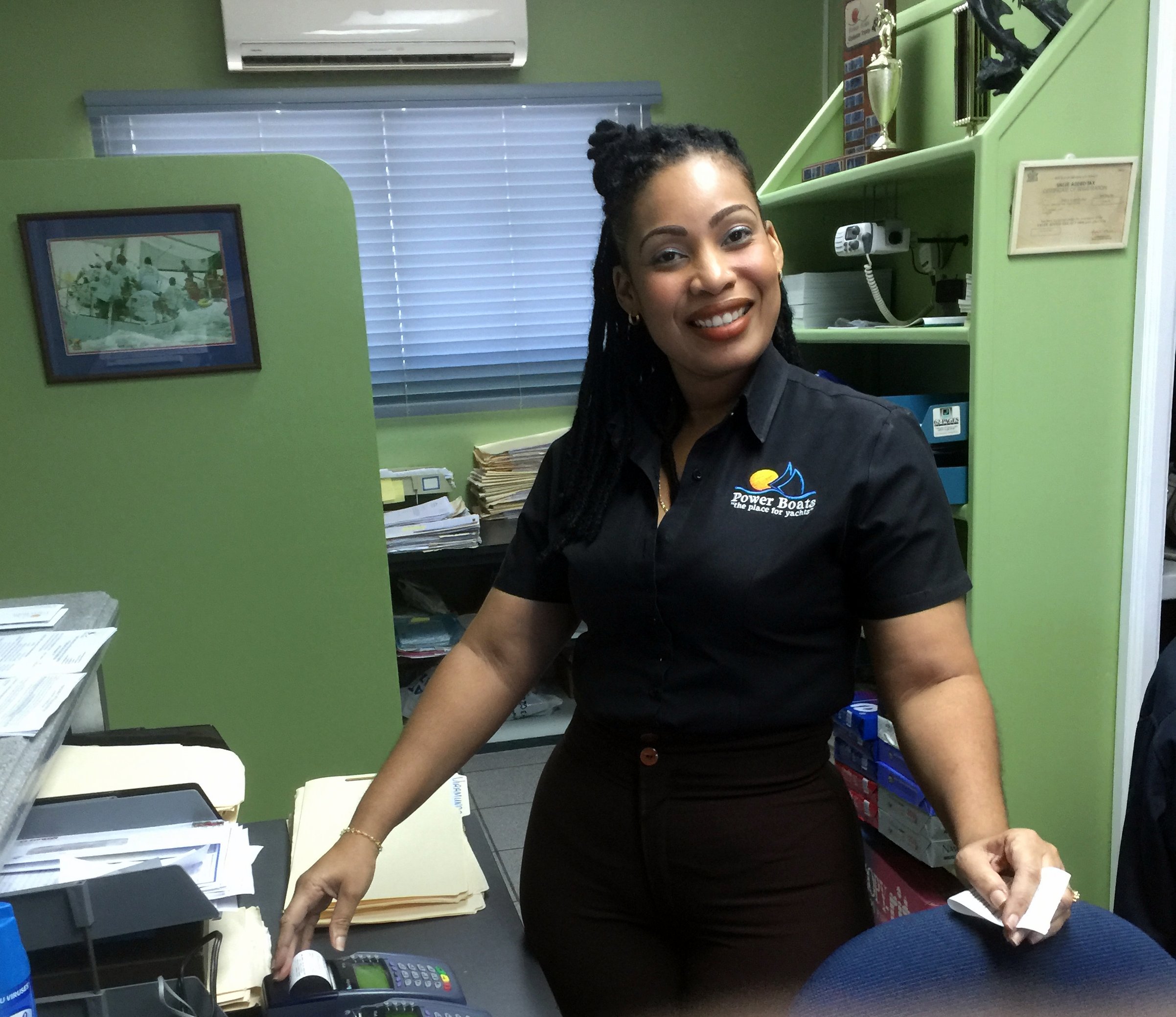
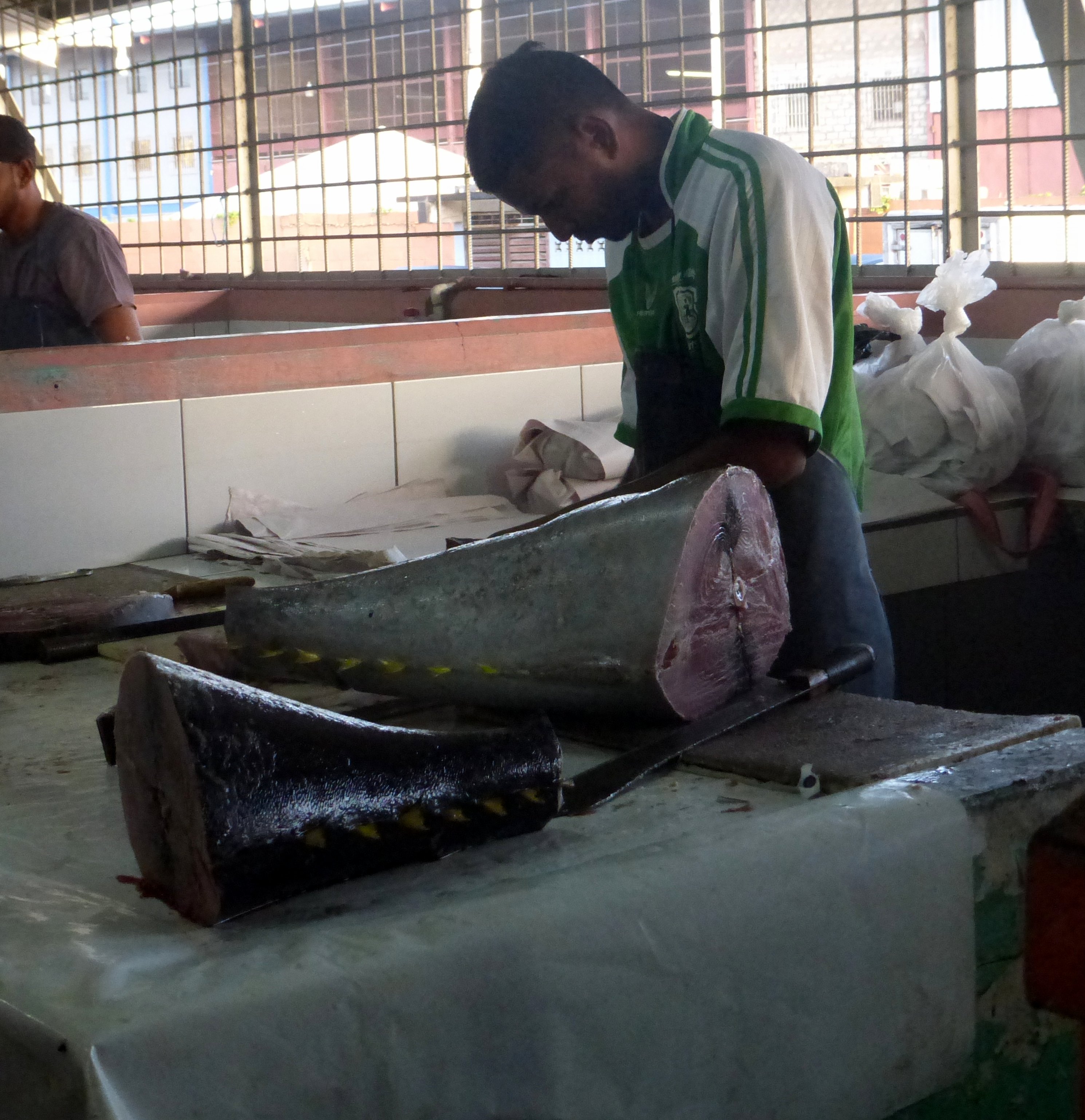
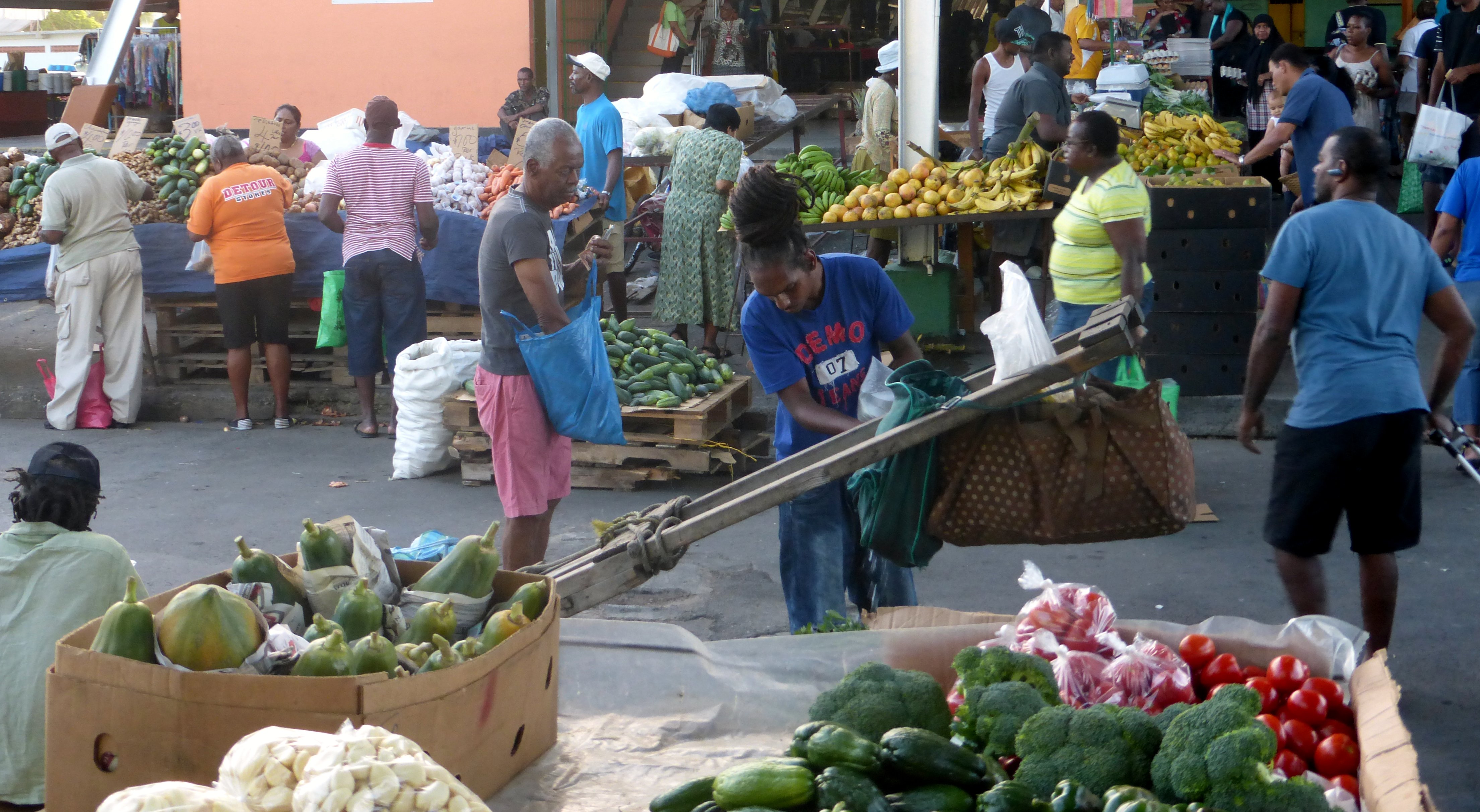
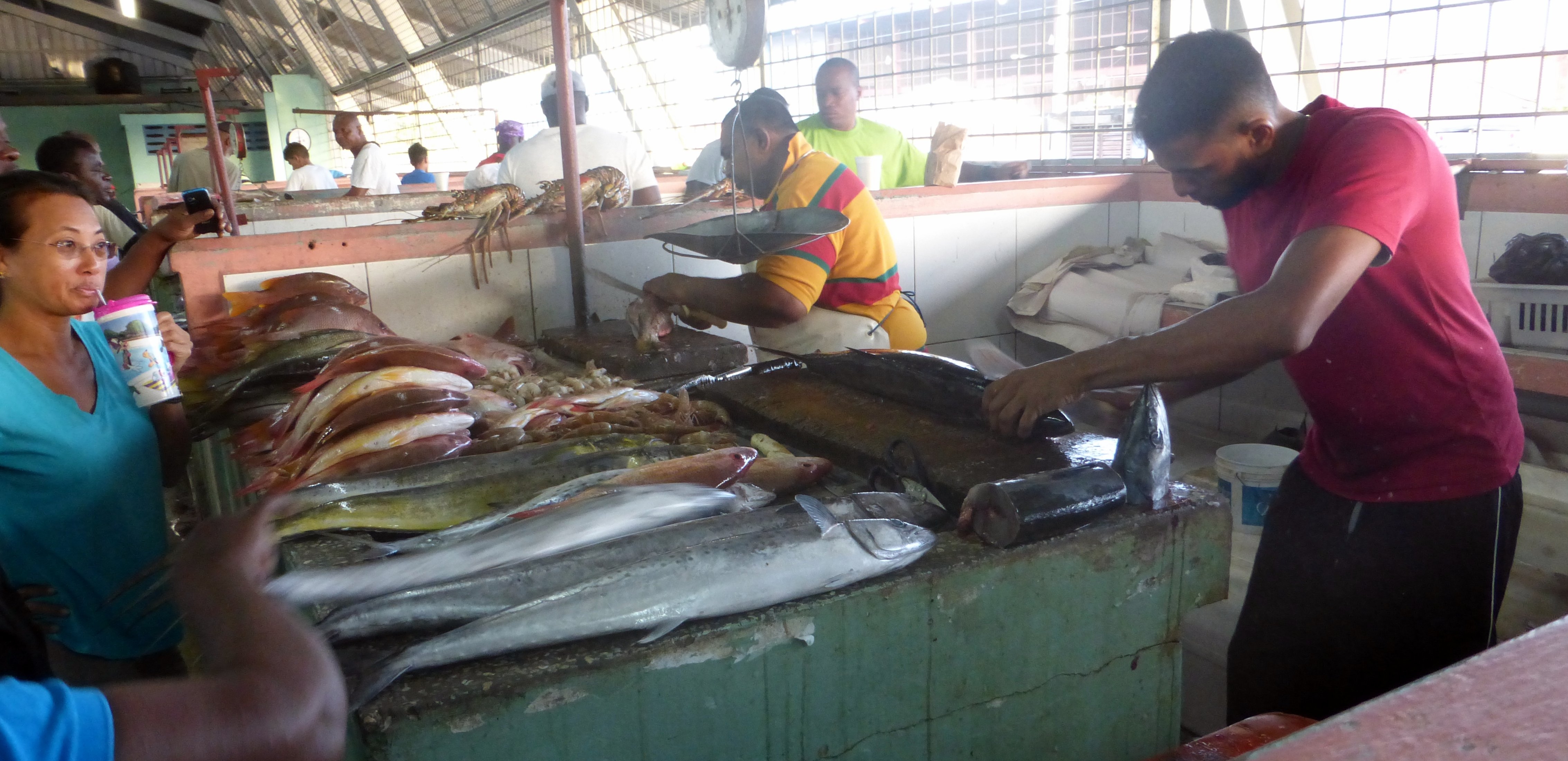
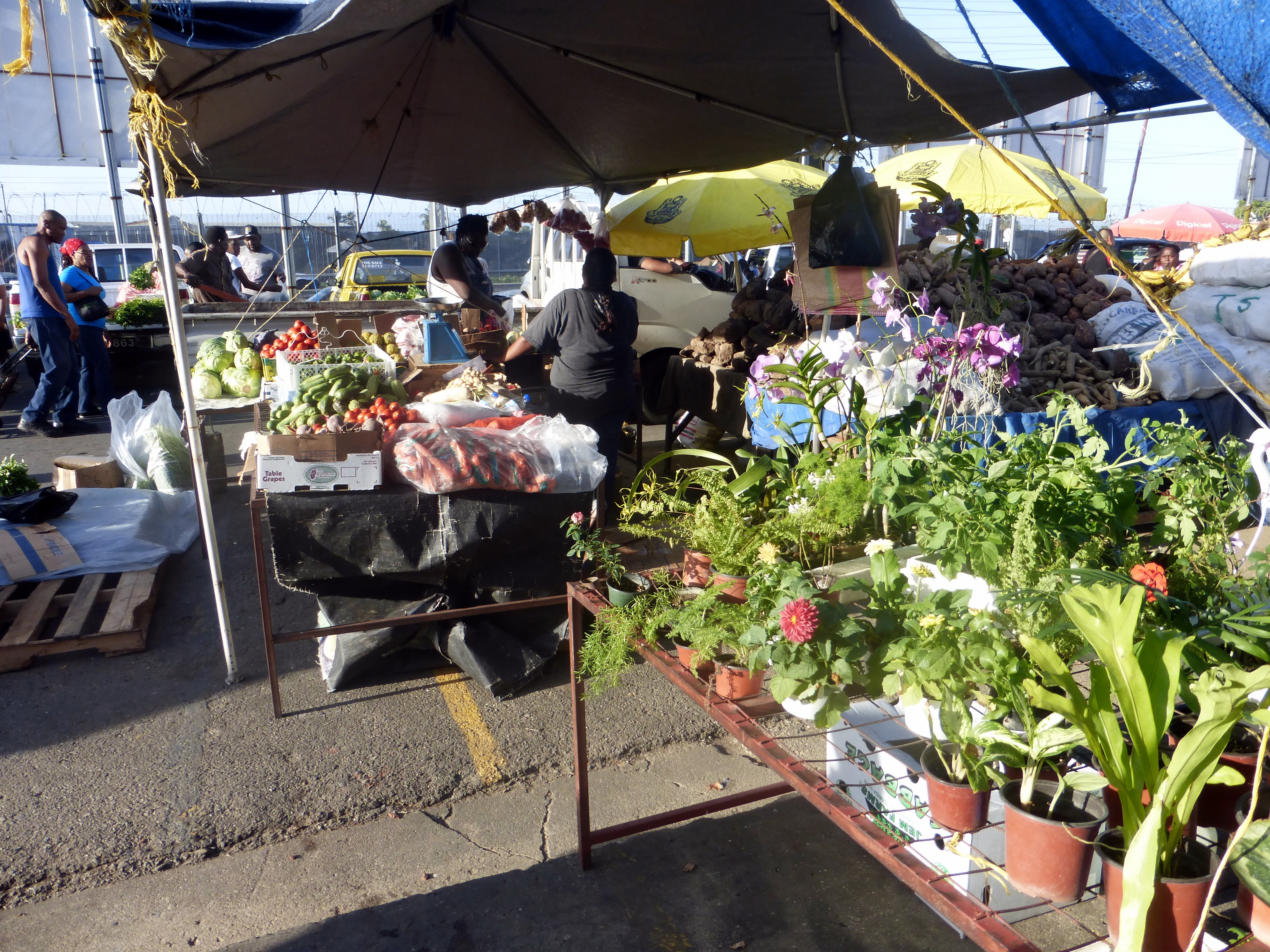
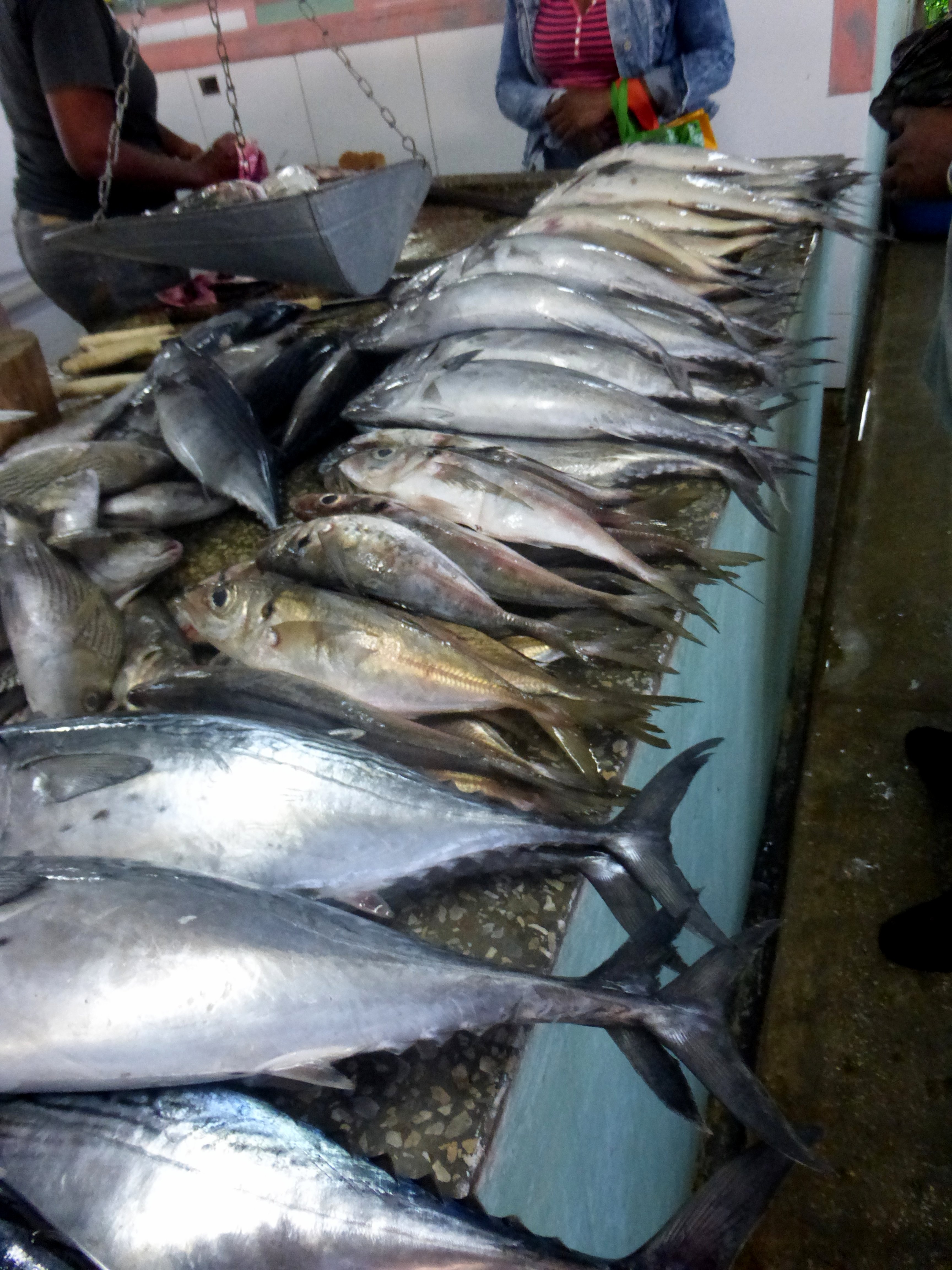
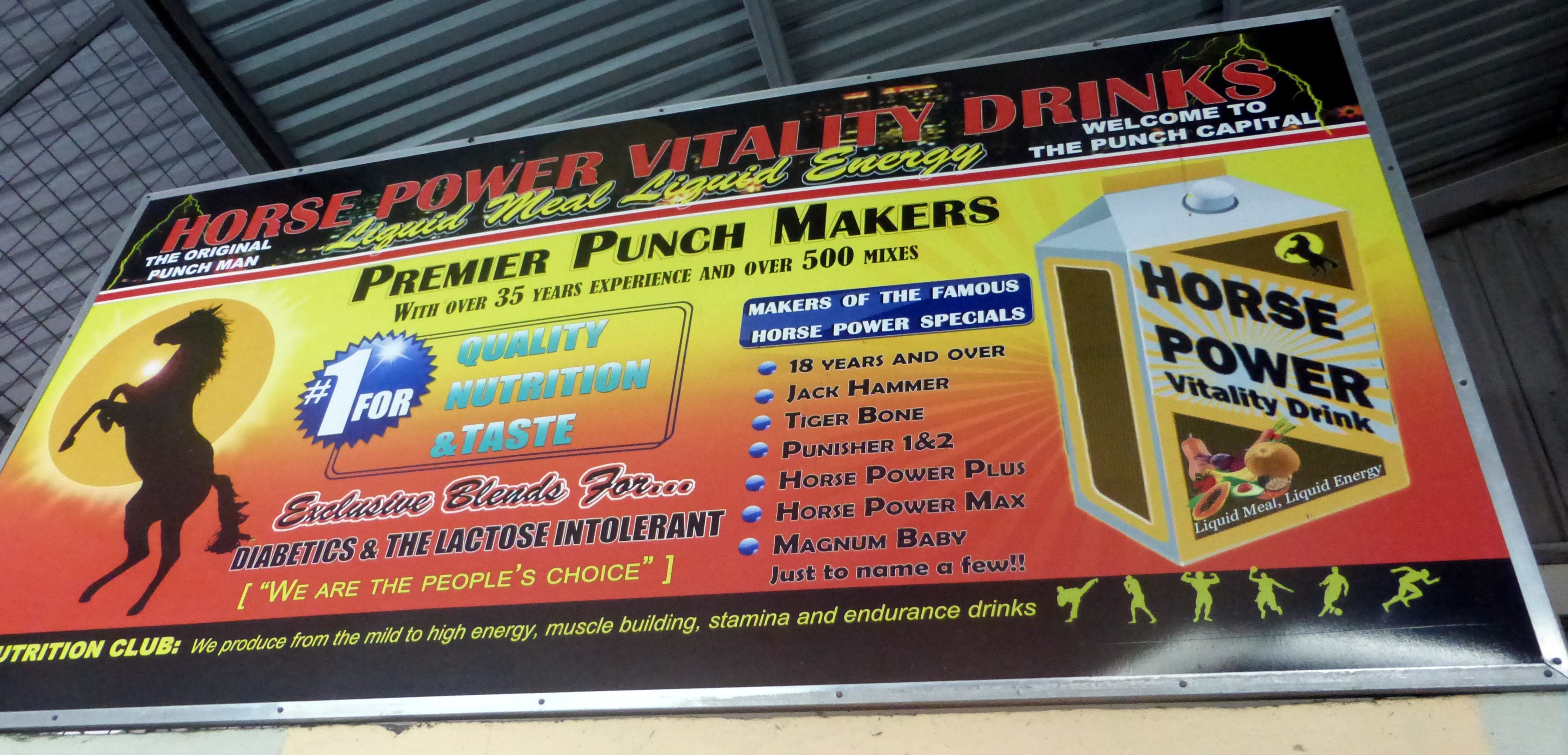
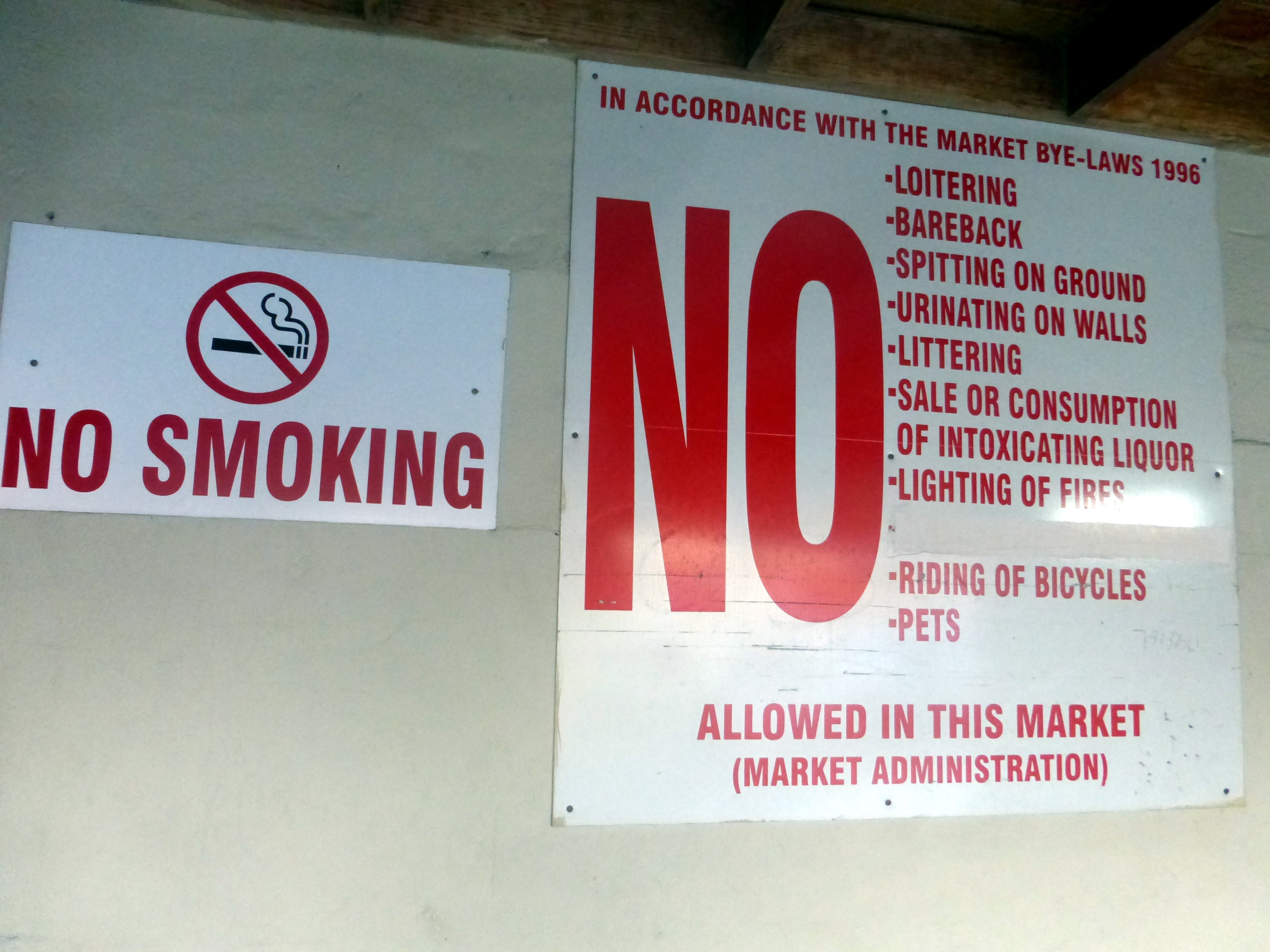
Lovely Simone at Power Boats. Friendly and efficient and always smiling (as I’m presented with the bill)Photos from Port of Spain market…….
You’d need to spend years in Trinidad to appreciate the island’s diversity and beauty, its raw green scenery, the vivid colours and characters. When not elbow-deep in boat chores, I chatted to many fellow sailors, predominantly long or short-term liveaboards (1 – 30 years or more), or holiday liveaboards, who come mainly from Europe or North America for the winter.
‘Liveaboards’ present a very broad church. (Incidently, the opposite of the liveaboard is the ‘dirt-dweller’. That’s you, and the six billion or so normal human beings who live on land!). Liveaboards come in many shapes and sizes and it would be silly to talk of the typical liveaboard. Generally speaking they are helpful, self-sufficient, self-reliant and ‘interesting’. By ‘interesting’ I mean there’s often the hint of a dark or overcolourful past, or unconventional background. The ‘interest’ I find is as much in what’s not said as in what you’re told. I sense that Somerset Maugham would have had a field day. There must be a wealth of black sheep, happy sheep, mischievous sheep among the floating community, that he’d have unearthed and brought to life.
…….rambling on a bit now…so back to life in Trinidad…. I learnt to play Mexican Dominoes (Trinidad variant) whilst there. It’s apparently ‘sweeping the world’ but had passed me by till now. It’s played with dominoes like the ones you know, except numbers up to 12 not six. It has heaps of ‘rules’ that are simple enough but need more concentration than I usually find on a Sunday afternoon. Fun all the same. (Sorry I forgot to take a photo.) Otherwise I went out and about and sweated a lot on some hilly walks (it’s over 30 deg C) …..till getting lost one day, I frightened myself and realised I should have a guide before any more impulsive hilly walks. Then there were early Saturday morning ‘market’ trips to Port of Spain fish/veg/meat market – always rewarding and educational …and supply fresh stuff for the week. (More photos somewhere)
‘Henrietta’, all ready to go…..
Finally excitement …last Friday my passport was returned from US Consulate; so I quickly checked out with immigration and customs, and left early Saturday, sailing just over 200 miles to here, Martinique. (For geography buffs, Martinique is a Windward Isle, and when you sail north for two days and nights, very close-hauled all the way into bumpy waves and northerly swell, you appreciate the origin of the name ‘Windward’), but…. I was really glad to be away from Trinidad. I’d had enough. Henrietta had had enough too. The oily, murky, rubbish-laden waters of the anchorage in Chaguaramas were foul and deterred me from swimming more than once; and left an oily skummy line on Henrietta’s pristine hull. Electrical SSB stuff was not properly fixed on Henrietta (despite the bills). Finally, unhelpful customs officials seemed hell-bent on extracting ‘overtime’ payments (even when in their offices within office hours). My grumpy-old-man gripes left an unpleasant taste, so it was delightful and a real joy to be at sea once more.
Approaching Sainte Anne, Martinique. Through the binolculars it’s a busy anchorage…..
Martinique is a fine French antidote. Tidy streets, colourful fashion shops, and of course a baguette and some Bordeaux plonk! (For sailor folk, customs/immigration stuff here cost two euros, not the 253 TT dollars extorted in Trinidad!). I’ll stay a few days before slowly heading further north.
Another bit of France in the Caribbean
Finally, this from a concerned American friend: “Americans think there’s an election coming up. The rest of the world thinks it’s an IQ test. And America’s not looking too bright!”
The last post said I’d go north. I’ve come south. Why? (Apart from this being “…The unreliable journal of a sailing boat…”)
Ah well, the reason ‘why’ could become a fairly long story,but, briefly, the fact is that after hours of failed attempts to submit an online US Visa Application, stubborn perseverence paid off and I finally succeeded. (Magic trick was to submit a passport type photo from my camera, not the iphone ‘selfie’ that I’d started off with [US Homeland Security clearly rejects the iphone ‘selfie’]….better method: rig up Henrietta’s saloon as photo studio, subdue lighting, white bed sheet for portrait backdrop; set off camera shutter with 10 second timer; dash round saloon table; sit and smile…oops, DON’T smile…this is a USA visa photo…) Edit photo…Find wifi hotspot. Try submitting again. Done! It worked; success!
….Alas! that’s just the first stage. Payment, interview, approval (or not) comes next. Furthermore, I was in Grenada at photo shoot stage, where none of the next stages were possible. In East Caribbean, if you want a US visa, there’s the choice of Barbados or Trinidad for next bits, ie. to pay the fee and attend interview. Futher hurdles to jump: Barbados was about 130 miles east and straight into wind, waves and current; Trinidad about 80 miles south, more favourable winds but with recent yacht bordings by Venezuelan robbers a concern. (I researched this robber trouble a bit and find all will be ok if I send ‘float plan’ to Trinidad Coastguard, choose a course well east and away from Venezuela and choose a fairly rough windy night – pirate types apparently don’t like choppy seas.) In a bit of a rush then, and as forecast was promising, I quickly exited Grenada customs/immigration, sent email to Trinidad coastguard, upped anchor and was off….delightful overnight sail, albeit a hard beat for the first 40 miles or so, out and round a brightly lit gas field…..(I always feel a thrill heading off-shore, out into the open wave-swept spaces and away from the workaday bothersomeness of life on land). As promised and before dawn, Trinidad Coastguard called me on VHF – checking all ok.
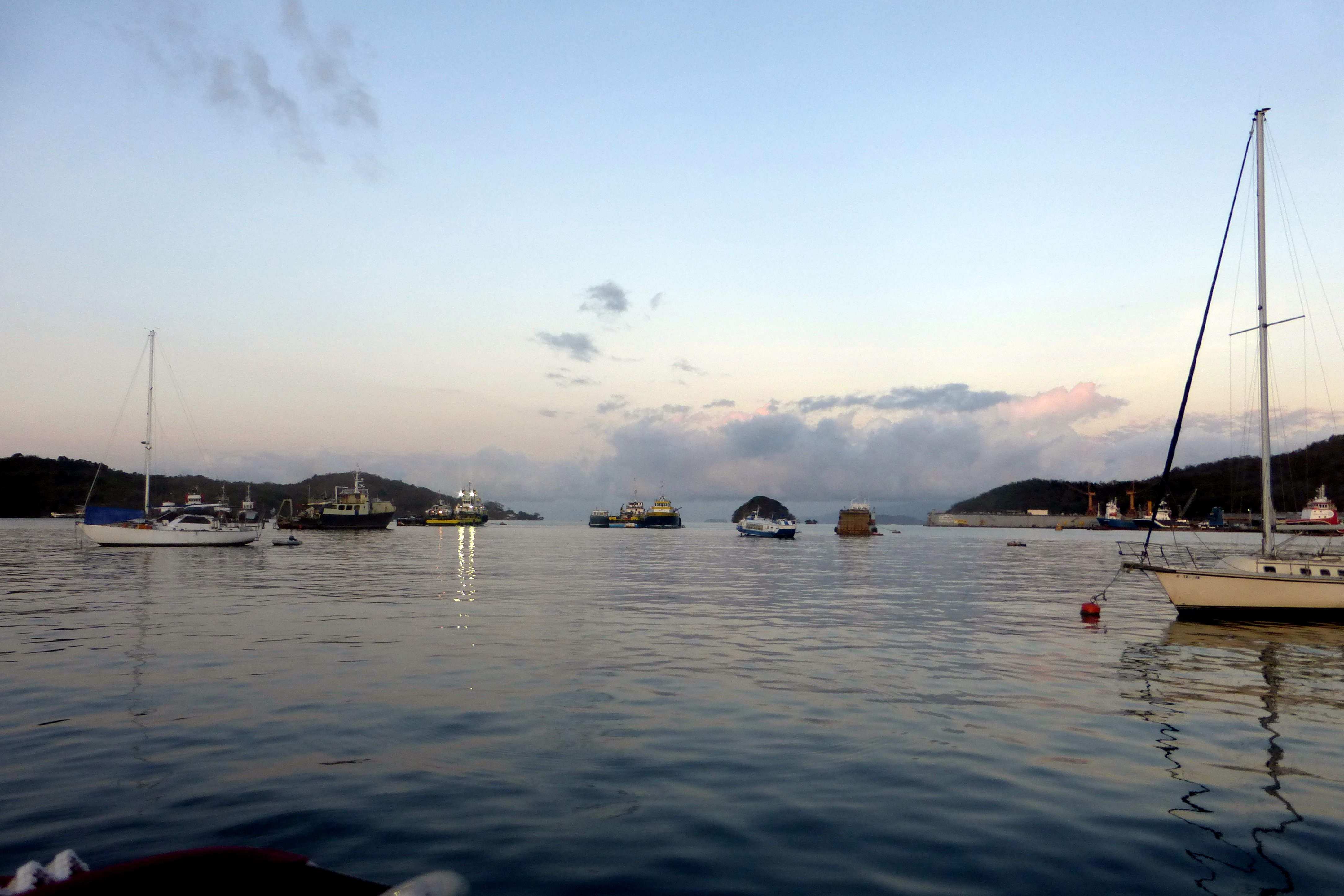
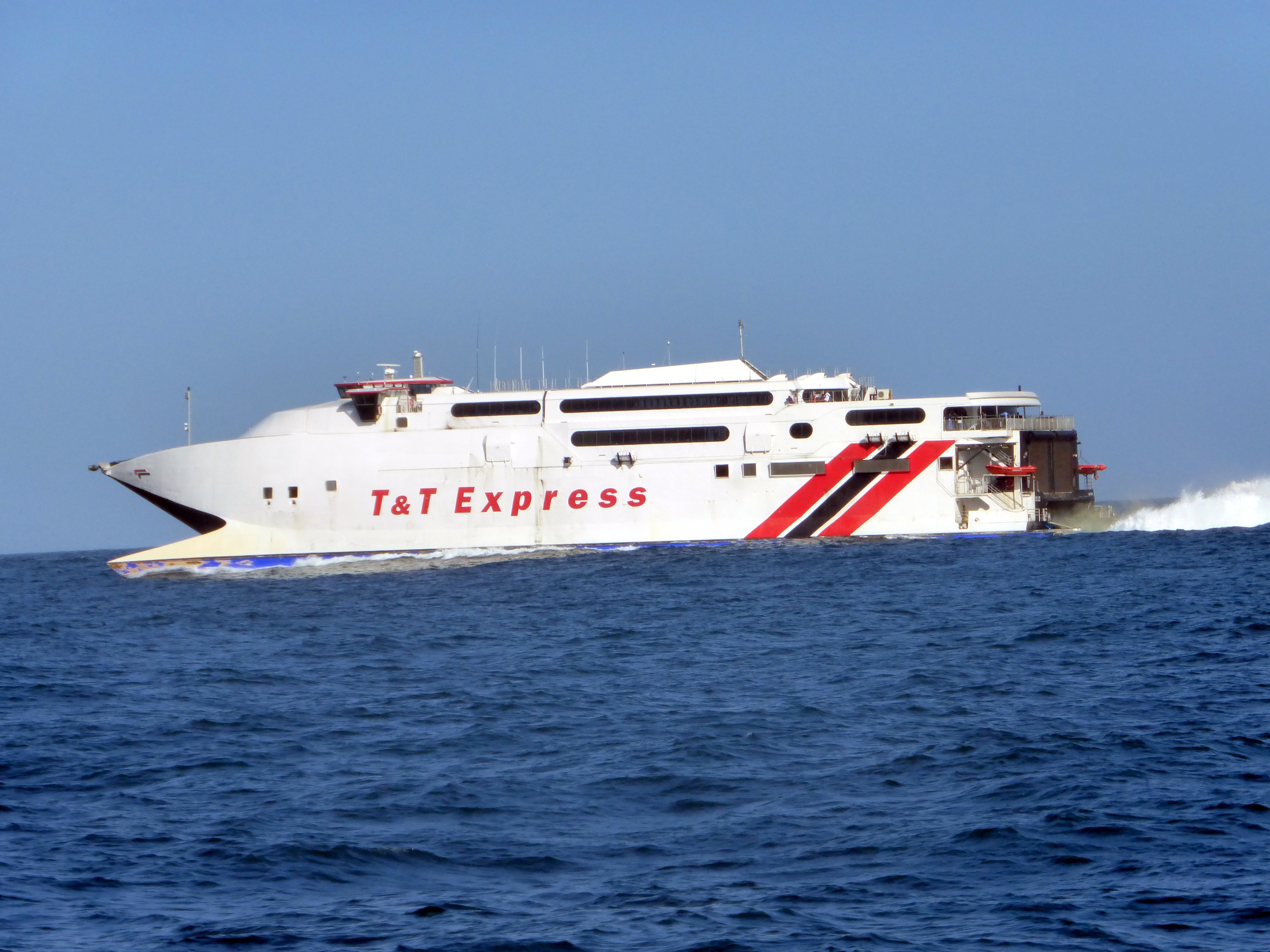
A few hours later on a clear bright morning, Tobago-Trinidad high speed ferry growled/roared past (memories of the Condor craft entering Poole Harbour – you hear them from miles away!).. … we head on and arrive at Chaguaramas, in the north of Trinidad. It’s the yachting mecca of Trinidad, if not the Caribbean – at least for maintenance work. Being far enough south to be out of main hurricane belt it’s a popular place for fixing, storing, and living on boats while hurricanes threaten more northerly islands. (Not sure how long this historic popularity will last given more competition from Grenada, plus some strange unfriendly immigration folk, and appalling arrival dock, and higher prices! But for now there are around a thousand spaces on land and every conceivable yacht skill on offer.)
Lift-out in Chaguaramas
Henrietta is out of the water, as, waiting for local US Embassy interview, I’ll work on her. On land in a giant boat yard I have a waterside spot . There’s a medium length list of chores and checks before relaunching, including anti-fouling, anodes, radio, rigging, solar panels, deck, ………… Oh! The 16 year old and heavily stained and beholed genoa finally had to go (delaminating) and a pristine new white one is up at last. We’d brought it all the way from England.
Waterside spot…..
With time ashore to meet people and see more (and despite my negative views of immigration service), I come
to like Trinidad more and more. Totally different from other Caribbean islands (did you know it is relatively wealthy with oil/gas, half population is of Indian extraction, around one and a half million people live here, and the local English comes with a pronounced Welsh accent?) It has a high murder rate too -per capita, I’m told, more than Jamaica – but not a problem if troubled gangland spots in Port of Spain, the capital, are avoided. There are many boats and yachtie folk in the yard and anchored off, so social life is as full as you like. Most of us work on boats much of the day or take trips to Trinidad’s interior (more about that another time). It’s not really a touristy sort of place though; there seems a more businesslike and serious-minded approach to life. (The Carnival, earlier in February, with its liberal dose of music, sensuality and all-round hedonism, being an exception to the general way of life.)
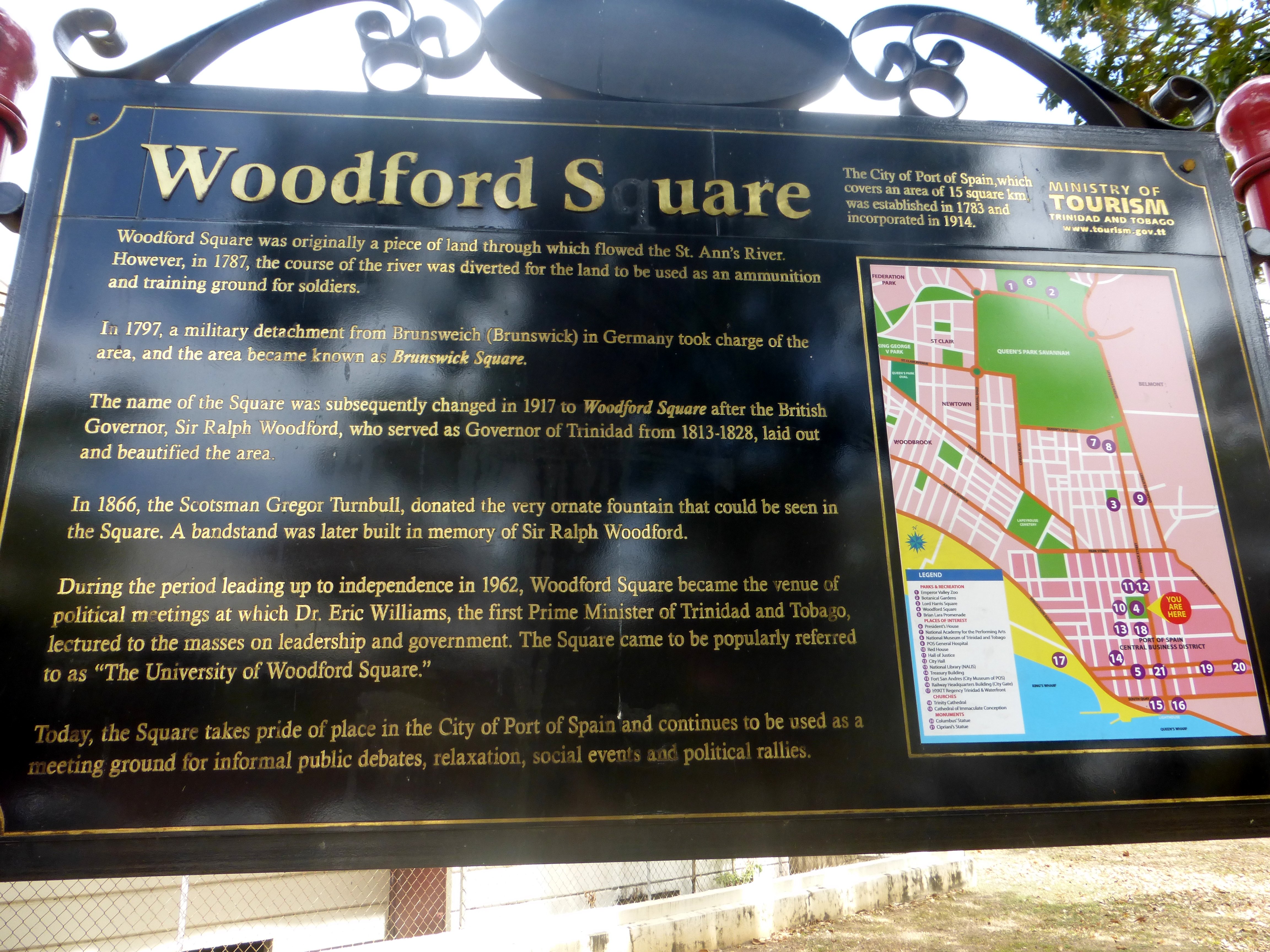
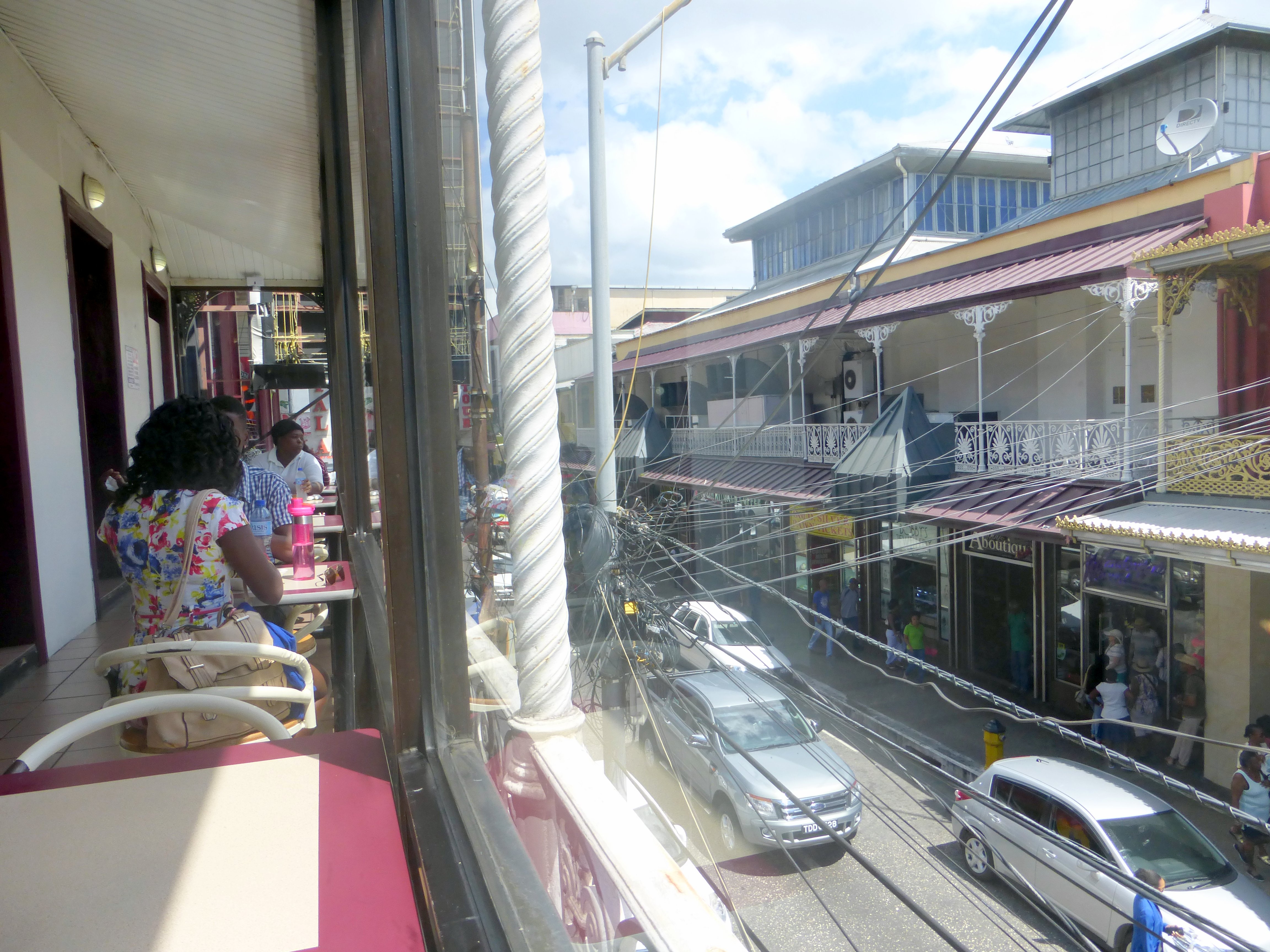
…view over yard…Photos from Port of Spain and its market………
Port-of-Spain is a traffic-plagued, overheated and bustling city, with gems of Colonial architecture and an occasional cruise ship, and good shops and exceptional market. I’ve visited twice so far. Traffic congestion thankfully keeps mini-buses (locally called ‘maxi-taxis’) to a less terrifying pace than elsewhere in the Caribbean!

























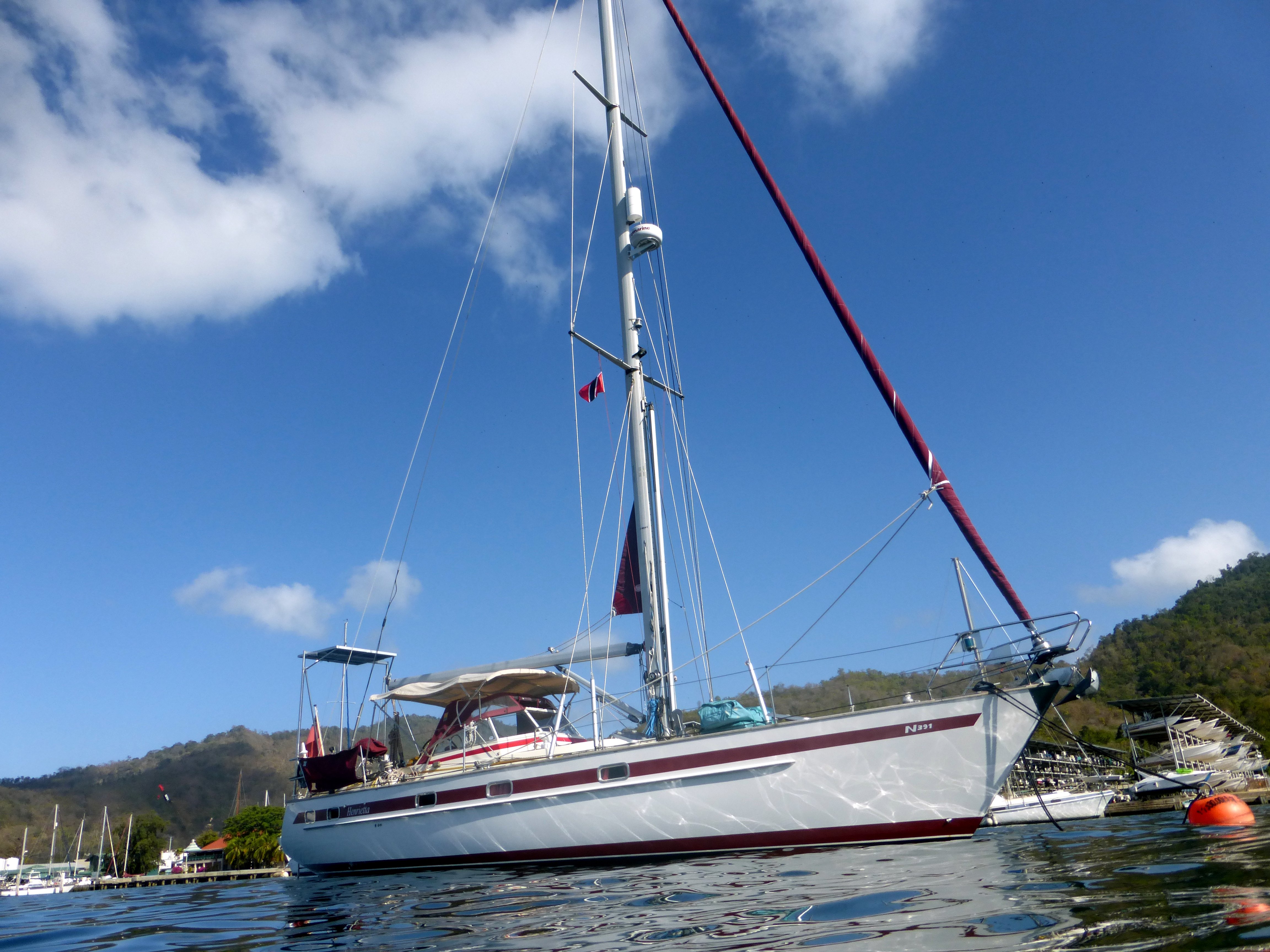



 Sailing Henrietta