Down to Valle Gran Rey (La Gomera) with GeorgeFor the past three weeks I’ve had company on board; first, son George, then friend, Stephanie. Since my favourite humans are my children and nice women, this has been a bit of a treat – even if Stephanie, for all her many virtues, is not a liberal vegetarian. (Stephanie won’t, I hope, mind me saying this!) For the next few weeks, if not months and years, I shall be single-handed, so it has seemed important to enjoy the company of others – stickily despondent as my current mood may be.
Of course, as a single-handed sailor – or even not as a single-handed sailor – you do meet many other lovely folk. For, most waterborne people agree, one of the greater delights of sailing – or travelling in general – is meeting, talking, and exchanging ideas, opinions, experiences and knowledge with others. But these encounters will always be fleeting compared with the hourly and daily contact of familiar others. Never mind… all travel is enriched with understanding (or trying to understand) fellow beings. The world seems such an overcrowded bundle of multiple confusion and fascination.
….The above stuff is not really what this blog set out to cover. But, if you read this, you might find it rather tedious to have a repetitive diet of ‘where I go and what I do and who I meet and what I eat’ – hence: the odd rambly thought.
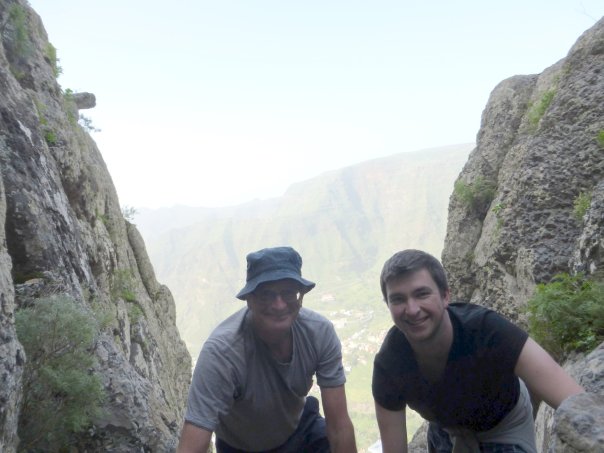
To cover briefly the where/what/who stuff….George and I enjoyed some typically inspiring walks on the island of La Gomera. With so many varied routes, you may spend many months here and rarely cover the same ground twice, and of course it was doubly delightful to share outings with my youngest son.
Walking on La Gomera….
…and swimming…
Garajonay National Park
Pretty street, Agulo
With George leaving me for the brighter lights of London for New Year, Stephanie and I, plus sailor-neighbours from Hampshire, Norway and Holland, enjoyed local New Year celebrations in San Sebastian de la Gomera (friendly and welcoming with magnificent fireworks and shared champagne). San Sebastian is perhaps my favourite little town on my favourite little island in all the Canary Islands – at least, while aboard a boat.
Lunch
Lunchtime
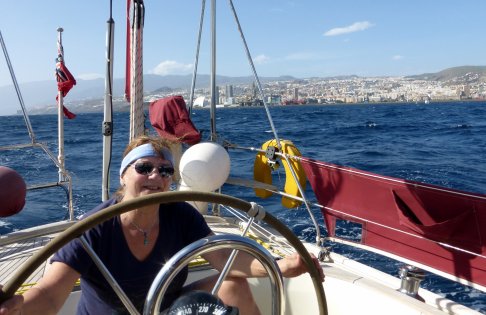
gently sailing north with StephanieThence, Stephanie and I sailed gently up the eastern side of Tenerife, via nights and launderette of Las Galletas, to the Tenerife capital, Santa Cruz. Whilst there in early January, we coincided with the ‘Procession of the Three Kings and Epiphany’. Apparently, children hereabouts don’t get their presents until the said holy kings have visited, some twelve days after Christmas itself. But we didn’t see these three latter-day gentlemen arrive after dark by helicopter in the football stadium and from there set forth through the city’s beautifully-lit streets, on camels; streets thronged with amiable local people though.
From Tenerife, the wind forecast looked just-about-ok for the 120-mile trip round the top of Tenerife and then round the bottom of another island, La Palma, to the welcoming port of Tazacorte. In the event, conditions were not really ok and temperamental winds blew from any of the compass’s 360 degrees with anything between five and nearly 50 knots – so, it was a sleepless 24 hours.
On arrival we were not allowed into a berth (manoeuvres considered too risky) and, with strong south winds, spent the first night lurching, creaking and wallowing at a reception pontoon. Next day, wind eased and we shifted to a berth. And now, a week later, as I write this, I feel pretty much at home. I’ve enjoyed several new walks on La Palma. Henrietta is comfortably sandwiched between two Dutch yachts, between them sporting three charming and disarmingly attractive girls from Holland.
Here are some images from La Palma….
This slideshow requires JavaScript.
Despite such delights, it’s been a time of half-hearted decision-making – i.e.not quite ‘-making’. I’ll head back to La Gomera in a day or two, or three. Then, try to work out if I really want to leave the beauty, the diversity, the security, the cultures and the delights of Europe (especially warm friendly Canary Islands) for the world’s less-privileged continents.
H: The trouble with Michael is that he’s just a human being, just a plonker human bean. Not homo sapiens, more like homo plonkus. He has all these feelings and thoughts and human stuff. He gets moods of despondency and melancholic glumness. And when we sailed one of our demanding nights the other night, fickle wind and lumpy bumpy seas, and there was a lot of reefing and unreefing, and altering course and other boats on the sea that he had to watch, and then his chickpea and veg and saucepan jumped out of the gimballed stove making a very dreadful mess, he got a bit frazzled and I heard him groaning and grunting a lot, and saying things, and his muscles ached. (And personally, I think he sometimes thinks he’s getting a bit old).
Anyhow, I can see the advantages of being a sailing boat: – none of this emotional stuff or feeling sad or gloomy or cold or tired. Humans: homo sapiens, a miracle of creation. Nonsense! That’s me – pure beautiful functional plastic sailing boat: boatus miraculus.
Luckily, most sailors are optimistic. They’re pretty stubborn and often silly too. Otherwise they would have given up sailing ages ago. They need to be optimistic and a bit stubborn/determined. They’re always believing that tomorrow will be better – not just better breeze and sea and sunshine either; they also believe that tomorrow, nothing on the boat will break or wear out, and it wil be better with other experiences – experience of interest or happiness or music or exotic food or wondrous scenery or marvellous sea-life or amazing other people.
Somewhere in Gran Tarajal
M has a severe case of sailor optimism. He’s a romantic optimist. That’s the worst sort. Us boats, we know life doesn’t always work out. We’re pure fatalists and know we’re just here to suffer most of the time. Groan!
You may not want to read all this stuff…so. Where have we been and what has happened?
After Anna left Madeira, we had a gentle enough sail down to Lanzarote. Rude people used to call this island Landzagrotty. But we liked it. Arrecife, the capital, has a big, shiny, newish marina with lots of polished stainless steel, big glass-fronted fashion shops and restaurants. Best of all for me (though I don’t think M liked it so much) was piped music coming from speakers all over the marina frontage playing soppy Christmas music – not proper carols like you used to sing in church or school concerts, but slow modern drippy carols, often sung by girls or children who’d eaten too much honey. And at night there was very loud party beat disco sort of music, and I think a bit of karaoke. (Again I quite like it, but M feels quite ill when he hears karaoke – possibly the most abhorrent Japanese import of all time, he says.)
We missed the little island of Graciosa this time, for reasons too long to explain. It’s the small empty island north of Lanzarote (lovely we’re told), and we’ll have to go back another time.
Here are pictures of Canary coastal sailing……
Coast of a Canary Island?
Coast of Lanzarote
After Arrecife, we had some rolly-polly nights anchoring on the coasts of Lanzarote and Fuerteventura; then on to Gran Tarajal, at the south of Fuerteventura, and another marina. It has extremely cheap mooring and the town is a low key tourist spot, with a nice beach and Spar supermarket but little discernible night-life. I think M’s highlight there was meeting the amazing Anglo-Australian couple, Chris and Elayne, who built a car (yes, a car…not a boat) and drove it all over the world. Furthermore, Chris is one of the world’s most wonderful story-tellers and one-man entertainers who will enthrall anyone for hours with his tales of adventure. Just have a look at his blogsite http://www.ouradventurebug.com. He and Elayne are now trying sailing. They bought one of those aluminium French boats in Marseille a year ago. “Sell it when we get to Australia and recoup our costs”, Chris says. And we berthed alongside a friendly talkative English couple who had spent years and years and years on their boat in the Canaries, so they were super-knowledgable.
Next after Fuerteventura, we sailed overnight to Gran Canaria’s capital, Las Palmas. It was soon after dawn when we confidently pootled into the giant marina, fenders out and mooring lines ready, only to be told to go away. (And we had radioed ahead but had no reply) It’s the marina from which the ARC fleet of yachts departed a few weeks ago, and M was told there’s always space once they’ve gone. Trouble is that mooring there is so absurdly cheap that boats stay for months, leaving little chance for newcomers. We were told to anchor outside with the 20 other yachts all waiting for a berth in the port. M is short of patience when tired and, rather than hang around for days waiting to berth, we sailed on south to a marina in the south of Gran Canaria – Pasito Blanco.
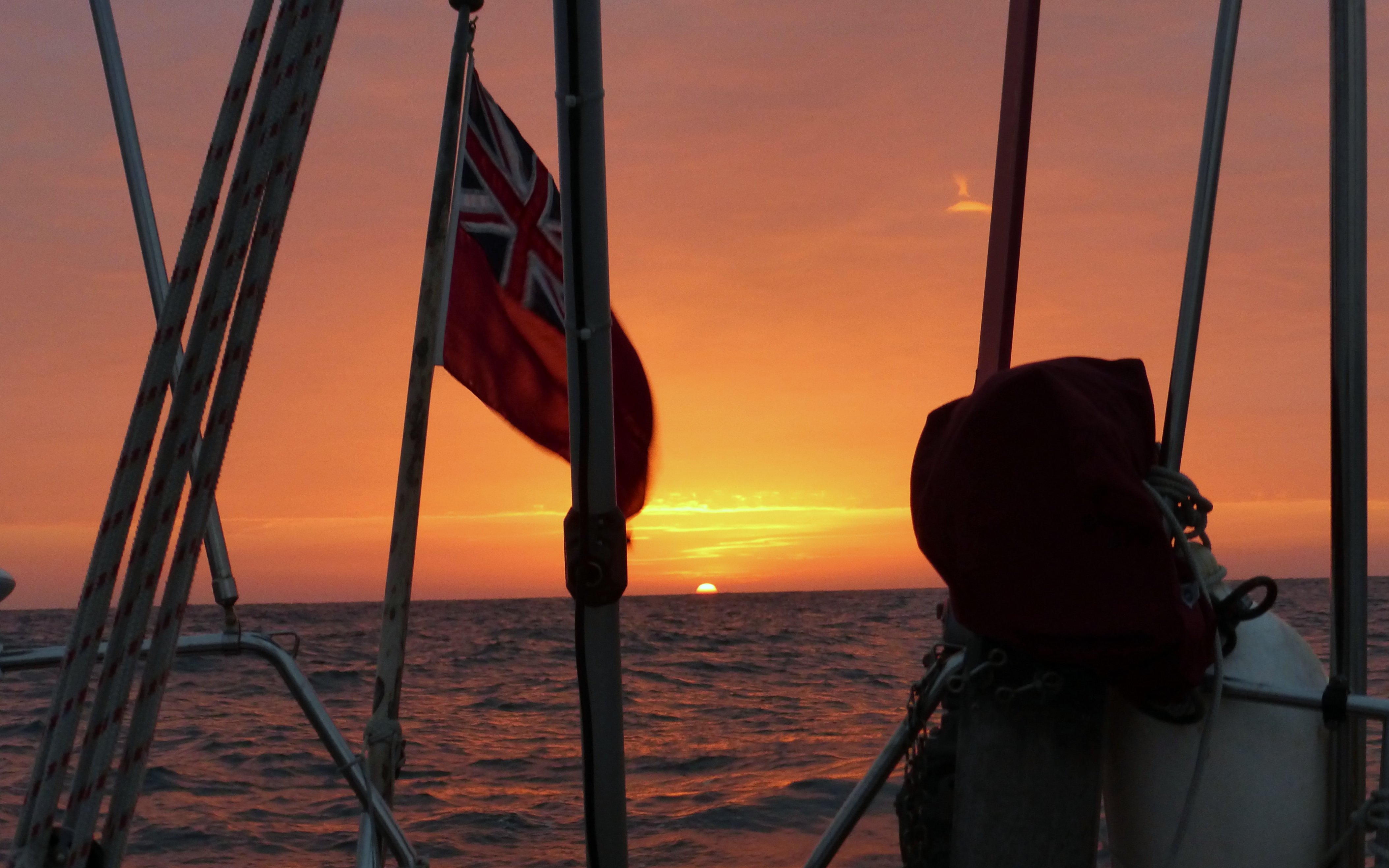
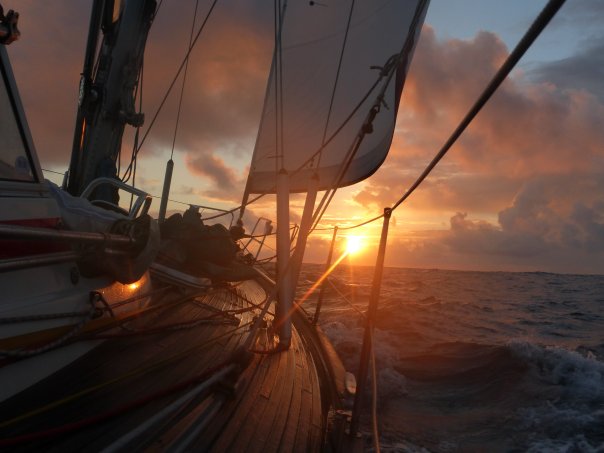
Sunset at sea again…
One day out from the cocoon of the Pasito Blanco marina complex, I know Michael walked along the seashore under the crumbly cliffs, over rocks and boulders, and past enclaves of well-oiled pink people sunning their not-so-private parts, to a nearby holiday resort; a mega-mega-holiday resort with more tourists than you’d think could sensibly be flown in to one island. Sailors tend to avoid these mega resorts. They’re better suited to people who need football on telly, a casino or two, golden beaches, a ‘good time’ and Irish Pubs. And though, the square miles of hotels, conference centres, flesh pots and shopping malls that make up the Maspalomas metropolis are smarter and more upmarket than the equivalent Los Cristianos on Tenerife, the coffee and cakes are still twice the going rate (and pizza cheap as chips), and you come across.endless almost identical restaurants and the supermarkets always have the Sun and Daily Mail. And M gets depressed and is reminded, if he had ever forgotten, that he understands so little of how most of his countrymen, and other north Europeans, live and think and feel.
Maspolomas…
Neat and tidy at Pasito Blanco
Pasito Blanco Marina
We left and sailed, overnight again, to La Gomera. It was a bit trying.
Neighbours, Lukas and Theresa, help me leave a tight mooring
This has been a dreadfully long blog. Bye-bye for now and Happy Christmas from Henrietta.
M: Henrietta wrote that after we arrived in La Gomera a day or two ago. It was a low spot. It’s best that Henrietta writes when I am out of sorts. And I am happy now. This place is a spirit-lifter. It’s a smaller Canary Island, quite near Tenerife.
I’ve been for a couple of leg-stretching walks, and some swims (and had a horrifically drastic haircut – the outcome of my pathetic Spanish and a suspected sadist hairdresser). More next time…..I’ll stay in La Gomera a while. Apart from the hairdresser, I like it here, and my youngest son, George, joins me on Boxing Day.
Our spell on Madeira is nearly over. I’ll head southeast to the Canaries soon and Anna went to England yesterday.
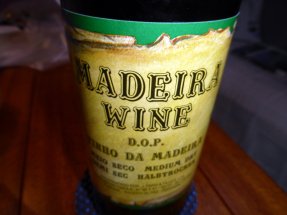
It’s been a mainly happy stay on this magical island with ever-friendly and helpful Portuguese/Madeiran people, varied lush mountainous scenery, good wine – and lots and lots of tunnels.
I’d heard of Madeira wine, but never the tunnels. The faster roads seem to spend half their time underground with successive long sections of fine sinuous subterranean tubes; and the “levada” walks include dozens of narrow dark low wet tunnels,between a dozen metres and a kilometre long. Enough about tunnels; the island is thoroughly well burrowed.
Leaving Porto Santo astern
Scenic Quinto Do Lorde marina
“Levadas”, the small irrigation channels that meander along precipitous mountainsides, are a well-known feature of Madeira. (If you’ve been here you know that already) With a career spent briefly in the world of irrigation, I can only marvel at the scale and ingenuity of the Madeira irrigation schemes: built mainly from the 16th century on, the “levadas” run for nearly 2,000km, countless men died in their construction which often involved lowering workers down mountainsides in wicker baskets to blast a route through the rock and, as mentioned, include dozens of long mountain tunnels. Nowadays, many of the canals are well maintained and run alongside near-level contour paths used by the numerous walkers who tramp back and forth through the mountain flora – always dripping wet for our stay on the island. (Madeira’s walkers are, it seems, predominantly fit lean amiable and focussed Germans.) Some walking photos below….
Lunch stop
Typical popular walk
Funchal Market
Start of stroll to summit
So, we walked lots of “levada” routes and, on the only day when clouds lifted from the top peaks, we joined a throng of fellow walkers to clamber to the highest point – and on a bit, where the throng thinned out, and we ate our sandwiches in mountain peace.
It so happened that Christmas lights were switched on on 1st December. And we ambled through the streets of Funchal savouring the gentle warmth and good-natured hospitality of residents, feeling as content as happy children. Giant Father Christmas and pretty elves do that.
More Christmas lights pictures:
Yesterday, Anna and I bade farewell with heartache and went our separate ways.
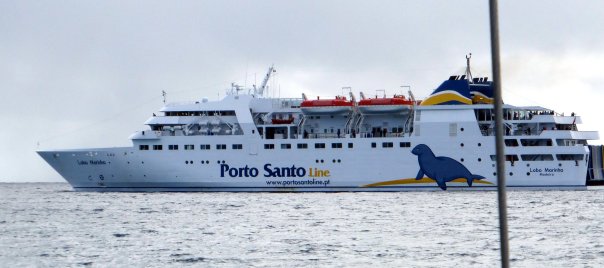
From Cascais, near Lisbon, to Porto Santo is nearly 500 miles. After my first premature departure (when I’d left but turned back a few hours later in face of not-quite-forecast headwinds and seas), Henrietta and I finally rolled across this patch of ocean, under just the poled-out genoa, in less than four days, anchoring in the dark off a beach with thundering surf. Next fine morning the ferry from Madeira passed by and I upped anchor and followed it into port.
Company on the sail over…..
Reflecting aimlessly on the sail over, it occurred to me again that open ocean sailing sometimes seems to induce a sense of overwhelming insignificance and listless melancholia, especially, I find, when feeling slightly queasy. It’s a kind of hollow alternative reality – and may of course just be simple incipient madness. Most of us at sea are all too well aware of our fragility on a little boat in a vast empty mighty ocean, but sometimes you look up skywards on a black moonless night and recognise that all humanity on planet earth is pretty insignificant too. Our tiny planet seems so fragile, wobbling round our fairly average star, the sun, in that endless dark ocean of stars. Even the so-called supermoon did nothing but magnify the sense of us being a mere speck of humankind on a tiny planet in a mere speck of a solar system. But we can’t grapple with infinity right now. Plus you may have mounting excitement at the prospect of Christmas. I don’t want to spoil it. But if we could organise such a thing, I’d send Messrs Trump, Farage and acolytes on a little sailing boat for a few days ego-deflation in the Atlantic. A prerequisite to high political office.
What of Porto Santo? In case you didn’t know, it’s a little island near Madeira. I’ve malingered here for nearly two weeks now. It’s one of those small, peaceful, friendly, low-key places that suit me. Pop. about 5,000, with some prominent mini-mountains, retired volcanoes, (1,000 to 1,500ft), and a perfect golden sandy beach about four miles long. One small town, scattered homesteads, a few rural bars and some local touristy settlements – mostly deserted now the summer is over. Here are some random pictures…..
I’ve trekked up almost every mini-mountain, walked or cycled nearly every road or dusty track, plus swum/bodysurfed a few times. I should be quite fit. But I’m also pretty lazy and I drink too much, so I’m not.
The marina (one and a half pontoons with wobbly little fingers) is laid-back, multi-lingual and sociable. A few boats come and go each day: passage-making sailing boats and some amateurish local fishermen.
Little marina
Hundreds of yachts’ signature artwork
Many hours’ art from visiting sailors
Passage-makers come from most corners of Europe, dominated by the ever-adventurous French. They include some of the smaller scruffier boats and prettiest women of our continent. Indeed, I’d say Porto Santo marina has probably the prettiest boat sailors I’ve ever seen anywhere: not just French (we expect them to be pretty) but English, German, Czech, Estonian, Dutch et al. A charming and exquisite assortment of European delight. The sort of thing that makes hopeless wrinkly old men sigh wistfully and daydream pathetically. But where else can I socialise with fascinating talented thoughtful worldwise young, and not-so-young, travellers? Incidentally, the sailing community is well-balanced and sane (and very pretty) compared with some of the handful of non-Portuguese visitors, I’ve encountered. Exhibit A: a middle-aged but retired Bulgarian chef, adamant the world economic system is on the verge of complete collapse (you first heard it here; it’ll happen before Christmas according to his unquestionably correct thinking – derived from long hours gazing at a candle); and Exhibit B, a serious lanky ‘night-shift taxi driver’ from Kiel who’s come here to exercise his muskles…and more. He seems to know too much about NATO strategy. Not many dull moments!
All in all, you’ll see why I’ve stayed so long. Though, the fact that marina fees encourage longer stays and that I’m not due to meet Anna in Madeira till next week, have given added reasons to stay on.
It’s been a busy couple of weeks: sail down coast of Iberian peninsular from top of Spain to Lisbon with a few brief stops; leave Henrietta in a Lisbon marina; fly to England for a few days; come back with Anna; touristy whizz round Lisbon……
To add a bit of colour and some photos, it has been wonderful – mostly. Sailing the 250-odd miles down the coast in a bit of a hurry (as I had air tickets booked) meant some overnight sailing and short stops and not nearly enough time to explore, but you can’t have everything. I did spend a night anchored off Isla Ons (“beach is favoured by nudists” – but chilly so not a soul in sight). Then, a night at sea, one in Fig. de Foz and another brief halt alongside a wet wobbly seagull-pooped pontoon in Nazaire.
And I got to Lisbon with a day to spare and Easyjetted off to Bristol and Devon. Wonderful to see George (son no.3), find legs ok for a brisk walk with friends in Dartmoor, paint brushes ok for a couple of days’ house decorating, wallet ok for shopping for new underwear and Marmite (subsequently confiscated by airport security)…and other stuff.
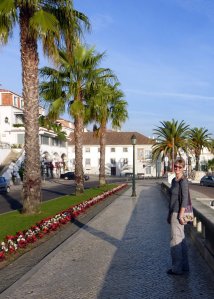
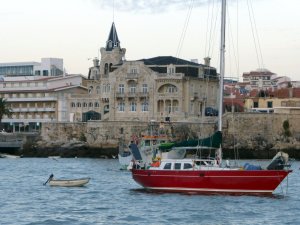
Anna and I then flew back to Lisbon to rejoin Henrietta and indulge in some high intensity Lisbon sightseeing and move to Cascais, a well-heeled and established tourist hot-spot on the coast nearby. Here are some photos of Cascais….
early walk to train
Cascais anchorage
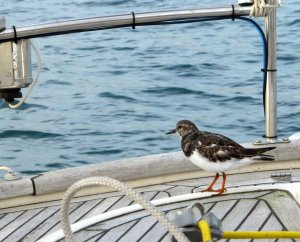
Sandpiper visitor
view from anchorage
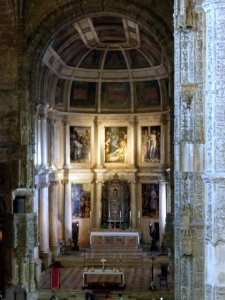
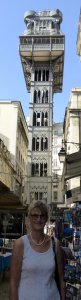
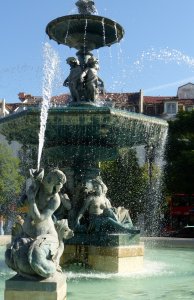
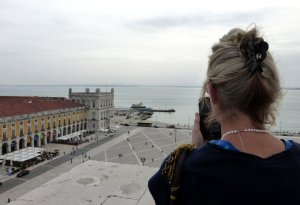
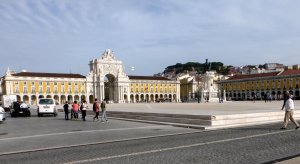
Lisbon is a truly fabulous and fascinating city with civilised, courteous, friendly population; countless exquisite streets, heavenly coffee and fine functional public transport. And, even if we seemed to be almost the only tourists not indulging in obsessive selfie pics, I think it’s a thoroughly attractive and all-round gorgeous place – even better photographed without us in the foreground. Personally and for what it’s worth, my ratings would give Lisbon an 8 out of 10 (cf. Paris and Venice 9/10, Amsterdam 8, Prague 7, Barcelona 6, Madrid and Berlin 5, Sydney -3, Los Angeles -2,000). If you have nothing to watch on telly, discuss with your spouse or someone, how you’d rate the places you’ve visited. Here are some touristy photos of Lisbon…
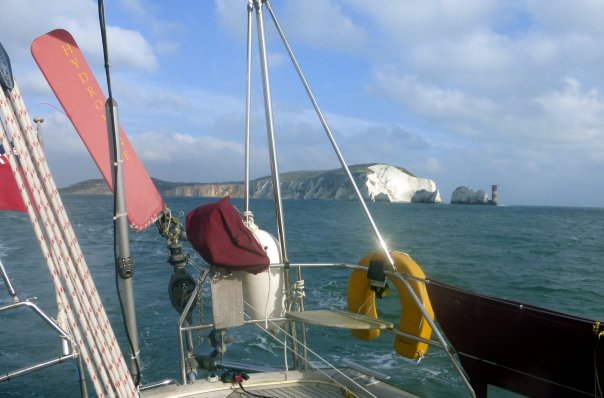
As Britain slowly makes its tortured tortuous exit from the EU, Henrietta and I make a swift silent simple exit from England. We left from a sunny windswept Lymington pontoon one afternoon in early October – out past the Needles at the end of the Isle of Wight, and away.
Past the Needles and…away…
It really was simple to leave: filled water tanks, fresh bread and milk loaded, toss off the ropes and we’re away. (There are some old newspapers aboard somewhere so I can read yet more of our collective Brexitosis saga should I be really desperate.) But it’s always exhilerating to think we could go anywhere in the world.
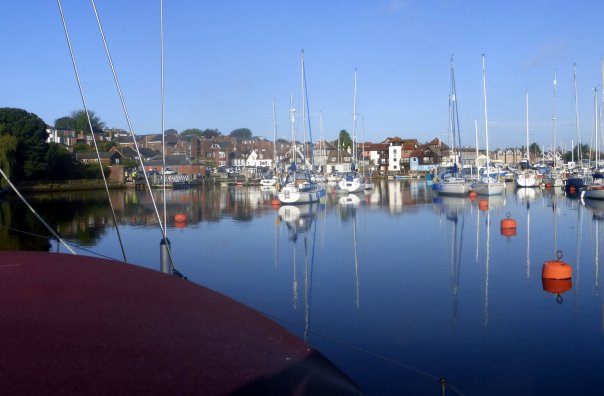
Peaceful morning in Lymington
Three and a half months of English summer was a delightful spell, personally, and I did appreciate the beauty of verdant countryside, comfort of security, and general friendliness of normal folk, the cheapness of life’s essentials like food and clothes, efficiency of transport etc. (albeit a bit of a horror show on the public political front, but we shan’t go there – Brexitosis says it all). I wonder sometimes why I’m driven to leave. Friends and family, I shall miss. But then a cold wet autumn day and darkness drawing in, remind me that summer is a fleeting affair.
Final few weeks in England were busy, sailing west to Falmouth, then east to the Solent, seeing kith and kin along the way, fixing bits of Henrietta and me….Here are some photos…
Tranquil anchorage in Falmouth Harbour
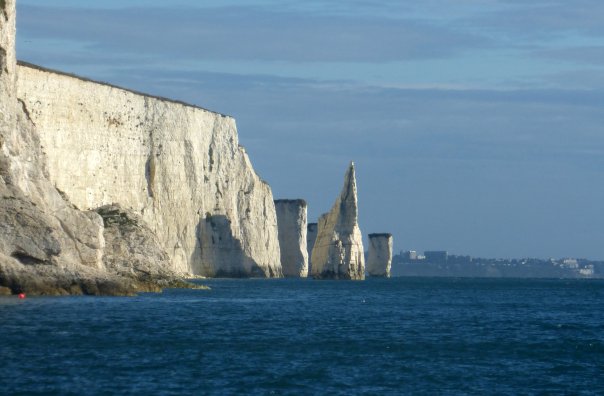
Old Harry Rocks (or teeth?)
Blink of history: then (1950s) and….
…now
Johnny (with hat) and Roz (Poole Hbr)
..
Tom and Kim, near Brighton
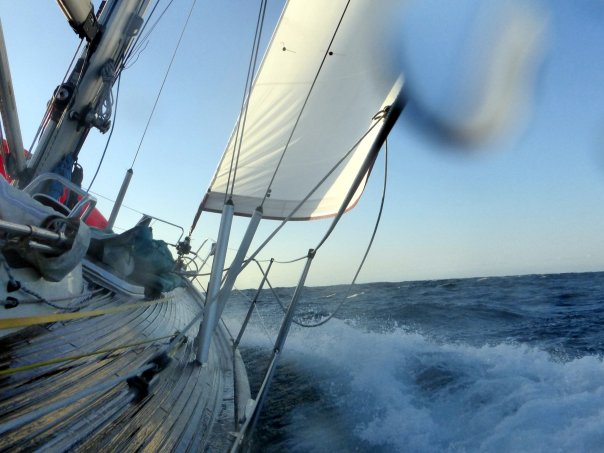
Then, with an unusual period of easterly winds, sometimes a bit strong, we set forth, west down the Channel, round the top left corner of France, and across the boisterous and charcoal grey seas of Biscay, to Spain. Nearly 700 miles non-stop in five days.
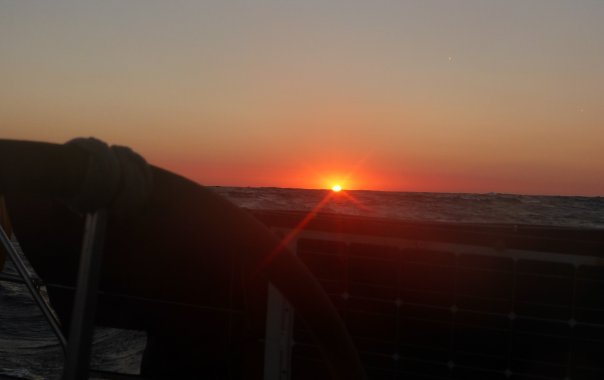
Heading SouthAnother welcome sunrise in Biscay
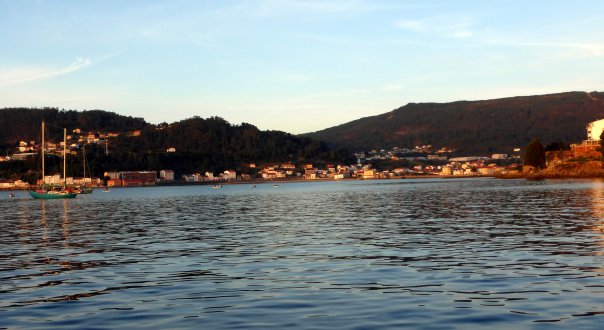
Now we’re in Muros, a pretty Galician town, nestled in a tranquil Spanish Ria.
Muros from anchorage opposite
And today I took a bus ride to Santiago de Compostela, to rub shoulders with fellow tourists. Some of them are walkers who’ve tramped a long way to get there.
…..
….
Streets of Santiago….
The walking pilgrims are mainly late middle-aged with giant rucksacks and walking sticks (poles, I mean). The men sometimes have grey beards and look earnest and honest. I admire them. Non-walking tourists and pilgrims are bulkier and outnumber the admirable few. A huge number want to ‘hug the apostle’ in the cathedral (my Spanish is limited, but I think this is what the sign said), and they join a long slow-moving queue. I don’t want to ‘hug the apostle’, so go in through a side door, and spend ages in a nearby cathedral museum instead. (There’s no beating Catholic art when it comes to advanced soul-wrenching suffering, with its endless depictions of arrows, nails, thorns, blood, anguish and pale-faced wretchedness. Even poor Virgin Mary doesn’t look too happy with her new baby. To lighten matters I always try to find a cheery face among the anguished – but it’s hard.)
???
??
?
Anyhow, here are a few words from Henrietta:
I’m pretty happy to be dancing over the waves again. Wish I didn’t have this unsightly red kayak on my foredeck though (it’s M’s bargain toy from Southampton Boat Show!); and I wish M hadn’t mucked it up when leaving that Lymington pontoon and I picked up a dreadful scratch on my newly polished hull, from a metal plate protruding from the pontoon. Ouch, it hurt!
I’m glad to say that M’s spirits have picked up a bit now we’ve been away a few days. To start with he was a rather gloomy old grump, groaning with bruised bits of body and sore hands, sloppy sea legs and all round queasiness. I reckon he’d forgotten how uncomfortable life at sea can be: constant rolling, lurching, bobbing, splashed with chilly spray, slapped with cold winds, fingers numbed, muscles aching and not nearly enough sleep.
Basically, he needs to remember his good fortune in venturing forth with me. After all, he could be slobbing on the sofa in front of the telly, or dozing under a cosy duvet, or drinking draught beer in a squalid pub, or sitting in a traffic jam – like most sensible dirt-dwellers. As it is, he’s out and about usually enjoying himself and fresh air, and meeting lots of lovely people.
Here are some pictures of boats I passed last week (or they passed me):
I’ll tell you a little secret: Henrietta is 16 boat years old. That’s 32 in human years. She’s in her prime, beautiful, lithe and bursting with zest. I’m well over double her age, so well past my prime, zest less obvious. Henrietta can probably do somersaults and dance daintily almost anywhere. I can’t – and probably never could.
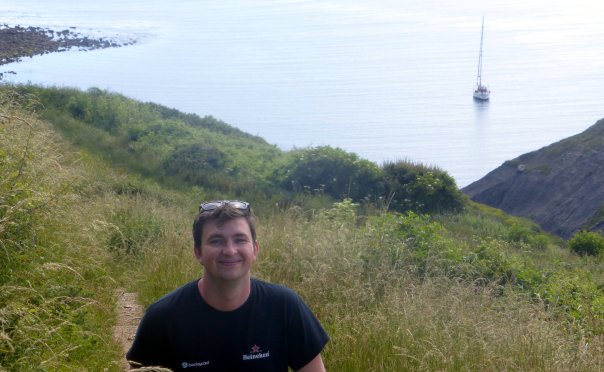
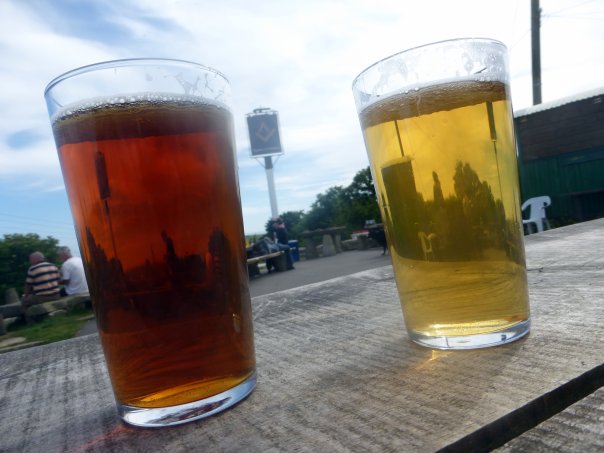
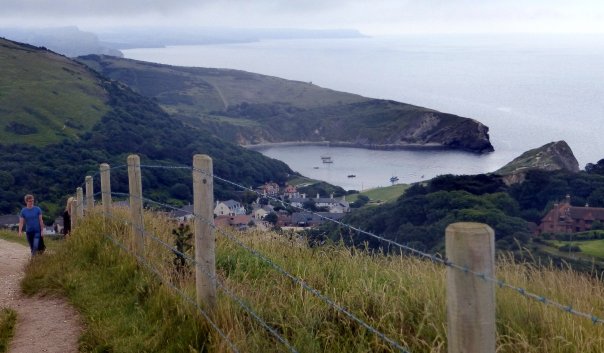
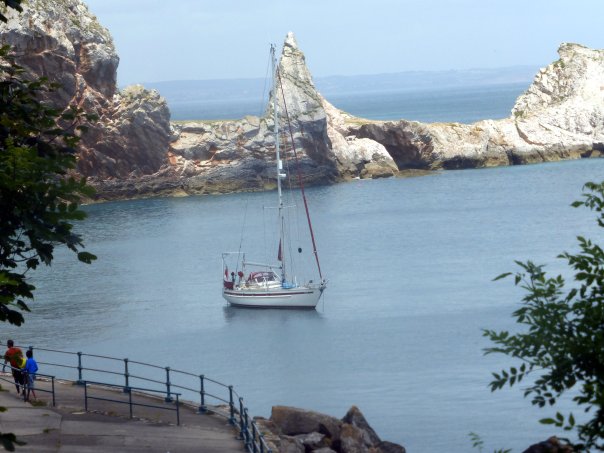
Sailing west (way back in July) from the Solent with George, we visited some of my favourite south coast haunts – pictures below:
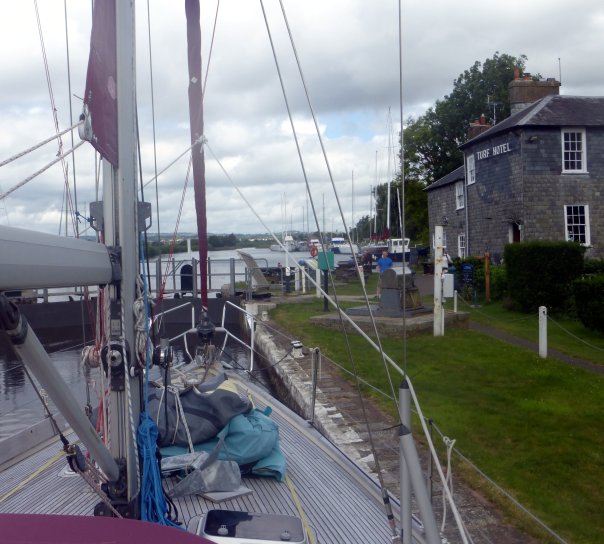
Chapman’s Pool (peaceful)Square and Compass and ..Lulworth CoveAnstey’s CoveTurf Lock (River Exe)Exeter Canal (for two weeks)
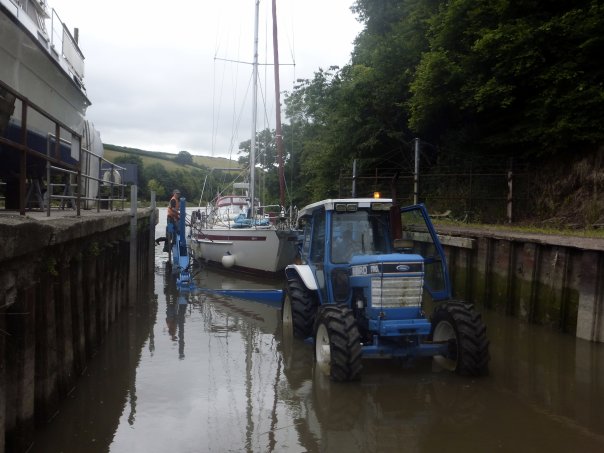
Up River Dart with Liam, and …..Lift-out at Baltic Wharf, Totnes
Yesterday, in early September, was relaunch day (after a few weeks in Baltic Wharf Boatyard, Totnes). With one day of easterly wind, I sailed 14 hours west to Falmouth and, though Henrietta did dance daintily, I really felt tired, achey and a bit decrepit as I carefully anchored in pitch black darkness up a West Country creek. But that’s enough about aches et al; this is just an update on what’s going on with good ship H and skipper M.
Henrietta has some new bits and pieces. If you’re interested, that’s VHF radio, anchor, new batteries, some more stripey cushion covers and a TV and printer and yoghurt maker (thank you, Nigel)…plus a glimmering shiney polished hull and brand new antifouling. (Can’t think that I’ll get round to fitting the TV but it’s sitting there in a remote locker in Amazon’s delivery cardboard box).
I have done a lot of eating and drinking and shopping, and, more important, it’s been an unaccustomed treat to see lots of friends and family, visit London, Cambridge and Berlin plus watchRio Olympic prowess and read newspapers. (A few photos here to summarise)
The ‘plan’, for what it’s worth, is to have experts in Falmouth fix some snags (rigging and SSB), then sail east to Solent (boatshow and sociability), then west to Devon (hospital stuff), then, all being well, south to sunshine, before it gets too cold in northern Europe.
(Photos below: – Relaunch and sailing west, misty down river Dart, exit Dartmouth, Eddystone LH, fine playful dolphins en route……..)
Photos of Henrietta in the Atlantic (sent from a passing yacht)…
When you return to your home country after a spell away, first impressions count. My impressions of my home country were that it is very affluent, tidy, organised and generally friendly and often beautiful, with a population of industrious efficient good-natured people, huge numbers of whom are constantly on the phone. Such is the nature of generalisations. As ever, I am out of touch with the majority. I know little of northern cities or right wing zealots. I’m privileged to meet mainly sane and moderate sailors.
A few weeks ago I knew one reason for returning to England was to vote in the EU referendum because I knew I’d be cross and sad if the other side won and I’d not had a teeny weeny say in trying to stop it. Deary me, even though I did place a cross to remain, I still find I am cross and sad, very sad, with the outcome. I don’t even take comfort from thinking the Brexit crowds will have to stop whinging about Brussels, or bureaucracy or immigration.They won’t.
I shan’t dwell on the EU business too much as millions of excellent professional writers have filled the column inches (and miles) with their own analyses. It does occur to me though that in voting to leave, the nation has behaved like a cigarette smoker who knows it’s very very silly to smoke and may lead to fatal cancer, and certainly ill health, and yet, despite knowing the consequences has an uncontrolled death wish. He smokes just as he votes; it’s bad for him, but he can’t help it. You can take the analogy quite a long way. Some people don’t seem to believe the ill health that will come about; and there are cases of people who even think smoking is healthy (remember the Marlborough ads?). And don’t forget there are the greedy tobacco companies like Gove Chokers Inc. whose vile vested interests try to tell us that smoking is actually a very good idea if only we’d listen and buy his brand. And then, us older folk, a majority of whom voted to smoke, are tainting the air and good health of the younger generation, a majority of whom voted for fresh air. …but this analogy has gone too far….
It’s all too depressing to contemplate for long. I am of course seriously fortunate in being afloat on a sailing boat. In theory I can distance myself from the nonsensical arena of British politics. But I like Radio 4 and cannot resist reading the newspapers.
Anna on watch again
Familiar places like Needles, IoW
Gig rowing practice
Kingswear
Fowey
However, moving on….as I type this, there’s the beautifully sweet sound of terns squeaking as they dive and fish around my anchorage – off Newtown, IoW. A cool English summer dawn had me up early, revelling in the fresh calm clear morning light. (This is in sharp contrast to the busy throngs that were out and about for the Round the Island Race on Saturday.) From Falmouth, I’d sailed east to the Hamble in the Solent, where I’d booked to attend a radio course. Overnight stops and short day sails, stopping in familiar haunts: Fowey, Dartmouth, Weymouth, Swanage, Lymington and now, off Newtown. It’s been really good to see friends along the way, and enjoy the company of Anna and, now George on board. (I’m back in Lymington to upload this lot.)
Lymington Town Quay
It’s just over a year since I bought Henrietta. We’ve sailed over 12,000 miles together, visited 23 countries and 46 islands. There’s now some maintenance needed for both of us. We’re heading back to Devon to get on with it, and delight in that county’s beauty and charm. (Small comfort that Exeter and Totnes – the two places for Henrietta and me – voted in.)
First bit in need of repair….much more to do
If you’ve followed Henrietta’s little adventure over the past ten months, thank you. Like lots of solitary people, I quite enjoy scribbling away. With few people to talk to, it’s a way of sharing experiences. It’s also a way of venting thoughts that otherwise are liable to fester and go mouldy. Even worse than barnacles on Henrietta’s bottom would be mould in my brain.
After a bus trip to Praia on the island of Terceira (when it poured with rain all day but still looked pretty – though not nearly as fine as Angra), I left next day, bound for Britain. Nine and a half days later, just after midnight, I rounded the Lizard and reached Falmouth.
Final dawn before Cornwall – 100 miles to go
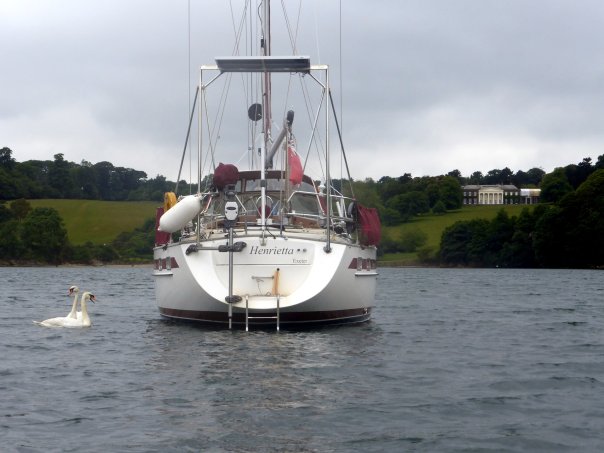
Falmouth was packed with boats. It’s Classics Weekend – meaning dozens and dozens of beautiful old sailing boats all over the place, but impossible in darkness to find a spot to stop – and so I meandered in moonlight a few miles upstream to a calm anchorage in Channal’s Creek, overlooked by National Trust’s Trelissick House, and then in the peaceful early hours enjoyed a giant glass of Antiguan rum.
French catamaran overtakes me on the way
…and there’s a ‘low’ over Britain
Well reefed and on the way from Azores (photo from overtaking catamaran)
It had been a varied ocean voyage from the Azores with busy days and nights, almost continuously (or so it seemed) reefing/unreefing/altering course. Mainsail clew tore off its webbing straps when half way, so, until managing a crude repair, I sailed with only the genoa for almost 500 miles.
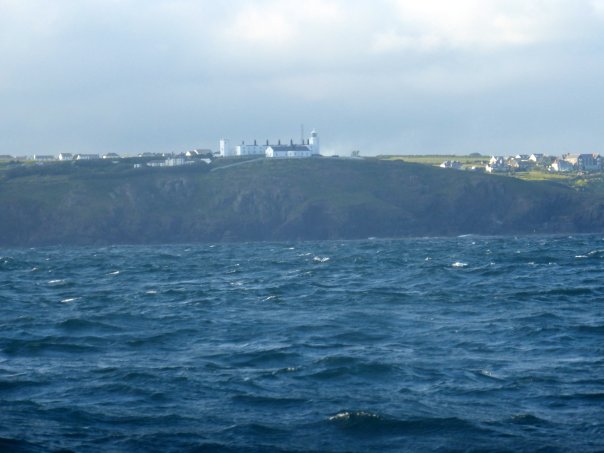
Rounding the Lizard at dusk
For me, ocean voyages are far too long. In fact, anything more than a day trip of about 40 miles is too long. I’d rather have a good night’s sleep, have an early morning and leisurely pot of tea, see if the weather looks cheery and, if so, set sail along a pretty coastline with sunshine and birdlife for a few daylight hours, reach a calm and secure anchorage, have another pot of tea, later watch sunset with fresh food and a glass of plonk, then go to bed. In short, I don’t like the dark; human beings are meant to be asleep at night when it’s dark, not hauling in sails and watching out for ships. But the world wasn’t made that way, so before long I’ll have to do more of these long ocean trips.
After a weekend in Truro and Falmouth, it’s as if I’ve never been away. People I meet in Cornwall are as delightful as those I’ve met anywhere. Fine food is good, varied, cheap and plentiful. Scenery and wildlife is wonderful. And, since arrival here has coincided with both Classics Weekend and a shanty-singing festival, the streets and pubs of Falmouth are fun and busy, and chocabloc with hairy sea salty folk and lusty bearded singers, and beautiful women’s choirs too and quality buskers. Anna came and joined me in Truro so it’s been a treat to have company and shared experience once more. (In case you’re interested, first experience was Wetherspoons, Truro, for fish and chips and pint of Doombar – it really is as if I’ve not been away!)
Falmouth is busy
with shanty singing and…
…classics..
I’ve had plenty of time to reflect upon these months afloat, living peacably and mainly alone on “Henrietta”. I’ll not burden you now with what I’ve learnt of the sea or me, or other places and people; what I’ve enjoyed or missed; where my life is enriched or shrunken. Without the detail and the secrets, I must conclude that for folk like me, for now, the sailing life is best. (Just need to sort the EU question, then fix my boat and body, see family and friends, and see what happens next.)Henrietta in home waters
The Azores islands are lovely: people civilised, warm, friendly and welcoming; countryside fresh green and bursting with early summer zest; interests abound in walks, history, buildings and people. I’ve visited four of the islands; there are five others for another time.
Flores, my first landfall, was charming and I loved walking on sunlit rural roads with hydrangea, wild rose, sweet pea, canna lilies and more adding colour to the hedgerows, listening to tuneful birdsong, and feeling solid ground beneath my feet. With a gaggle of well-kitted German walkers I enjoyed a delightful cliff walk a mile or two from the marina – but blow me, marinised leg muscles feel mighty stiff afterwards.
Then a bus ride to the capital, Santa Cruz, which has a modern and fascinating whale museum (making use of the defunct whale factory) – and not a lot else (you mustn’t get too excited by the term ‘capital’). It’s not a good port for yachts and we’re told not to go there (see photo below).
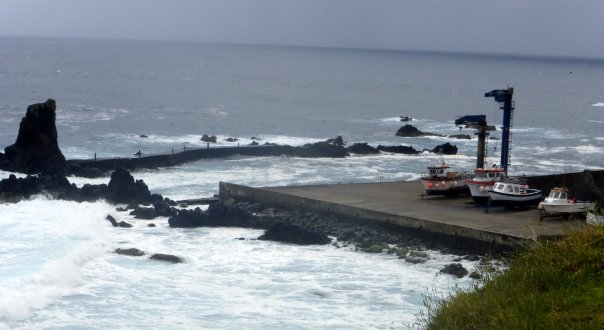
The port at Santa Cruz, Flores (fishing boats are lifted out)
Whaling boat in museum (tubs have 700 metres of rope for harpooned whale)
Alas! Even Flores’s little marina suffers from wave surge with NNEasterly swell and Henrietta’s strain and discomfort shortened my visit; four of us yachts leaving earlier than hoped for for the sail 130 miles east to Horta. (The islands are well spaced.)
Horta, on the island of Faial, is one of the world’s busiest yacht transit centres. Apparently around 1,300 boats call in each year. I reckon a large part of the 1,300 were there at the same time as me. The place seems to have become the key Atlantic sailors’ cross-roads with all manner of yacht from almost everywhere. Constant movements, bustle and excited shouts as friends recognise one another. There were no free berths for Henrietta and the anchorage was crowded, so after a troubled spell rafted alongside others next to a quay, I didn’t stay long. But it was a shame to move on so soon as Horta, the town, was beautiful: lots of charm and colour, good shops, marvellous cafes and bars and more. And I met up with several others whom I’d met earlier in the year.
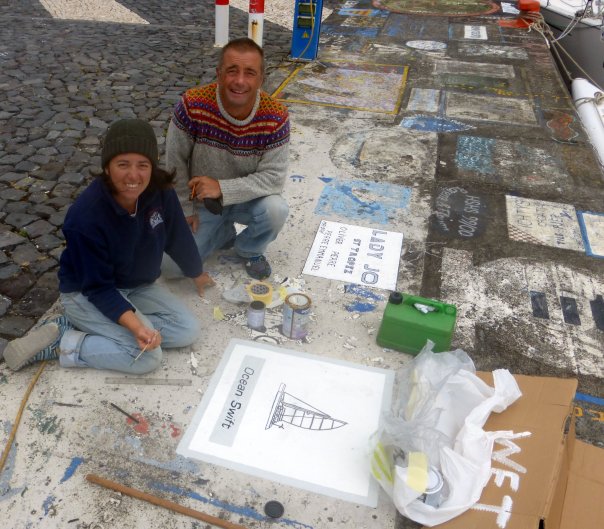
Emma, with John, finishes her artwork for Ocean Swift joining the thousands of murals already there….
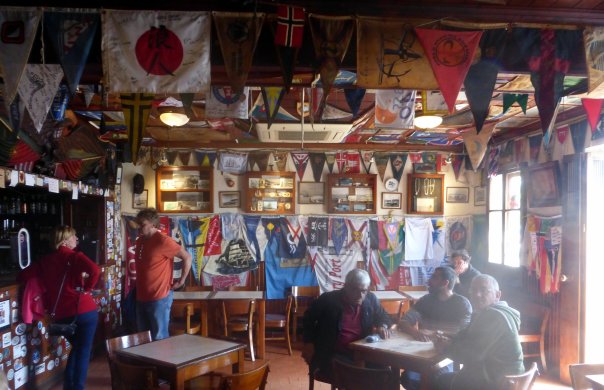
Popular sailors’ Sport Bar, festooned with global burgees and more…
The day I left Horta was very windy and very wet, but much more comfortable for me on Henrietta than running the Azores Trail Run, one of those super-arduous mountain marathons from a cloud-swept caldeira, which was taking place on Faial that same day. (I later met a sinewy Swedish/German couple who’d taken part.)
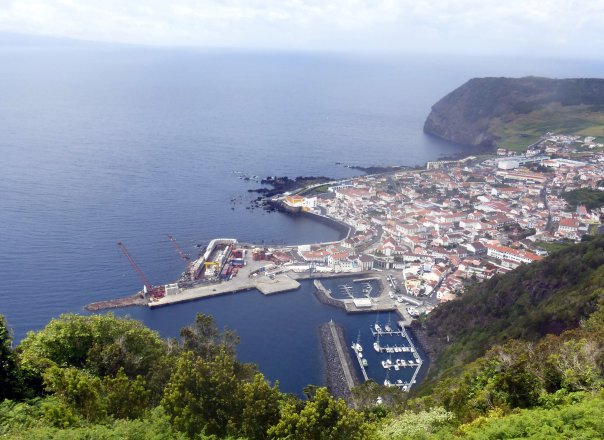
Next stop after Horta was Vila das Velas on Sao Jorge (Sao has an accent I can’t do on laptop) where Jose manages a little marina. Jose, like all the staff I meet, is helpful, charming and knowledgeable – even coming out in cold torrential horizontal rain as I arrived, to help me tie up. Spent several days here as it’s friendly, has good walks etc. Hired a car to see more of the place than buses allow.
Velas, Sao Jorge (my version of pilot book cover photo) – Henrietta upper pontoon on right
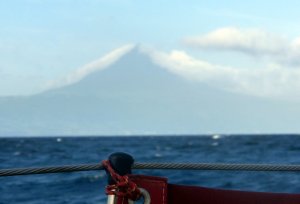
I left the island of Sao Jorge after a week and sailed next to Terceira, the third biggest Azorean island, just glimpsing the Azores’s highest mountain (and Portugal’s too), Pico, as I headed for Angra do Heroismo (its inhabitants had bravely resisted the Spanish invaders a few hundred years ago and were later given the title ‘Heroes’ – indeed the island was the only bit of Portugal that was not conquered) .
Pico
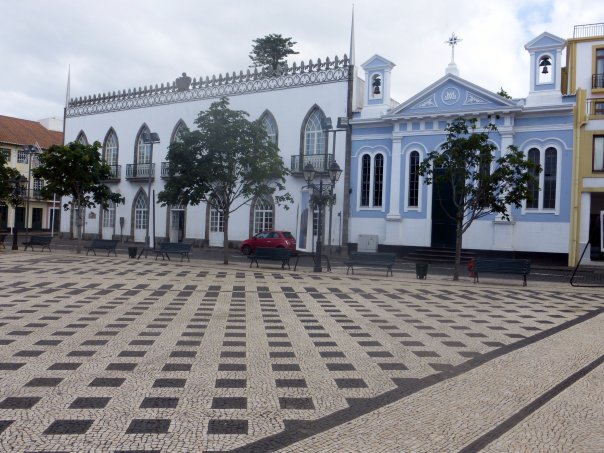
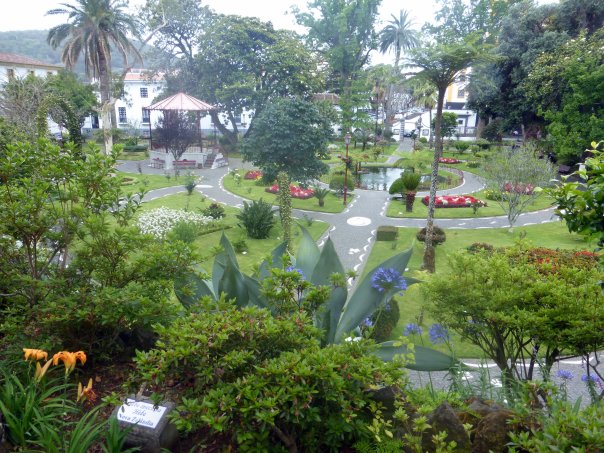
Most of the town (city really) of Angra is now well-deserved UNESCO heritage stuff —-full of really fabulous buildings, decorous stone cobbled streets and exquisite public gardens….one of the most marvellous places I’ve ever seen…and I don’t use the word ‘fabulous’ lightly….though I acknowledge perhaps its beauty is magnified by way of contrast with the architectural deserts of Eastern Caribbean.
Central square in Angra do Heroismo……and public gardens
Two particular things hereabouts remind me of my age. One is whaling; amazing to think it was big business in many places, including Azores, till 1980s, when nowadays it seems so barbaric and so unthinkable to kill magnificent whales (unless you’re primitive or Japanese, I suppose). The other is being reminded of the recent colonial wars that Portugal fought in 1960/70s; with many little Azorean settlements having a memorial for the young who died fighting in Angola, Mozambique or Timor (and I can remember hitching a lift myself with a lorry full of Portuguese troups in Mozambique as recently as 1974 – maybe it’s not recent anymore!) Had we been Portuguese, we’d probably have been conscripted.
……at this point I realise I’m just wittering on…not of much interest to anyone except me…(The photos scattered in this post try to show more)
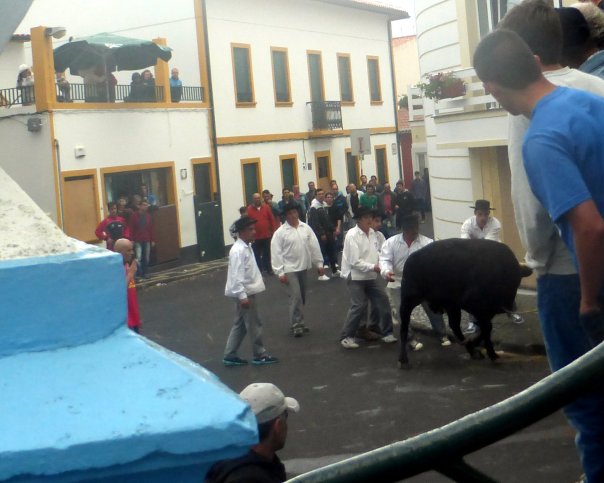
Without the detail, next stop, all being well, will be Scilly Isles or Cornwall (1,200 miles). Just waiting now for a patch of better weather….Meanwhile it’s been good to have the company of Alex and John on a handsome yacht, Free Spirit, and others heading for Europe too. They told me of this tourada (a sort of sociable bullfight in the streets of Angra), picture below.
Tourada – a frequent summer happening in the towns of Terceira
But before I go, I’ll just say that the sharp contrast of Europe’s western islands with the islands further south and west across the Atlantic (Bermuda, Caribbean) makes me truly grateful for my good fortune in belonging on the European side. And whilst the British Isles are my home, and I like them well enough, I know they are merely a part of many European islands, each with their own distinctive histories, cultures, interests, problems and delights, but each insignificant in the wider world. I’ll aim to be back in Britain in time to vote. (It would make me very cross and sad were the ‘other side’ to win, had I not had my one teeny weeny say in trying to stop it.)
And on a less important note, I’ve now owned Henrietta for exactly one year. Nearly 11,000 miles sailed since then, and I cannot think how many different anchorages and islands and countries. Perhaps I’ll add them up one day.













 Our spell on Madeira is nearly over. I’ll head southeast to the Canaries soon and Anna went to England yesterday.















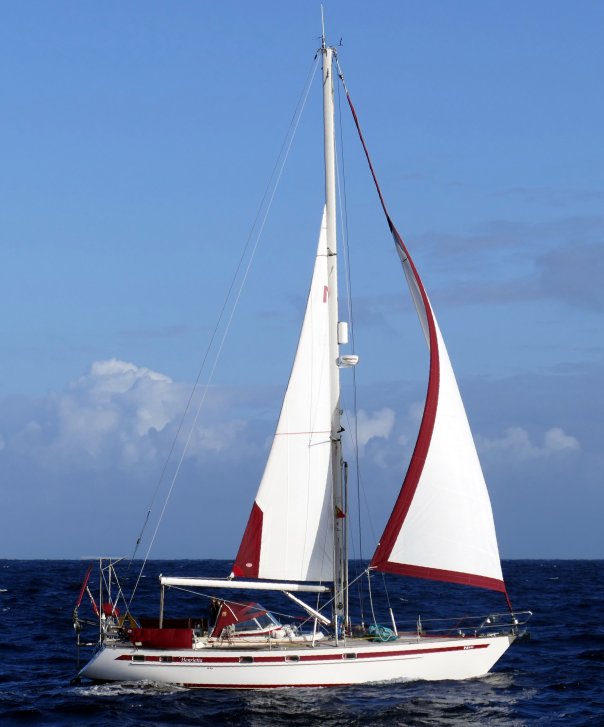
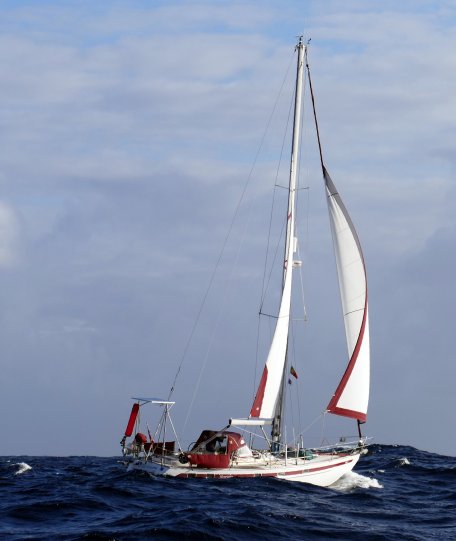


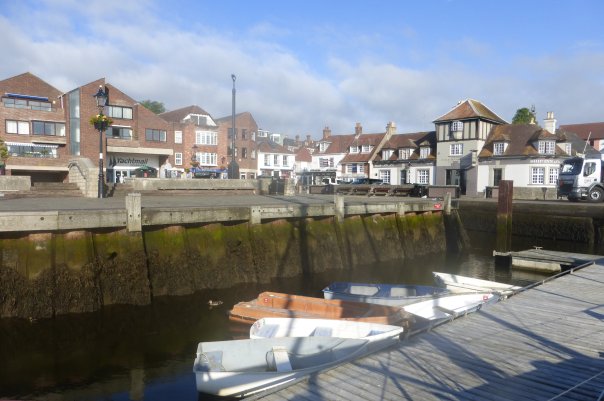
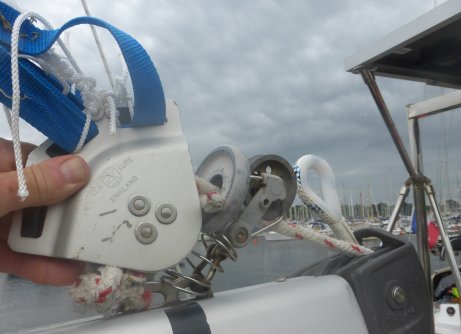










 Sailing Henrietta